On this page
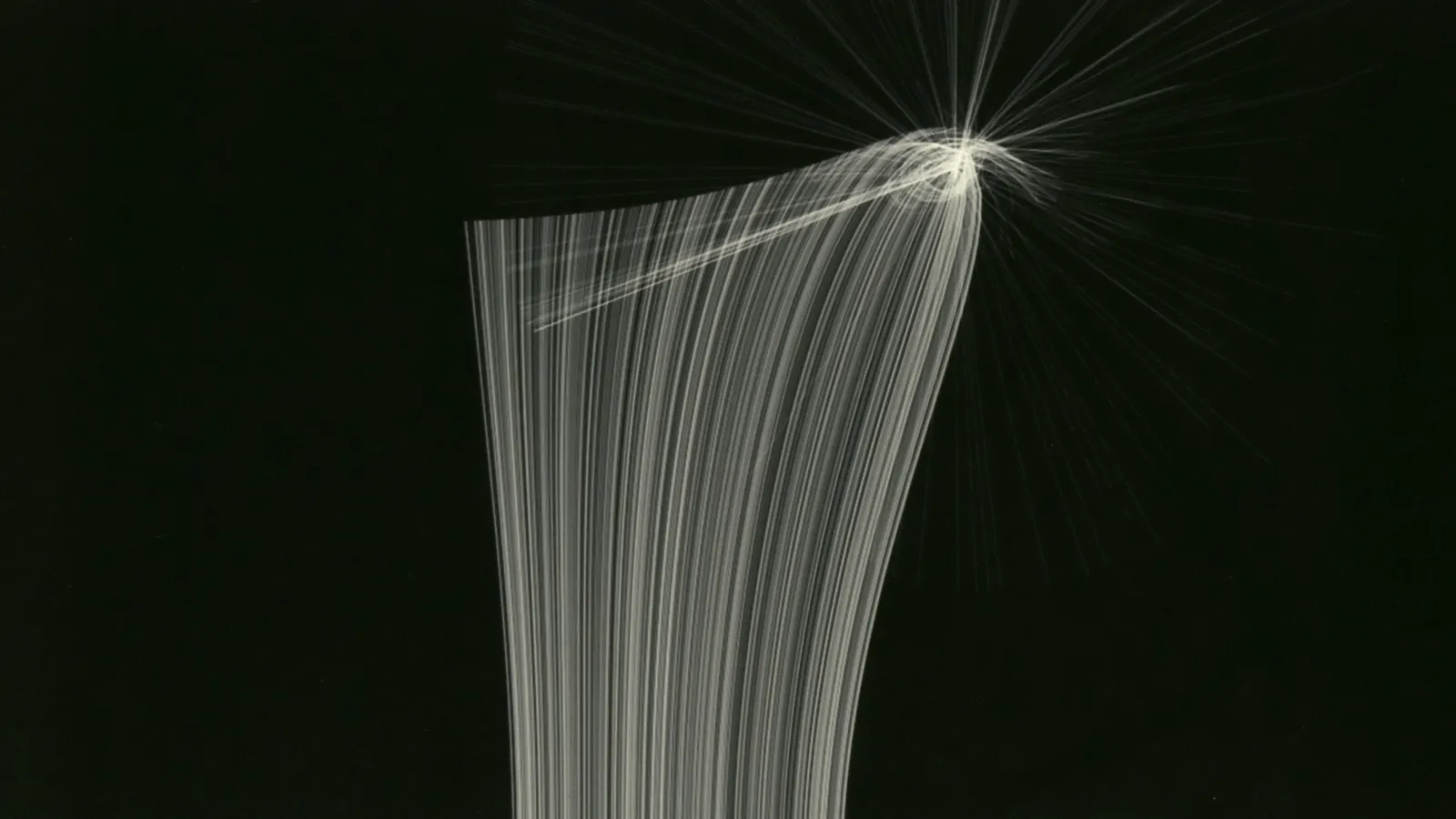
Drop a handful of pebbles in space and let them fall freely. Will their paths spread out or come together? Gravity is attractive, so you might guess they converge. Amal Kumar Raychaudhuri turned that guess into an exact equation in Einstein's general relativity. This post explains what his 1955 paper did, how its idea can be pictured with simple examples, and why the equation matters.
Who was Amal Raychaudhuri, and what did he publish?
His paper Relativistic Cosmology. I appeared in Physical Review on 15 May 1955. The APS abstract page gives his address as the Theoretical Physics Department of the Indian Association for the Cultivation of Science, Jadavpur, Calcutta, and records that the paper was received on 28 December 1953, well over a year before it was printed. The abstract says the paper "presents some general relations obtaining in relativistic cosmology", and that a simple change to anisotropy without spin does not solve the difficulties of the isotropic models.
A tribute by Naresh Dadhich of IUCAA, Pune, posted on arXiv in 2005, records that Raychaudhuri died on 18 June 2005 and was still working on solutions of Einstein's equations without singularities.
What question was he asking?
A review of the equation by Sayan Kar and Soumitra SenGupta in the journal Pramana (2007) sets the scene. By the early 1950s the known solutions of general relativity, Schwarzschild's black hole and the expanding universes, all had singularities, points where the theory breaks down. Raychaudhuri's aim was cosmological: he did not assume the universe was the same everywhere and in every direction, and asked whether rotation, anisotropy or a cosmological constant could avoid the initial singularity.
The review explains that he computed the same quantity in two ways, once from Einstein's field equations and once from the geometry, and set them equal. That gave an equation for how the expansion of a bundle of paths changes along the paths. The paper also reached what is now called the focusing theorem, though not under that name.
What does the equation say?
In the modern form given in the review, for a bundle of freely falling paths:
dΘ/dλ = −Θ²/3 − σ² + ω² − R_ab v^a v^b
You do not need the tensors to read it. Θ is the expansion: the rate at which the cross-section of the bundle grows. σ² measures shear, a stretching of the bundle's shape. ω² measures rotation. The last term comes from matter, and for ordinary attractive matter it pushes Θ down. The review sums it up: rotation resists convergence, while shear helps it, and if matter is attractive the paths "must be eventually drawn towards each other".
Worked example 1: focusing on a globe
Here is an analogy from ordinary geometry, not general relativity. Two travellers start on the equator, 100 km apart, and walk due north. Each walks in a perfectly straight line on the curved surface. Their separation is d = 100 × cos(latitude) km.
At 60° N. d = 100 × 0.5 = 50 km.
At 80° N. d = 100 × 0.174 ≈ 17 km.
At 90° N. d = 0. They meet at the pole.
Neither traveller turned. The curvature of the surface brought them together. This is only an analogy, but it carries the key idea: straight paths in a curved space can converge with no force acting.
Worked example 2: how soon must paths meet?
Take the simplest case: no shear, no rotation, and matter that only helps focusing. Then dΘ/dλ is at most −Θ²/3. Look at the boundary case dΘ/dλ = −Θ²/3. Its solution is 1/Θ = 1/Θ₀ + λ/3.
The values here are sample numbers. Suppose the bundle starts contracting with Θ₀ = −0.3 per unit time.
At λ = 0. 1/Θ = −3.33, so Θ = −0.3.
At λ = 5. 1/Θ = −3.33 + 1.67 = −1.67, so Θ = −0.6.
At λ = 9. 1/Θ = −3.33 + 3.00 = −0.33, so Θ = −3.0.
At λ = 10. 1/Θ = 0, so Θ runs off to minus infinity: the paths cross.
Any extra focusing from matter or shear makes it happen sooner. So a bundle that starts converging at rate |Θ₀| must focus within 3/|Θ₀|, here 10 units of time. The review stresses one subtlety: focusing alone does not prove a singularity, because paths can cross without spacetime breaking down. Turning focusing into singularity theorems took the further work of Hawking and Penrose.
Common mistakes when reading the equation
Treating it as a force law. It describes geometry along paths, not a push or pull.
Ignoring signs. Negative Θ means the bundle is shrinking.
Thinking focusing equals a singularity. Focusing is necessary for the theorems but not enough on its own.
Forgetting rotation. A rotating bundle can resist focusing.
How did the equation become famous?
The review says the equation's "true recognition" came about a decade later, when Stephen Hawking and Roger Penrose used geodesic focusing to prove their singularity theorems, and only then did the name "Raychaudhuri equation" enter the literature. Our post on Stephen Hawking and black holes follows that later story, and Karl Schwarzschild and black holes covers the first solution with a singularity.
General relativity is not in the JEE (Main) 2026 syllabus, but the skills behind these examples are: trigonometry, rates of change and solving a simple differential equation. If those are the weak link, the Fermi Concept Library covers every concept in physics, chemistry, biology, mathematics and computing.
What can a student take from how Raychaudhuri worked?
Ask the question others avoid. He asked whether singularities could be escaped, instead of assuming them away.
Compute one thing two ways. Equating two expressions for the same quantity gave him the equation.
Drop simplifying assumptions when you can. He did not assume a perfectly uniform universe.
Keep going. He was working on non-singular solutions until he died.
Practice routine: find the separation of the two travellers at 45° N, solve dΘ/dλ = −Θ²/3 for Θ₀ = −0.5 and find when Θ diverges, and explain in two sentences why rotation resists focusing.
Next step: draw two straight lines of longitude on a ball and watch them meet, then write the equation's four terms and what each one does.