

On this page
In November 1915 Einstein used his new general theory of relativity to explain the orbit of Mercury, with an approximate calculation. Within weeks, an astronomer serving in the German army found the first exact solution, the one that describes the gravity of a single mass and, as later physicists realised, a black hole. This post covers who Karl Schwarzschild was, what his solution says, a worked calculation of the Schwarzschild radius, and what students can learn from him.
Who was Karl Schwarzschild?
The MacTutor biography from the University of St Andrews gives the outline. He was born on 9 October 1873 in Frankfurt. By sixteen he had mastered celestial mechanics, and two papers he wrote at school on the orbits of double stars were published in 1890. He was a professor and observatory director at Göttingen from 1901 to 1909, then director of the Astrophysical Observatory in Potsdam, the most prestigious post for an astronomer in Germany.
He also had an eye for talent. The obituary of the Danish astronomer Ejnar Hertzsprung by K. Aa. Strand (1968) records that Schwarzschild invited Hertzsprung to Göttingen in 1909, had him made a professor within months, and took him to Potsdam. Our post on the Hertzsprung-Russell diagram tells what Hertzsprung did there.
When war broke out in 1914, Schwarzschild volunteered. MacTutor records that he served in Belgium, in France, where he calculated artillery trajectories, and in Russia. In Russia he wrote two papers on general relativity and one on quantum theory. He developed pemphigus, a rare autoimmune skin disease with no treatment at the time, was sent home in March 1916, and died in Potsdam on 11 May 1916.
What did his 1916 paper solve?
Schwarzschild's paper was communicated to the Prussian Academy on 13 January 1916. An English translation, On the gravitational field of a mass point according to Einstein's theory, shows how he set up the problem. Einstein had used an approximation to explain the anomaly in Mercury's orbit. Schwarzschild wrote that "the following calculation yields the exact solution of the problem," and that it also proves the solution is unique, which Einstein's method had left in doubt.
His result describes space and time around a point mass. It contains a single constant, which he called α, that "depends on the value of the mass at the origin". He also noted that for Mercury, α/r is close to twice the square of the planet's speed in units where the speed of light is 1. Since a planet in a circular orbit has v² = GM/r, that gives α = 2GM/c². This is what we now call the Schwarzschild radius.
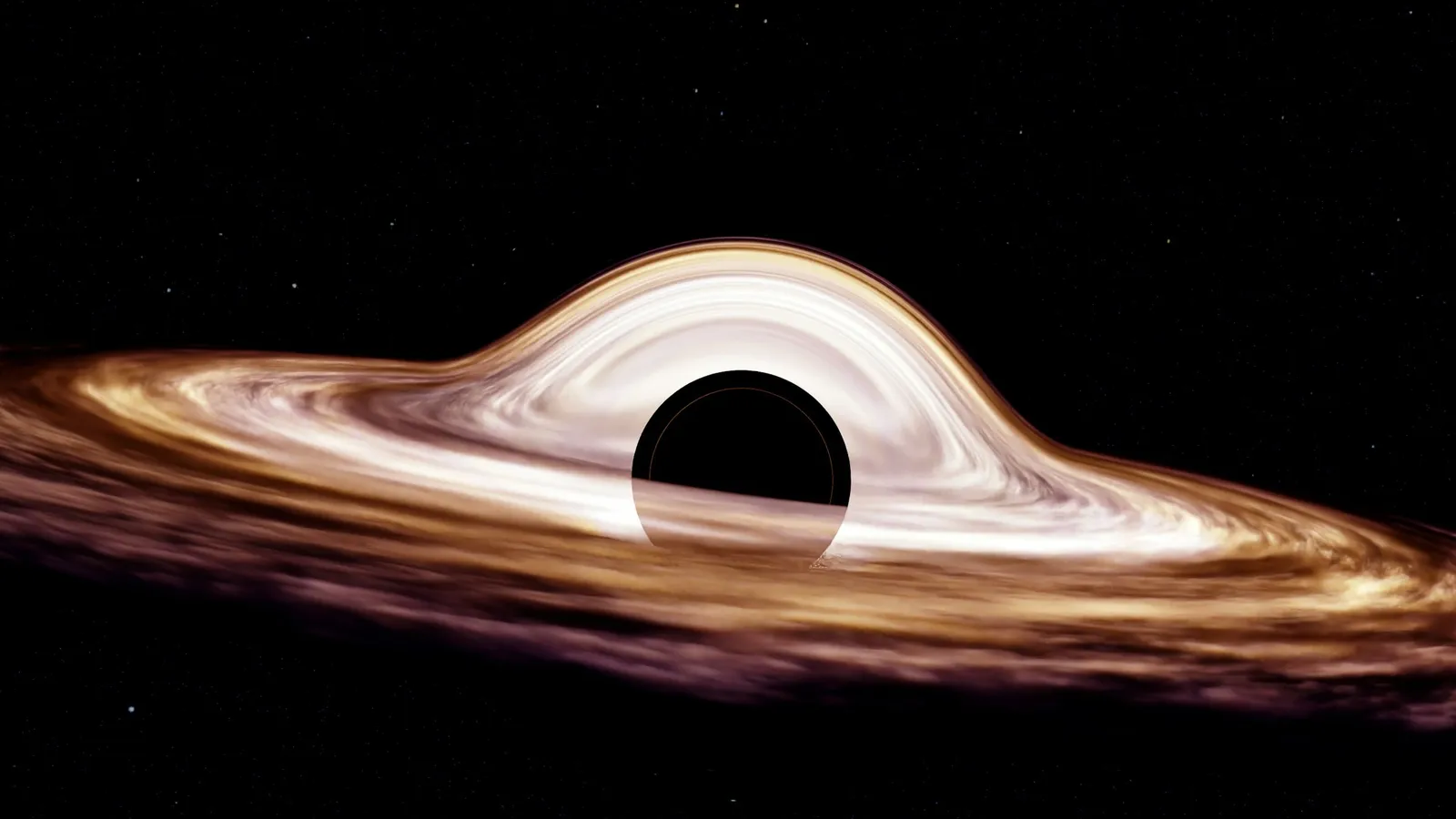
MacTutor notes that Schwarzschild himself thought this feature of the solution was physically meaningless. It took decades before physicists accepted that a mass squeezed inside this radius forms a black hole, from which not even light escapes.
Worked example: how big is a black hole?
The Schwarzschild radius is r_s = 2GM/c². Instead of multiplying G and M separately, use the product GM, which astronomers know far more precisely. The IAU 2015 Resolution B3 gives nominal values GM(Sun) = 1.3271244 × 10²⁰ m³ s⁻² and GM(Earth) = 3.986004 × 10¹⁴ m³ s⁻². Use c = 2.998 × 10⁸ m/s, so c² = 8.988 × 10¹⁶ m² s⁻².
The Sun:
r_s = 2 × 1.3271244 × 10²⁰ / 8.988 × 10¹⁶ ≈ 2.953 × 10³ m ≈ 2.95 km.
The Sun's radius is about 696,000 km, so it is nowhere near this. To become a black hole it would have to be squeezed to a ball about 6 km across.
The Earth:
r_s = 2 × 3.986004 × 10¹⁴ / 8.988 × 10¹⁶ ≈ 8.87 × 10⁻³ m ≈ 8.9 mm, about the size of a marble.
The black hole in galaxy M87: the Event Horizon Telescope collaboration (2019) estimated its mass at 6.5 × 10⁹ Sun masses. Because r_s is proportional to M, r_s ≈ 6.5 × 10⁹ × 2.953 km ≈ 1.9 × 10¹⁰ km, about 128 times the Earth-Sun distance.
A shortcut check. The escape speed from a sphere is v = √(2GM/r). Setting v = c and solving for r gives r = 2GM/c², the same formula. This Newtonian argument is not a proof, because light and strong gravity need general relativity, but it is a quick way to remember the formula.
Common mistakes:
Forgetting the 2. GM/c² is half the Schwarzschild radius.
Using c instead of c². Square it first: 8.988 × 10¹⁶, not 2.998 × 10⁸.
Mixing units. With GM in m³ s⁻² and c in m/s, the answer comes out in metres. Convert to km only at the end.
What can a student take from Schwarzschild's way of working?
Look for the exact answer. Einstein's approximation worked for Mercury. Schwarzschild asked whether the problem could be solved exactly, and it could.
Keep thinking in hard conditions. He did some of his most important work at the war front, while ill.
Read your result physically. His remark linking α to a planet's speed connects a strange constant to something you can picture.
For the next chapter in this story, read about Stephen Hawking and black hole radiation and the Chandrasekhar limit. If escape speed and orbits still feel shaky, the Fermi Concept Library covers every concept in physics with its own lesson.
Try it now: find the Schwarzschild radius of a star of 10 Sun masses, then check that it is ten times the Sun's.


