On this page
Math of Space: Surface Area and Volume is Chapter 14 of Ganita Manjari Part II, the new NCERT Grade 9 maths book (First Edition, August 2026). The chapter PDF is the source of every formula below. The CBSE 2026-27 Class IX Mathematics curriculum lists the same solids under Unit V, Mensuration.
Not in this chapter: a "lateral surface area" formula for a cuboid or cube, the frustum of a cone, and solids made by combining two shapes. Cylinders and cones are right circular only.
Symbols: TSA = total surface area, CSA = curved surface area, V = volume. Total surface area means the whole outer surface: every flat face plus every curved part. The book lets you take π ≈ 22/7 or π ≈ 3.14, and 1000 cm³ = 1 litre.
What are the cuboid and cube formulas?
A cuboid has length l, width w and height h (the book says width, not breadth). A cube has side a.
Cuboid: TSA = 2(wl + hl + hw), the sum of three pairs of equal rectangular faces
Cuboid: V = lwh
Cube (the case w = h = l = a): TSA = 6a²
Cube: V = a³
Worked example: a box is 12 cm long, 5 cm wide and 4 cm high. TSA = 2(60 + 20 + 48) = 256 cm², and V = 12 × 5 × 4 = 240 cm³. A cube of volume 343 cm³ has a = 7 cm (since 7³ = 343), so its TSA = 6 × 49 = 294 cm².
Watch for: a cube's side is the cube root of its volume, not a third of it.
What are the formulas for a right circular cylinder?
Here r is the base radius and h the height. The curved surface unrolls into a rectangle of width 2πr and height h.
CSA = circumference × height = 2πrh
TSA, closed at both ends (like a biscuit tin) = 2πrh + 2πr² = 2πr(h + r)
Surface area, closed at one end only (like a tumbler) = 2πrh + πr² = πr(2h + r)
V = cross-sectional area × height = πr²h
Worked example: a tumbler has r = 3.5 cm and h = 10 cm (π = 22/7). Its surface area = (22/7) × 3.5 × (20 + 3.5) = 258.5 cm². It holds V = (22/7) × 3.5² × 10 = 385 cm³, which is 0.385 litre.
How do you find the slant length, surface area and volume of a cone?
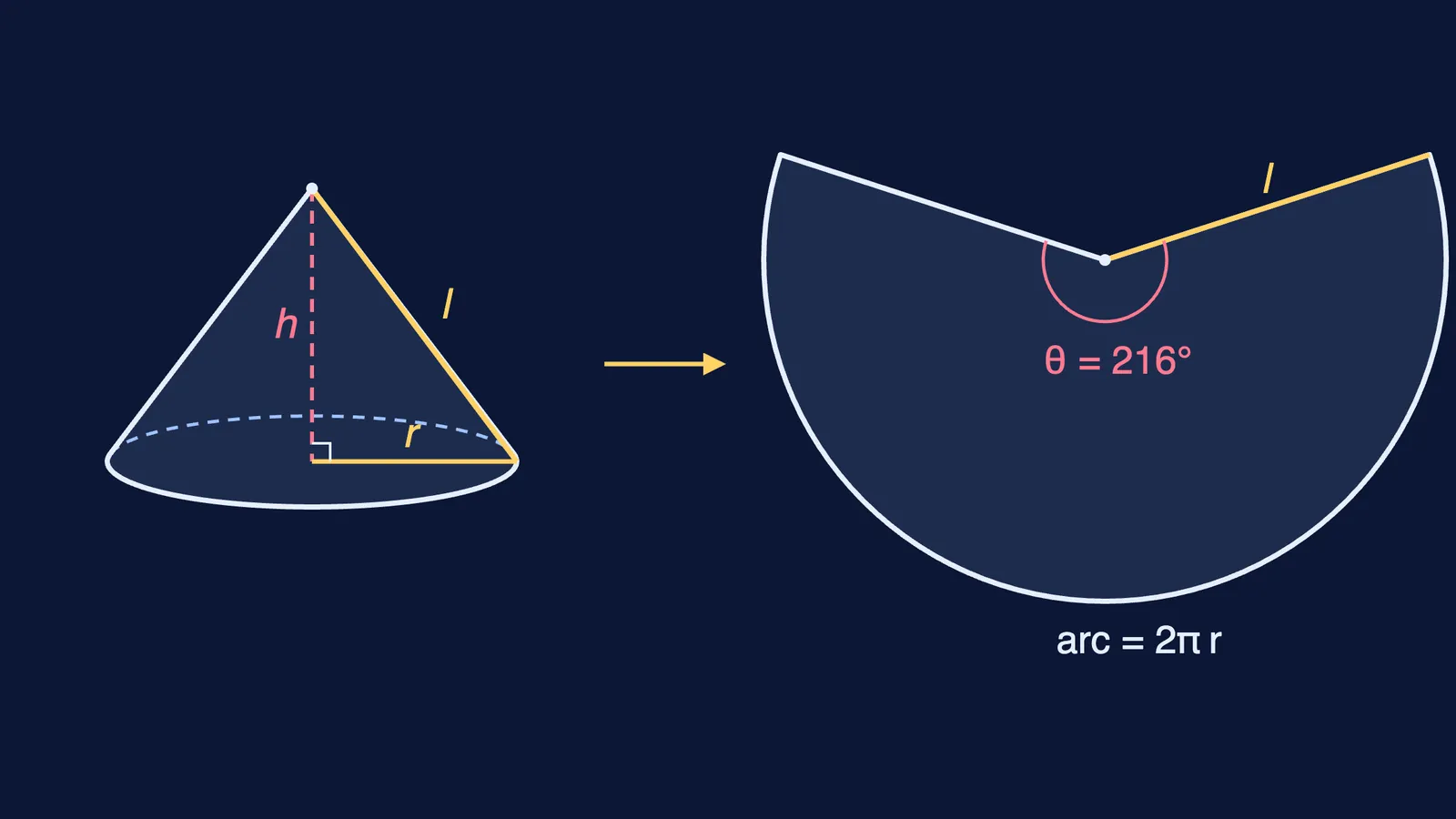
A right circular cone has base radius r, height h and slant length l (the exercises also call it slant height). It forms when a right triangle is rotated about one of its legs.
Slant length: l² = h² + r² (Baudhāyana–Pythagoras theorem)
CSA = πrl
Same CSA from the unrolled sector of radius l and angle θ: CSA = πl² × θ/360°, where θ/360° = r/l
TSA (curved part + flat base) = πrl + πr² = πr(l + r)
V = (1/3)πr²h, which is one third of a cylinder with the same base and height, or (1/3) × area of base × height
Worked example: a cone has r = 9 cm and h = 12 cm (π = 3.14). Then l = √(144 + 81) = 15 cm. CSA = 3.14 × 9 × 15 = 423.9 cm², TSA = 3.14 × 9 × 24 = 678.24 cm², and V = (1/3) × 3.14 × 81 × 12 = 1017.36 cm³. Unrolled, its curved surface is a sector with θ = 360° × 9/15 = 216°.
Watch for: mixing up h and l. Surface area uses the slant length l; volume uses the vertical height h.
What is the volume of a pyramid?
A pyramid has a flat base (a triangle, a square or any closed shape) whose points all join to one apex.
Pyramid: V = (1/3) × area of base × height, whatever the shape of the base
Pyramid surface area: add the areas of all its polygonal faces; the book gives no separate formula
The book notes that a cone can be thought of as a pyramid with a circular base. Worked example: a square pyramid with base side 6 cm and height 10 cm has V = (1/3) × 36 × 10 = 120 cm³.
What are the sphere and hemisphere formulas?
Here r is the radius. Archimedes showed the sphere's surface equals the curved surface of a cylinder of radius r and height 2r that fits tightly around it: 2πr × 2r = 4πr².
Sphere: surface area A = 4πr²
Sphere: V = (4/3)πr³, which the book also writes as (1/3) × 4πr² × r
Hemisphere: CSA = 2πr² (half of the sphere's surface)
Hemisphere: TSA = 2πr² + πr² = 3πr² (curved part plus the flat circular base)
Hemisphere: V = (2/3)πr³
Worked example: a ball has r = 2.8 cm (π = 22/7). A = 4 × (22/7) × 7.84 = 98.56 cm², and V = (4/3) × (22/7) × 21.952 ≈ 91.99 cm³. A hemispherical bowl of radius 7 cm has CSA = 308 cm², TSA = 462 cm², and holds (2/3) × (22/7) × 343 ≈ 718.67 cm³.
Watch for: using a diameter as the radius. Halve it first, because a doubled r makes the volume eight times too large.
How to revise this formula sheet
Rebuild the cuboid and cylinder surface formulas from their nets: three pairs of rectangles, then one rectangle plus circles.
For every cone question, write l² = h² + r² on the first line, then check whether each formula needs h or l.
Group the "one third" formulas (cone, pyramid, sphere as (1/3) × surface × r) on one card, and check the cone against the cylinder with the same base and height.
For the reasoning behind each formula and the guesstimate problems, read our Math of Space Class 9 chapter guide, then test the vocabulary with the Math of Space Class 9 key terms.
If a cone or hemisphere question keeps going wrong, the Fermi Problem Library has worked problems with a step-by-step solver that explains the reasoning rather than printing an answer.