On this page
The World of Algorithms is Chapter 11 of Ganita Manjari Grade 9 Part II, the new NCERT maths book (first edition, August 2026). Here are 30 of its key terms in four groups, with our own examples. For step-by-step gcd examples and practice questions, read our World of Algorithms Class 9 chapter guide.
What is an algorithm in Class 9 maths?
From section 11.1 and the summary of the NCERT chapter.
Algorithm: a systematic, step-by-step procedure for solving a problem. Example: column addition. Don't confuse with: the answer; the algorithm is the method.
Al-Khwārizmī: the Persian scholar who wrote on Indian arithmetic around 820 CE; "algorithm" grew from Algoritmi, the Latin form of his name.
Executing an algorithm: running through its steps one by one. Example: checking 1 to 18 to get divisors(18).
Basic step: an action the algorithm assumes you can already do directly. Example: adding two single digits.
Repeated step: one step carried out many times. Example: for each j in 1, 2, ..., n, check if j divides n.
Conditional step: a step done only when a condition holds. Example: add j to the list only if j divides n.
Justifying correctness: giving a reason the algorithm always gives the right answer.
Analysing an algorithm: counting how many steps it takes as the input grows. Don't confuse: justifying asks "is it right?"; analysing asks "how much work?"
How does the addition algorithm work?
From section 11.1.1 of the NCERT chapter.
Place-value alignment: lining digits up from the right, so units add to units and tens to tens.
Carry: the 1 passed to the next column when a column adds up to 10 or more. Example: 358 + 467. Units 8 + 7 = 15, write 5, carry 1; tens 5 + 6 + 1 = 12, write 2, carry 1; hundreds 3 + 4 + 1 = 8. Answer 825.
Final carry: a carry of 1 left after the last column is written on the far left. Without this step, 600 + 500 comes out as 100.
Counting method: drawing dots for both numbers and counting them. Don't confuse with: digit-by-digit addition. One more digit means about 10 times as many dots, but only one more column.
What are divisors, gcd and lists?
From sections 11.2 and 11.3 of the NCERT chapter.
Divisor (factor): a natural number that divides n with no remainder. Don't confuse with: a multiple. 4 is a divisor of 20; 40 is a multiple of 20.
divisors(n): the list of all divisors of n, found by checking each j from 1 to n. Example: divisors(20) = [1, 2, 4, 5, 10, 20].
List: values kept in order inside square brackets; it starts empty, [ ], and each new value goes at the end.
Data structure: an arrangement for storing intermediate values, such as a sorted list, chosen so the algorithm runs faster. Don't confuse with: the algorithm, the steps that use it.
Common divisor: a number that divides both m and n; 1 always does. Example: the common divisors of 20 and 30 are [1, 2, 5, 10].
gcd(m, n): the greatest common divisor, the same as the HCF. Example: gcd(20, 30) = 10, the rightmost entry of the increasing list above. Don't confuse with: the lcm, the least common multiple.
max(m, n) and min(m, n): the larger and the smaller number. A common divisor cannot exceed min(m, n), so checking up to the minimum is enough.
most-recent-common-divisor: one value that starts at 1 and is replaced whenever a larger common divisor turns up; at the end it is the gcd.
How do Euclid's and Āryabhaṭa's methods find the gcd?
From sections 11.3.3 and 11.3.4 of the NCERT chapter.
Reducing a problem: replacing it with the same kind of problem on smaller numbers, then repeating.
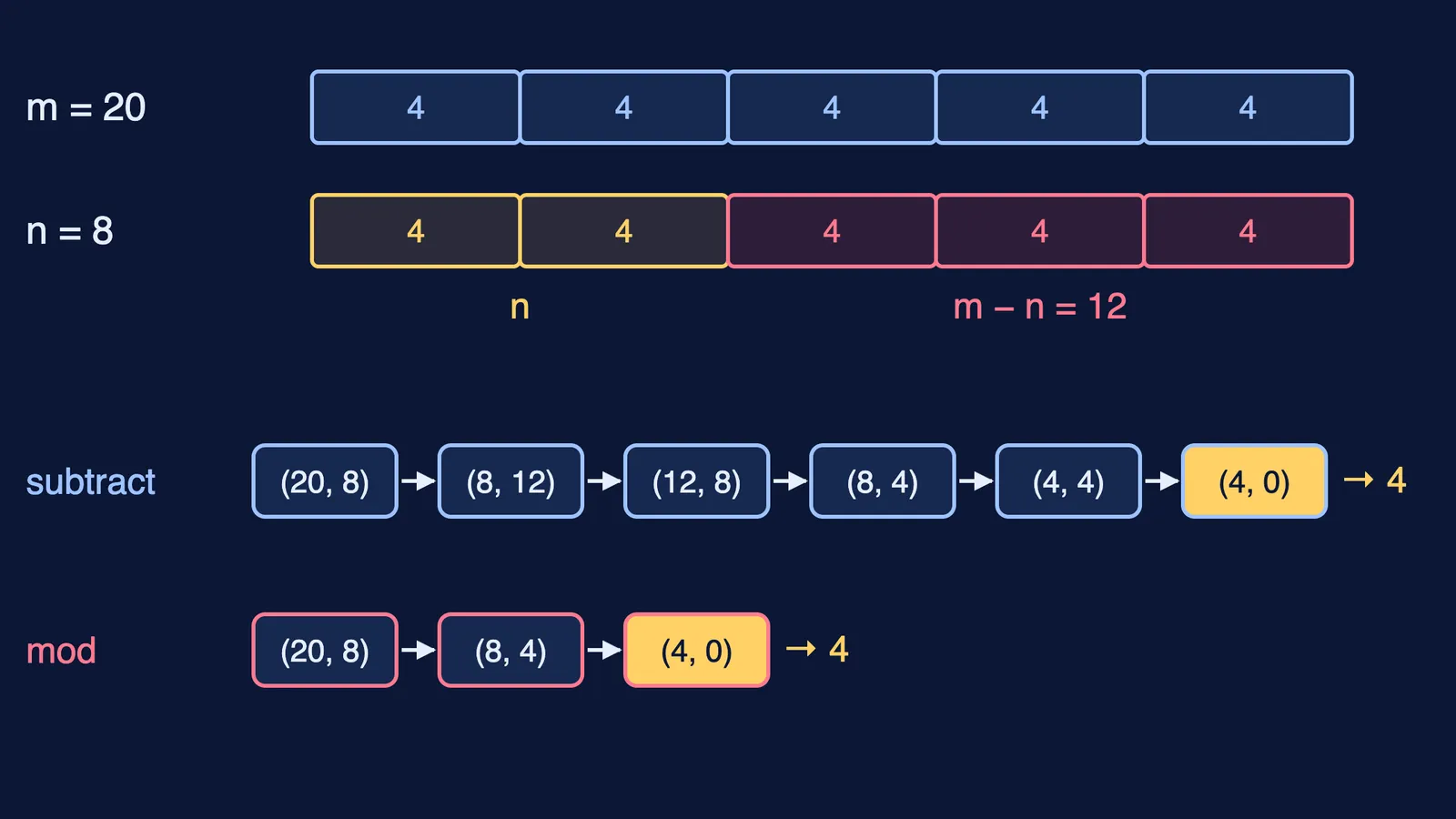
Euclid's subtraction rule: for m ≥ n, gcd(m, n) = gcd(n, m − n), because both pairs have exactly the same common divisors. Euclid wrote it down in Elements.
Tiling argument: if blocks of size d exactly fill lengths m and n, they also exactly fill m − n. Example: blocks of 4 fill 20, 8 and 12, as in the picture above.
Swap step: if m < n, reverse the pair first. Example: gcd(8, 12) becomes gcd(12, 8).
Stopping condition: when the second number is 0, the answer is the first: gcd(m, 0) = m. Example: gcd(20, 8) by subtraction passes (8, 12), (12, 8), (8, 4), (4, 4), (4, 0), so the gcd is 4.
m mod n: the remainder when m is divided by n, always less than n. Example: 45 mod 12 = 9, since 45 = 3 × 12 + 9. Don't confuse with: the quotient, 3.
Āryabhaṭa's division algorithm: the rule gcd(m, n) = gcd(n, m mod n), seen as a "long division" method in the Āryabhaṭīya (499 CE). Example: gcd(45, 12) goes to (12, 9), (9, 3), (3, 0), so the gcd is 3 after three reductions; subtraction needs seven.
Efficiency: how the work grows with the input. With subtraction, gcd(51, 2) takes 27 reductions; with division, 2. The chapter says division's work grows with the number of digits, and leaves the proof for later grades.
Prime number: a number with exactly two distinct factors, 1 and itself. Example: divisors(13) = [1, 13]. Don't confuse: 1 is not prime.
Prime factorisation: writing a number as a product of primes, another route to the gcd. Example: 60 = 2² × 3 × 5.
How to learn these terms
Learn them in pairs: divisor and multiple, gcd and lcm, quotient and remainder, justifying and analysing.
Run both gcd methods on one pair, say (20, 8), writing every pair you pass through.
Draw the tiling bars for one example to explain why gcd(m, n) = gcd(n, m − n).
For each algorithm in the chapter, point to its basic, repeated and conditional steps.
If a term still feels abstract, the Fermi Concept Library gives each concept in mathematics and computing its own lesson and its place in the map. To see gcd and lcm at work, try predicting how many points a spirograph draws, using LCM and HCF, or read why there are infinitely many primes.