On this page
This sheet covers Chapter 8 of the new NCERT Class 9 book, Predicting What Comes Next: Exploring Sequences and Progressions in Ganita Manjari Part I, in the book's notation; the chapter sits under Algebra in the CBSE Class IX Mathematics curriculum for 2026-27. For the ideas behind each formula, read our chapter guide to Predicting What Comes Next. The chapter gives no general formula for the sum of n terms of an AP or GP.
How do you write the nth term of a sequence?
A sequence is an ordered list of numbers; each number is a term (NCERT Ganita Manjari, Chapter 8).
tₙ is the term in position n (the book also writes sₙ or uₙ).
Explicit rule: tₙ as a formula in n, such as uₙ = 2n − 1 (the odd numbers).
Is k a term? Solve tₙ = k. Condition: n must come out as a natural number.
Worked example: for tₙ = 7n − 4, the 25th term is t₂₅ = 7 × 25 − 4 = 171. Is 241 a term? 7n − 4 = 241 gives 7n = 245, so n = 35: yes, it is the 35th term. Is 250 a term? 7n = 254 gives n = 254/7 ≈ 36.29, which is not a natural number, so no.
Watch for: saying "yes" before checking that n is a whole number of at least 1.
How does a recursive rule work?
A recursive rule gives each term from the terms before it (NCERT, Section 8.3).
One-step rule: t₁ = 1, tₙ = tₙ₋₁ + 3 for n ≥ 2 (this gives 1, 4, 7, 10, …).
Two-step rule (Virahānka–Fibonacci): V₁ = 1, V₂ = 2, Vₙ = Vₙ₋₁ + Vₙ₋₂ for n ≥ 3: 1, 2, 3, 5, 8, 13, …
Condition: the rule applies only from the stated n onward; the first terms are given.
Worked example: u₁ = 2, uₙ = 3uₙ₋₁ − 1 for n ≥ 2. Then u₂ = 3 × 2 − 1 = 5, u₃ = 3 × 5 − 1 = 14, u₄ = 3 × 14 − 1 = 41, u₅ = 3 × 41 − 1 = 122.
Watch for: applying the rule to the first term, or forgetting that without a starting value the rule fixes no sequence.
What is the nth term formula of an AP?
An arithmetic progression (AP) is a sequence in which the difference between consecutive terms is constant (NCERT, Section 8.4).
General form: a, a + d, a + 2d, a + 3d, …, a + (n − 1)d.
a = first term; d = common difference = any term minus the term before it (it can be negative).
nth term (explicit): tₙ = a + (n − 1)d.
Recursive rule: t₁ = a, tₙ = tₙ₋₁ + d for n ≥ 2.
Graph: the points (n, tₙ) lie on a straight line.
Worked example: an AP has 4th term 19 and 9th term 44. Then a + 3d = 19 and a + 8d = 44. Subtracting, 5d = 25, so d = 5 and a = 4. The 20th term is 4 + 19 × 5 = 99.
Watch for: writing a + nd instead of a + (n − 1)d.
Sum of the first n natural numbers
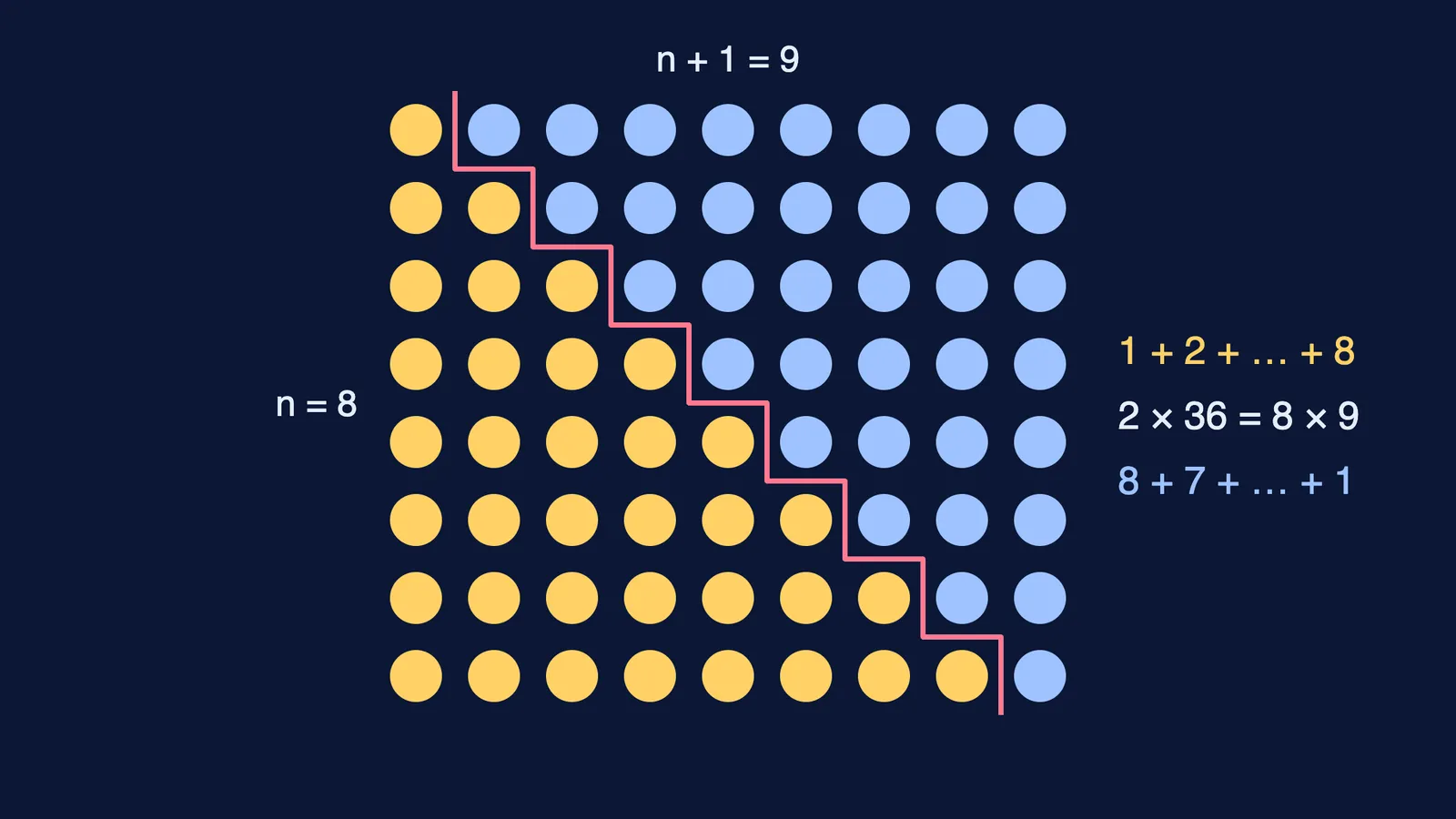
Write S = 1 + 2 + … + n, write it again backwards and add: 2S = n(n + 1) (NCERT, Section 8.5).
Sₙ = 1 + 2 + 3 + … + n = n(n + 1)/2, for n a natural number.
Āryabhaṭa's rule in words (Āryabhaṭīya): (first + last) ÷ 2 × number of terms.
Triangular numbers 1, 3, 6, 10, 15, …: tₙ = n(n + 1)/2.
Odd numbers and squares: 1 + 3 + 5 + … + (2n − 1) = n², the nth square number.
A block of consecutive numbers: m + (m + 1) + … + k = Sₖ − Sₘ₋₁.
Worked example: 31 + 32 + … + 80 = S₈₀ − S₃₀ = (80 × 81)/2 − (30 × 31)/2 = 3240 − 465 = 2775.
Watch for: subtracting S₃₁ instead of S₃₀.
What is the nth term formula of a GP?
A geometric progression (GP) is a sequence in which each term is the previous term multiplied by a fixed number, the common ratio (NCERT, Section 8.6).
General form: a, ar, ar², ar³, …, arⁿ⁻¹.
a = first term; r = common ratio = any term ÷ the term before it (it can be a fraction or negative).
nth term (explicit): tₙ = arⁿ⁻¹.
Recursive rule: t₁ = a, tₙ = r × tₙ₋₁ for n ≥ 2.
Graph: the points (n, tₙ) do not lie on a straight line.
Sierpiński triangle, with stages counted from 0 and Stage 0 of area 1 square unit: black triangles at stage n = 3ⁿ; black area at stage n = (3/4)ⁿ.
Worked example: for the GP 5, 15, 45, …, a = 5 and r = 3, so t₆ = 5 × 3⁵ = 1215. Which term is 3645? 5 × 3ⁿ⁻¹ = 3645 gives 3ⁿ⁻¹ = 729 = 3⁶, so n − 1 = 6 and n = 7. At Sierpiński Stage 6 there are 3⁶ = 729 black triangles with area (3/4)⁶ = 729/4096 ≈ 0.178 square units.
Watch for: arⁿ⁻¹ means a × rⁿ⁻¹, not (ar)ⁿ⁻¹; and the fractal formulas use 3ⁿ because stages start at 0.
How to revise this formula sheet
Write AP and GP side by side: general form, nth term, recursive rule. "Add d" becomes "multiply by r".
Plot five points of one AP and one GP on graph paper: a line against a curve.
Rebuild Sₙ = n(n + 1)/2 by writing the sum forwards and backwards.
End every "is k a term?" answer by saying whether n is a natural number.
Test the vocabulary with our Predicting What Comes Next key terms list.
If you get stuck on a question, the Fermi Problem Library has worked problems with a step-by-step solver that explains the reasoning rather than printing an answer.