On this page
Predicting What Comes Next: Exploring Sequences and Progressions is Chapter 8 of Ganita Manjari, NCERT's new Class 9 mathematics textbook (prelims). The chapter PDF matches the "Sequences and Progressions" row of the CBSE 2026-27 Class IX Mathematics curriculum. Its key terms are explained below in plain words. For solved exercises, see our chapter guide to Predicting What Comes Next.
What is a sequence, and what is a term?
Sequence: numbers written in a fixed order, so there is a first, a second, a third and so on. Example: 1, 4, 9, 16, 25, ...
Term: one number in a sequence. Example: in the square numbers, 25 is the fifth term.
Finite and infinite sequences: a finite one stops (6, 12, 24, 48, 96 has five terms); an infinite one never ends, shown by the three dots.
Term notation tₙ: t₁ is the first term and tₙ the term in position n; other letters (sₙ, uₙ) name other sequences. Example: for odd numbers, t₄ = 7. Note: n only counts places; tₙ itself can be negative, a fraction or any real number.
Triangular numbers: 1, 3, 6, 10, 15, ...; the nth one adds every natural number from 1 to n, and each can be drawn as a triangle of dots. Example: 15 = 1 + 2 + 3 + 4 + 5.
Square numbers: 1, 4, 9, 16, ...; the nth one adds the first n odd numbers. Example: 16 = 1 + 3 + 5 + 7. Don't confuse with: triangular numbers, which add 1, 2, 3, ... instead of 1, 3, 5, ...
How do you write the rule for a sequence?
Explicit rule (explicit formula): gives the nth term straight from its position n, with no earlier terms needed. Example: uₙ = 2n − 1 gives the odd numbers, so the 53rd is 105.
Testing whether a number is a term: set the rule equal to the number and solve; it is a term only if n is a natural number. Example: for sₙ = 5n − 2, 308 gives n = 62 (a term), but 471 gives n = 94.6 (not a term).
Recursive rule (recursive formula): builds each term from the term or terms before it, plus starting value(s). Example: t₁ = 1, tₙ = tₙ₋₁ + 3 for n ≥ 2 gives 1, 4, 7, 10, ... Unlike an explicit rule, it needs the 49th term before the 50th.
Virahānka–Fibonacci sequence: V₁ = 1, V₂ = 2 and Vₙ = Vₙ₋₁ + Vₙ₋₂ for n ≥ 3, giving 1, 2, 3, 5, 8, 13, ... The chapter says Virahānka wrote it down in the 7th century CE while studying Prakrit poetry metres, before Fibonacci (c. 1200 CE).
What is an arithmetic progression (AP)?
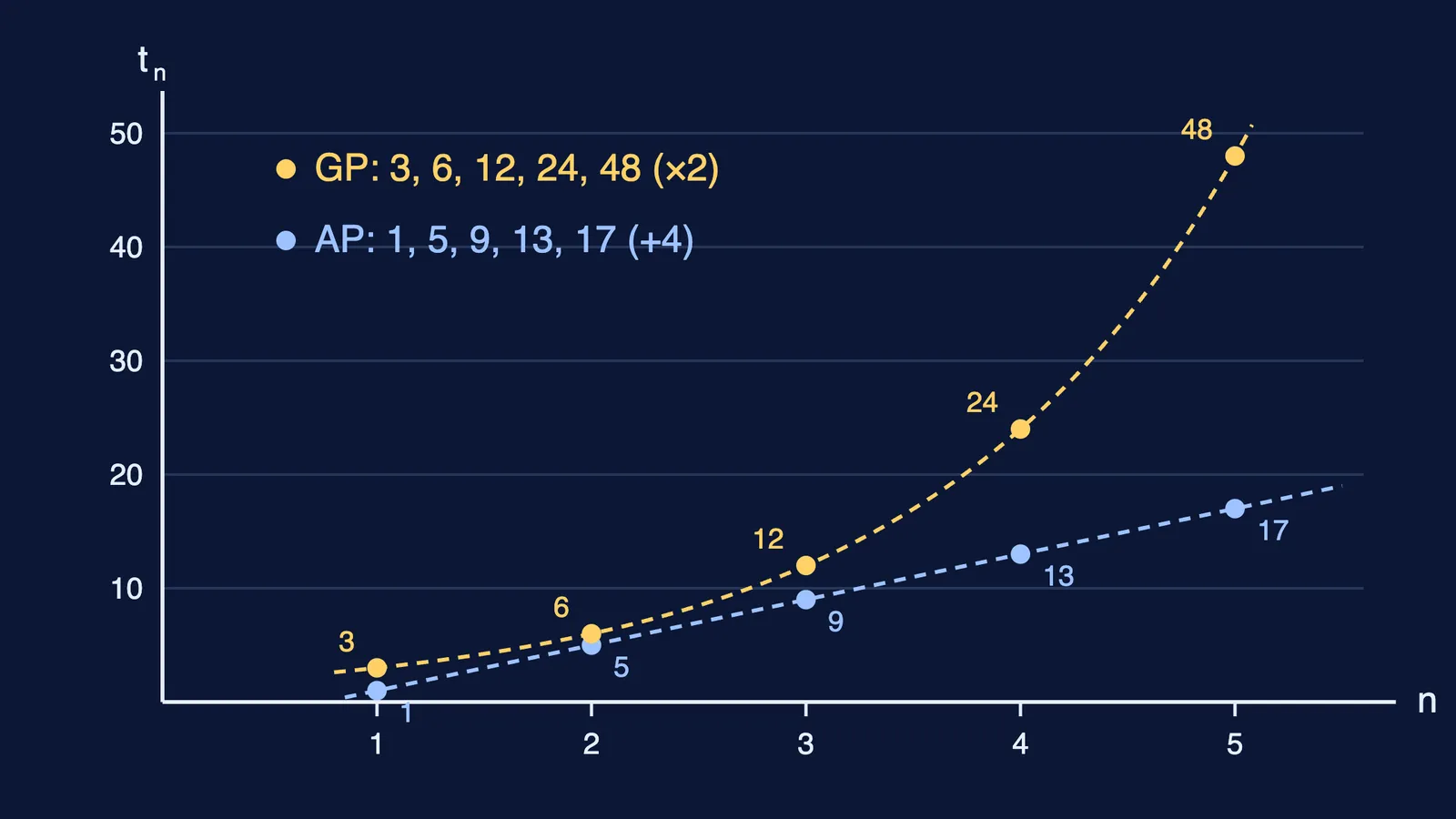
Arithmetic progression (AP): you add the same fixed number each time. Example: 1, 5, 9, 13, 17, ... (the chapter's growing pattern of squares).
First term (a) and common difference (d): a is where you start; d is any term minus the one before, and can be negative. Example: 11, 7, 3, −1, ... has a = 11, d = −4.
nth term of an AP: tₙ = a + (n − 1)d, from the general form a, a + d, a + 2d, ... Example: for 1, 5, 9, ..., tₙ = 4n − 3. Recursive rule: t₁ = a, tₙ = tₙ₋₁ + d.
Visualising an AP: the points (n, tₙ) lie on a straight line. Example: (1, 1), (2, 5), (3, 9), (4, 13).
Sum of the first n natural numbers
Sₙ: the sum 1 + 2 + ... + n. Don't confuse with: tₙ, a single term.
Reverse-and-add method: write the sum forwards and backwards and add; every column gives the same total. Example: for 1 to 10, each pair makes 11, so 2S = 110 and S = 55.
Formula: Sₙ = n(n + 1)/2, also the nth triangular number. The chapter traces its first known written mention to Āryabhaṭa's Āryabhaṭīya (Chapter 2, Verse 19).
The chapter does not develop a general sum formula for an AP or a GP. Its one sum formula is for the first n natural numbers, which it also applies to runs such as 25 + 26 + ... + 58.
Geometric progressions (GP) and fractals
Geometric progression (GP): you multiply by the same fixed number each time. Example: 3, 6, 12, 24, 48, ...
Common ratio (r): any term divided by the one before. Example: r = 2 above; 1, −1, 1, ... has r = −1. Don't confuse with: common difference. An AP adds d; a GP multiplies by r.
nth term of a GP: tₙ = arⁿ⁻¹, from a, ar, ar², ... Example: tₙ = 3 × 2ⁿ⁻¹. Recursive rule: t₁ = a, tₙ = r × tₙ₋₁.
Visualising a GP: the points (n, tₙ) do not lie on a straight line. With r = 2 they climb ever faster; the chapter's bouncing ball (dropped from 24 feet, rising to 3/4 of its previous height each bounce) gives heights that get smaller with every bounce.
Fractal: a shape built by repeating one simple rule, so that an enlarged small piece resembles the entire shape. Example: cauliflower, snowflakes.
Sierpiński triangle: join the midpoints of an equilateral triangle's sides, remove the middle triangle, and repeat on every remaining one. Stages 0 to 3 have 1, 3, 9, 27 black triangles (3ⁿ), while the black area shrinks to (3/4)ⁿ.
The CBSE curriculum row for this topic also names the Tower of Hanoi puzzle, but the book chapter does not develop it, so it has no terms in this list.
How to learn these terms
Learn in pairs: explicit and recursive, AP and GP, d and r, tₙ and Sₙ. Write one example that fits one and not the other.
For every sequence in the chapter, write both rules, for example 4n − 3 and t₁ = 1, tₙ = tₙ₋₁ + 4.
Plot one AP and one GP on graph paper to see a line against a curve.
If a definition will not stick, look it up in the Fermi Concept Library, which gives every concept in mathematics its own lesson. These ideas return in our Class 11 Mathematics guide to sequences and series.