On this page
Here are the key terms of Chapter 14, Math of Space: Surface Area and Volume in Ganita Manjari Part II, the new NCERT Class 9 maths book, with our own examples (π = 22/7 unless left as π). For solved problems, see our Math of Space Class 9 chapter guide.
The CBSE Class IX Mathematics curriculum for 2026-27 sets learning outcomes for cuboids and cubes, cylinders, cones, pyramids and spheres, with hemispheres among its key concepts. The chapter studies only right circular cylinders and cones.
What do surface area, volume and cross-section mean?
Surface area: the total area of a solid's outer surface, flat and curved parts together, in square units such as cm². Example: a cube of side 3 cm has six 9 cm² faces, so 54 cm².
Volume: how much three-dimensional room a solid fills, counted in unit cubes (cubic units such as cm³). Don't confuse with: surface area; a 6 cm cube has 216 of each, in cm² and cm³.
Net: a flat pattern that folds into a solid; the book gives cut-out nets of a cuboid, cube, cylinder, cone and two pyramids. Example: six squares joined in a cross shape fold into a cube.
Cross-section: the shape of a thin slice through a solid. Example: a cylinder sliced parallel to its base gives a circle.
Cuboid: a solid with six rectangular faces, set by length l, width w and height h; TSA = 2(wl + hl + hw), V = lwh (area of base × height). Example: 8 × 5 × 3 cm gives 158 cm² and 120 cm³.
Cube: a cuboid with all three dimensions equal to its side a; TSA = 6a², V = a³. Example: a = 4 cm gives 96 cm² and 64 cm³. Don't confuse with: a cuboid of equal volume; 8 × 4 × 2 cm also holds 64 cm³ but has 112 cm².
What do CSA and TSA mean for a cylinder?
Right circular cylinder: a cylinder with circular cross-sections and its axis perpendicular to the base, described by radius r and height h. Don't confuse with: an oblique cylinder, whose axis leans.
Curved surface area (CSA): the curved side only; unrolled, it is a rectangle 2πr by h, so CSA = 2πrh. Example: r = 7 cm, h = 5 cm gives 220 cm².
Total surface area (TSA): curved part plus flat ends: 2πr(h + r) for a closed tin, πr(2h + r) for a tumbler open at one end. Example: 528 cm² closed, 374 cm² as a tumbler.
Volume of a cylinder: cross-sectional area × height, πr²h. Example: 154 × 5 = 770 cm³, or 0.77 litres (1000 cm³ = 1 litre).
What is the difference between height and slant height of a cone?
Right circular cone: the solid traced by turning a right triangle about one of its two shorter sides. Example: a 3-4-5 triangle spun about its 4 cm side gives r = 3 cm, h = 4 cm.
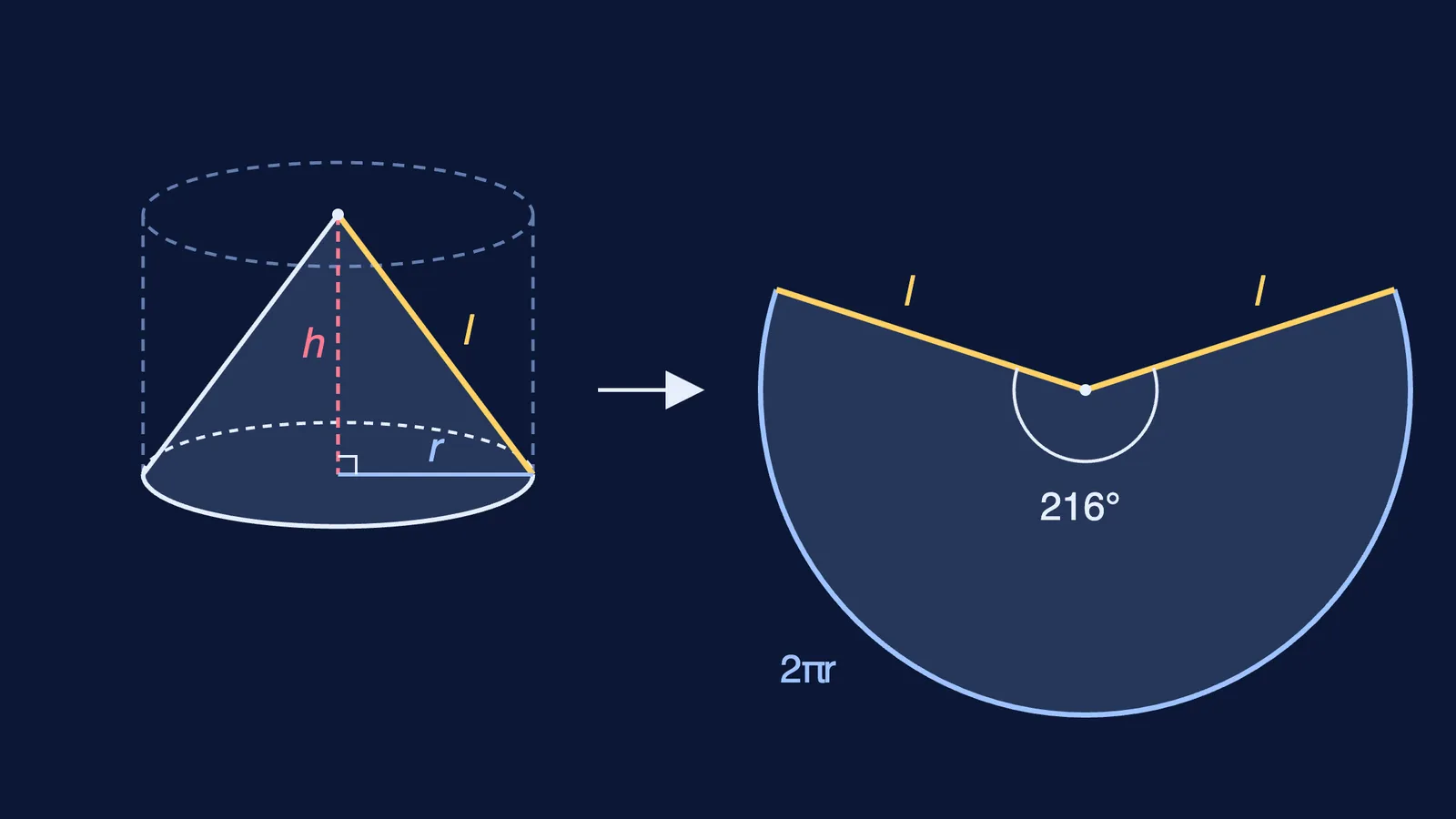
Slant length (l): the distance from the tip to the base's rim along the surface; the exercises also call it slant height. l² = h² + r² by the Baudhāyana–Pythagoras theorem; for where that theorem comes from, see our Class 11 Mathematics in India guide, which covers Baudhāyana's Sulbasūtra. Example: r = 3, h = 4 gives l = 5 cm. Don't confuse with: height h, straight down the middle and shorter than l.
Unrolled cone: the curved surface opened into a sector of radius l, with angle θ where θ/360° = r/l. Example: θ = 360° × 3/5 = 216°.
CSA and TSA of a cone: CSA = πrl; TSA = πr(l + r). Example: 15π cm² and 24π cm².
Volume of a cone: (1/3)πr²h, one third of the cylinder on the same base and height; three cone-fulls of salt fill that cylinder. Example: 12π cm³ against 36π cm³.
Pyramid (pyramidal shape): a solid with every point of a flat base (triangle, square or any closed shape) joined to one point, the apex, outside the base's plane. Example: Egypt's pyramids, on square bases.
Volume of a pyramid: (1/3) × area of base × height for any base; a cone is a pyramid with a circular base. Example: square base 6 cm, height 4 cm gives (1/3) × 36 × 4 = 48 cm³.
Surface area of a pyramid: the sum of its faces' areas. Example: that pyramid's triangular faces are each 5 cm high, so 36 + 4 × 15 = 96 cm². Don't confuse with: its height, 4 cm, from apex straight down to the base.
Which terms describe spheres and hemispheres?
Sphere: the 3D cousin of a circle: every point in space lying exactly r (the radius) from a centre O. Don't confuse with: a circle, the same idea in a flat plane.
Surface area of a sphere: 4πr², which Archimedes showed equals the curved surface of a tight cylinder of radius r and height 2r. Example: r = 7 cm gives 616 cm².
Volume of a sphere: (4/3)πr³, or (1/3) × surface area × r, from thin cones meeting at the centre. Example: r = 3 cm gives 36π cm³, two thirds of its 54π cm³ cylinder.
Hemisphere: one of the two equal halves made by slicing a sphere through its centre; it has one curved surface and a flat circular base.
Hemisphere formulas: CSA = 2πr², TSA = 3πr², V = (2/3)πr³. Example: r = 7 cm gives 308 cm², 462 cm² and about 718.67 cm³. Don't confuse with: CSA for an open bowl, TSA for a solid half-ball.
What is a guesstimate in surface area and volume?
Guesstimate: an estimate built from your own stated assumptions and rounded numbers when exact figures aren't available. Example: in the chapter's golgappa problem, two students' different assumptions give about 1850 and about 870.
Upper bound: a value the true answer cannot exceed. Example: in a 60 cm cubical box, volume alone allows about 1910 balls 6 cm across, yet only 10 × 10 × 10 = 1000 fit in rows; spheres leave gaps.
How to learn these terms
Pair the look-alikes, with an example each: h and l, CSA and TSA, sphere and circle, cm² and cm³.
Make paper nets, then label r, h and l on the cone and the apex on the pyramid.
Learn the one-third family together: cone, pyramid, and the sphere as thin cones.
For guesstimates, list assumptions before calculating.
If a term feels unclear, the Fermi Concept Library gives every concept in mathematics its own lesson and its place in the map.