On this page
Chapter 6 of Exploration, the new NCERT Class 9 science textbook for the 2026-27 session, is called How Forces Affect Motion. It replaces the old Force and Laws of Motion chapter with a more hands-on version: coins flicked by a rubber band, a cardboard cart pulled by a cup of coins, and two spring balances pulling on each other.
What does Chapter 6 of the new Exploration book cover?
The chapter PDF on the NCERT site covers pages 94 to 115 of the April 2026 first edition. It covers force and its unit, the newton, balanced and unbalanced forces, friction, Newton's three laws, and connected objects treated as one system (our Class 9 laws of motion post works a connected-boxes example). Momentum appears only in an optional "Ready to Go Beyond" box, so the core is F = ma.
In the CBSE Class IX Science curriculum for 2026-27, Chapter 6 sits in Unit III, Motion, Force, Work and Sound, with Chapters 4, 7 and 10. That unit carries 23 of the 80 theory marks. Practical 12 on the same list is verifying Newton's second law with a trolley, a pulley and hanging masses.
What are Newton's three laws, in simple words?
First law: with zero net force, an object stays at rest or keeps moving at constant velocity. You need a force to change motion, not to keep it going; pushing a moving box only cancels friction.
Second law: a net force makes an object accelerate in that direction, with a = F/m. One newton gives 1 kg an acceleration of 1 m/s².
Third law: when A pushes B, B pushes A equally and oppositely at the same moment. The two forces act on different objects, so they never cancel.
The chapter's examples include a canoeist pushing water back and Chandrayaan-3's Vikram lander firing its engine forward to slow down.
How do you solve F = ma numericals step by step?
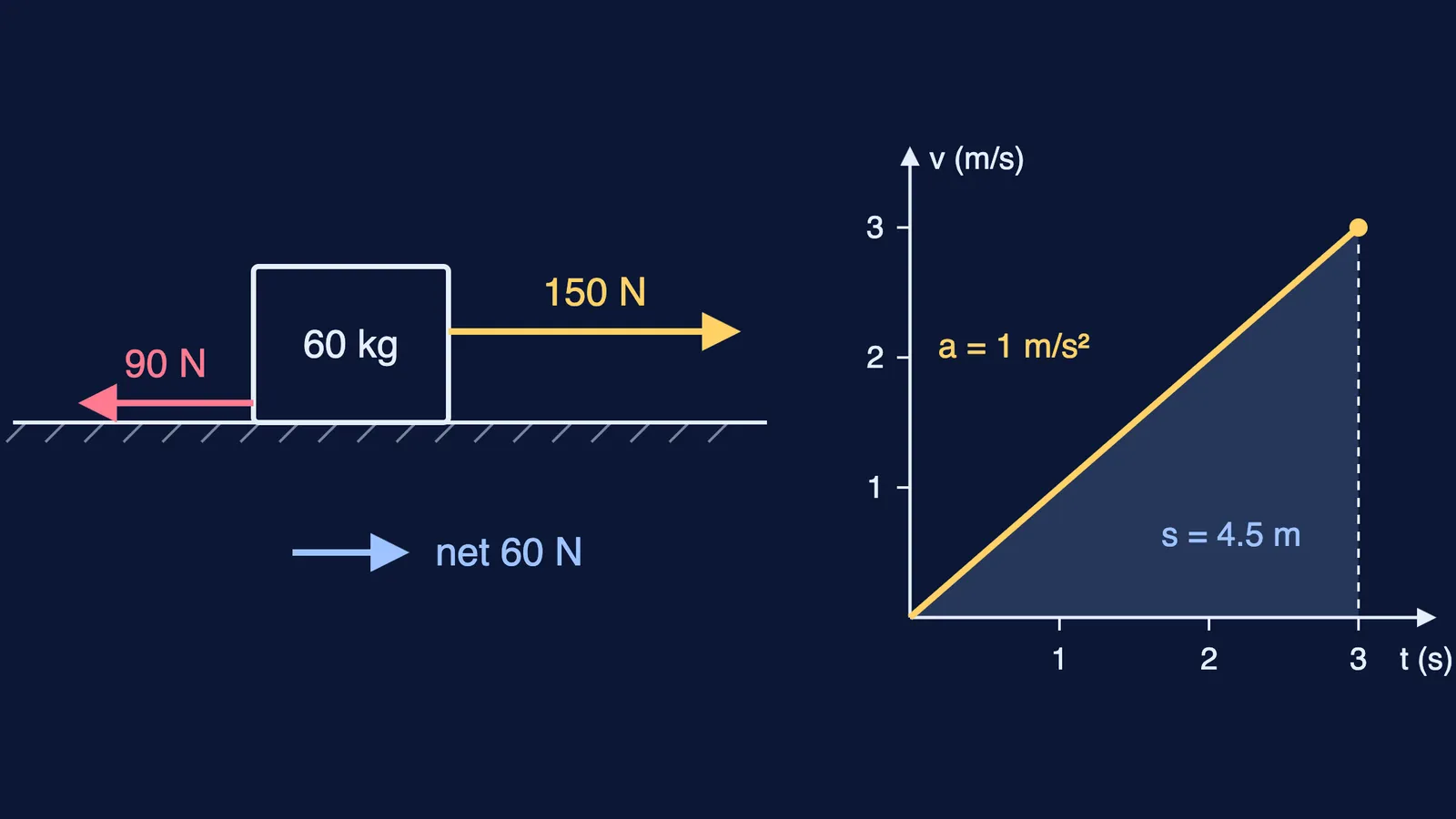
Example 1: a handcart (the diagram above). A seller pushes a 60 kg handcart from rest with 150 N against 90 N of friction.
Net force = 150 N − 90 N = 60 N, forward.
a = 60 N ÷ 60 kg = 1 m/s².
After 3 s: v = u + at = 0 + 1 m/s² × 3 s = 3 m/s.
s = ut + ½at² = ½ × 1 m/s² × (3 s)² = 4.5 m, the shaded area under the graph.
If the seller then pushes with exactly 90 N, the net force is zero and the cart rolls on at 3 m/s. That is the first law.
Example 2: equal forces, unequal accelerations. Two friends on skates, 50 kg and 25 kg, push apart with 100 N each way. Accelerations: 100 N ÷ 50 kg = 2 m/s² and 100 N ÷ 25 kg = 4 m/s².
Example 3: why fielders pull their hands back. A 0.16 kg cricket ball at 30 m/s has momentum 4.8 kg m/s. Stopped in 0.1 s, it decelerates at 300 m/s², so the force is 0.16 kg × 300 m/s² = 48 N. Stopped over 0.4 s, it is 75 m/s² and 12 N. Airbags work the same way; more in our post on change in momentum from force and time.
If your setups go wrong, the Fermi Problem Library has worked problems with a step-by-step solver that explains the reasoning rather than printing an answer.
How do you do the trolley practical for Newton's second law?
The cart starts from rest and covers the same distance s each run, so s = ½aT² gives a = 2s/T², and a₁/a₂ = T₂²/T₁².
Sample readings on a 1.0 m track:
Hanging mass m: T₁ = 2.0 s, so a₁ = 2 × 1.0 m ÷ (2.0 s)² = 0.50 m/s².
Hanging mass 2m: T₂ = 1.5 s, so a₂ = 2 × 1.0 m ÷ (1.5 s)² ≈ 0.89 m/s².
The ratio is about 1.78, not 2. The chapter mentions friction and timing error. Another reason: the falling cup moves too, so doubling its mass also adds to the mass being accelerated. Record both as sources of error. Our guide to Class 9 science practicals shows how to set out the record.
What mistakes cost marks in this chapter?
Saying a moving object needs a net force. Constant velocity means zero net force.
Cancelling a third-law pair. Forces on different objects cannot balance.
Expecting equal forces to give equal accelerations. Divide by each mass.
Leaving friction out of the net force.
Using grams in F = ma. Convert 160 g to 0.16 kg.
Confusing mass and weight. Weight is F = mg with g = 9.8 m/s², so a 5 kg bag weighs 49 N.
If force arrows are hard to picture, the Fermi Simulation Lab has interactive simulations for the ideas that are easier to see than to read.