On this page
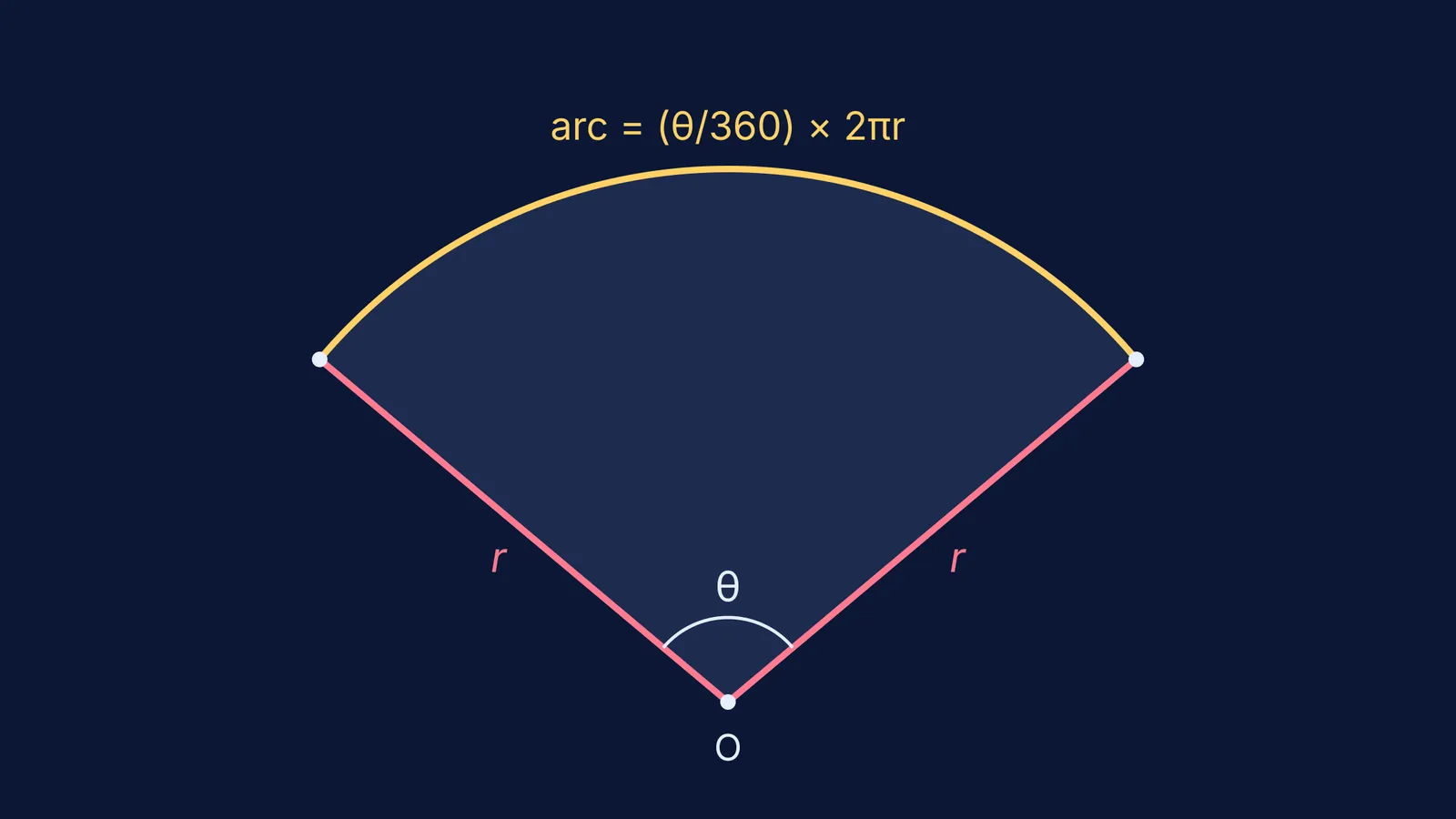
A sector looks like a slice of pizza. Its edge has three parts: the curved crust and the two straight cuts. A common slip when a test asks for its perimeter is to give just the crust. Here is the formula, where it comes from, and a quick check that catches the missing 2r.
What is the formula for the perimeter of a sector?
The NCERT Class 10 chapter Areas Related to Circles defines a sector as "the portion (or part) of the circular region enclosed by two radii and the corresponding arc". So the boundary is one arc and two radii.
The same chapter gives the arc length of a sector of angle θ as (θ/360) × 2πr, where r is the radius and θ is in degrees (NCERT, Chapter 11). The idea behind it: a full turn of 360° gives the whole circumference 2πr, so θ degrees gives θ/360 of it.
Add the two straight edges and you get:
Perimeter of a sector = 2r + (θ/360) × 2πr
If your angle is in radians, the arc length is simply s = rθ (Wolfram MathWorld, Circular Sector). The perimeter is then r(θ + 2).
Why do students write only the arc length?
Two things make this slip easy. First, the summary at the end of the NCERT chapter lists arc length, sector area and segment area, with no separate line for perimeter, so the formula you memorise is the arc. Second, for a full circle the perimeter really is just the curve, 2πr, and that habit carries over to the slice, where it no longer works.
The fix is to think about what a perimeter is for: it is the fence, not the field. Our explainer on when a sum needs perimeter and when it needs area uses the same test.
Worked example: what is the perimeter of a 60° sector of radius 21 cm?
Exercise 11.1, question 5 in the NCERT chapter uses a circle of radius 21 cm with an arc that subtends 60° at the centre, and asks for the arc length. Here is the perimeter, using π = 22/7 as the exercise does.
Write the formula: P = 2r + (θ/360) × 2πr.
Arc: (60/360) × 2 × (22/7) × 21 = (1/6) × 132 = 22 cm.
Two radii: 2 × 21 = 42 cm.
Perimeter: 22 + 42 = 64 cm.
The slip answer, 22 cm, is not a rounding error: it misses 42 cm, about two-thirds of the true perimeter.
Two more to try:
A quadrant. Exercise 11.1, question 2 uses a circle whose circumference is 22 cm, so r = 3.5 cm. A quadrant's arc is 22/4 = 5.5 cm, and its perimeter is 5.5 + 7 = 12.5 cm.
A major sector. The chapter notes that the major sector's angle is 360° minus the minor angle. For r = 21 cm and a 60° minor sector, the major angle is 300°, the arc is (300/360) × 132 = 110 cm, and the perimeter is 110 + 42 = 152 cm. The two radii still count.
Question 9 of the same exercise makes a brooch from silver wire: a circle of diameter 35 mm plus 5 diameters. The wire is 110 mm of circle plus 5 × 35 = 175 mm of straight pieces, so 285 mm in all. As in the 60° sector, the straight pieces are most of the total.
To see each step laid out, the Fermi Problem Library has worked problems with a step-by-step solver that explains the reasoning rather than printing an answer.
How can you check a sector perimeter in ten seconds?
Run these checks, using the 21 cm circle from NCERT Exercise 11.1:
Count the pieces. One arc plus two radii; one term means something is missing.
Size check. The perimeter must be more than 2r. For a radius of 21 cm, any answer under 42 cm is wrong, so 22 cm fails at once.
Arc check. The minor and major arcs together make the full circle: 22 + 110 = 132 cm = 2 × (22/7) × 21.
Units. Perimeter is a length, so cm or m, never cm².
Read the verb. "Length of the arc" wants the arc only. "Perimeter", "boundary" or "wire needed" wants every edge.
That cone question is worked through in our post on making a cone from a sector of a circle. For the companion formulas, see area of a sector and arc length, with clock and wiper sums. If arcs and angles still feel shaky, the Fermi Concept Library gives each concept in mathematics its own lesson.
Next time you see a sector, trace the edge first, then write 2r + arc.