

On this page
A sector-to-cone question looks like a 3D problem, but nearly all the work happens on the flat paper. Once you know which length goes where, the radius takes one line and the height one more. Here are the two matching rules, a worked example and the common mistakes.
What happens when you roll a sector into a cone?
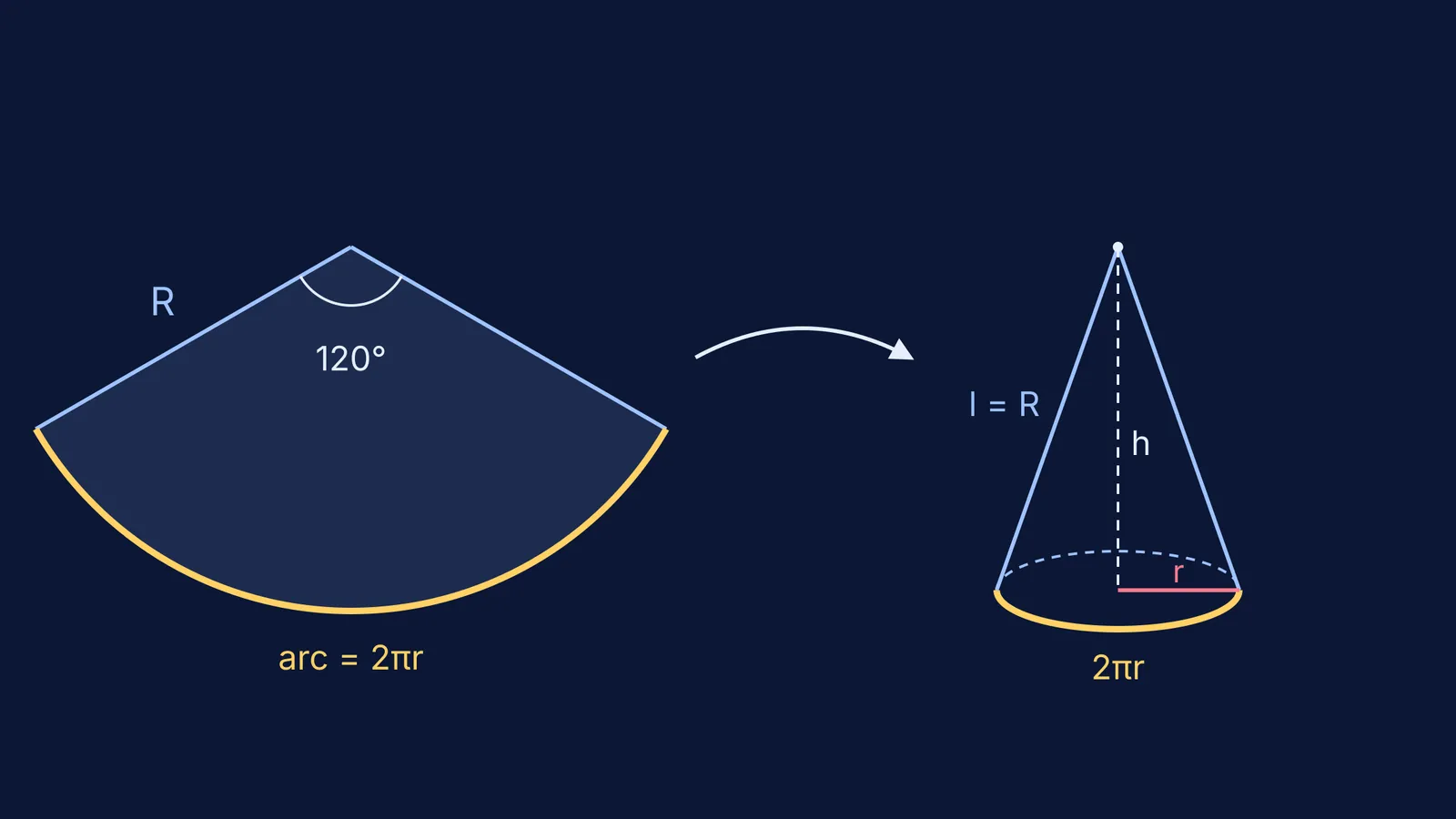
Picture a paper sector with radius R and central angle θ. Bring its two straight edges together: the tip becomes the cone's apex, and the curved edge closes into the base rim.
It works in reverse too. When you cut open the curved surface of a right circular cone and lay it flat, it becomes a circular sector whose radius is the slant height and whose arc length is the base circumference 2πr, as the Wikipedia entry on the cone sets out. That gives you two matching rules:
Sector radius R becomes the cone's slant height l.
Sector arc length becomes the base circumference 2πr.
No paper is stretched or lost along the way, so the sector's area is exactly the cone's curved surface area.
How do you find the radius of the cone from a sector?
The arc length of a sector is (θ/360°) × 2πR. If arc length or sector angles feel shaky, revise our guide to sector area and arc length formulas first. Set the arc length equal to the base circumference:
2πr = (θ/360°) × 2πR
Cancel 2π from both sides and you get a shortcut worth memorising: r = R × θ/360°. In words, the cone's radius is the same fraction of R as the sector's angle is of a full turn. A semicircle (180°) gives a cone with radius R/2. A quarter circle (90°) gives a cone with radius R/4.
How do you find the height and volume of the cone?
The height, the radius and the slant height make a right-angled triangle inside the cone. For a right circular cone the slant height is l = √(r² + h²), as given on Wolfram MathWorld's cone page. Rearranged, that is h = √(l² − r²). The same page gives the volume as V = (1/3)πr²h and the curved surface area as πrl.
Worked example: a 120° sector of radius 21 cm
A sector of angle 120° is cut from a circle of radius 21 cm and rolled into a cone. Find the cone's radius, height, volume and curved surface area. Take π = 22/7.
Slant height: l = R = 21 cm.
Arc length: (120/360) × 2 × (22/7) × 21 = 44 cm.
Base radius: 2πr = 44, so r = 7 cm. Shortcut check: 21 × 120/360 = 7 cm.
Height: h = √(21² − 7²) = √(441 − 49) = √392 = 14√2 ≈ 19.8 cm.
Volume: (1/3) × (22/7) × 7² × 14√2 ≈ 1016 cm³.
Curved surface area: πrl = (22/7) × 7 × 21 = 462 cm².
Check step 6 another way: the sector's area is (120/360) × (22/7) × 21² = 462 cm², the same, because the paper did not change. Our post on finding a cone's surface area from its net builds on this check.
What mistakes cost marks in sector-to-cone questions?
Using R as the base radius. R is the slant height. The base radius is always smaller.
Using l as the height. The slant runs along the side and the height runs down the middle, so h is always less than l.
Forgetting the remaining piece. If a 120° sector is cut out, the leftover 240° sector makes a different cone, with r = 21 × 240/360 = 14 cm and the same slant of 21 cm.
Mixing degrees and radians. If the angle is given in radians, use arc length = Rθ and leave out the 360°.
Rounding too early. Keep √392 as 14√2 until the last step, then round once.
If the volume formula itself feels like magic, read why a cone's volume is one-third of a cylinder's.
Can you work backwards from a cone to the sector angle?
Yes. Turn the shortcut around: θ = 360° × r/l. Take a cone with r = 5 cm and h = 12 cm. Its slant is √(25 + 144) = 13 cm, so the sector you need has radius 13 cm and angle 360° × 5/13 ≈ 138.5°. A quick sanity check: θ must stay below 360°, because r is always less than l.
If you keep choosing the wrong length for the wrong job, practise mixed mensuration questions in the Fermi Problem Library, where a step-by-step solver explains the reasoning rather than printing an answer. For the ideas underneath, the Fermi Concept Library gives every mathematics concept its own lesson.


