

On this page
Every sector question in Class 10 rests on one idea: a sector is a fraction of a whole circle, and the angle tells you which fraction. A 90° sector is a quarter of the area and a quarter of the circumference.
What is the formula for area of a sector and arc length?
The NCERT Class 10 chapter Areas Related to Circles defines a sector as the part of a circular region enclosed by two radii and the arc between them. It gets both formulas by the unitary method: if 360° gives the full area πr², then 1° gives πr²/360, and θ degrees gives θ times that.
Area of a sector of angle θ = θ/360 × πr²
Length of an arc of a sector of angle θ = θ/360 × 2πr
Here r is the radius and θ is the angle in degrees, as the NCERT chapter states. Its exercise tells you to use π = 22/7 unless a question says otherwise, and some questions ask for 3.14 instead.
Remember: the major sector is πr² minus the minor sector, and a sector's perimeter is the arc plus two radii.
How do you find the area swept by a clock's minute hand?
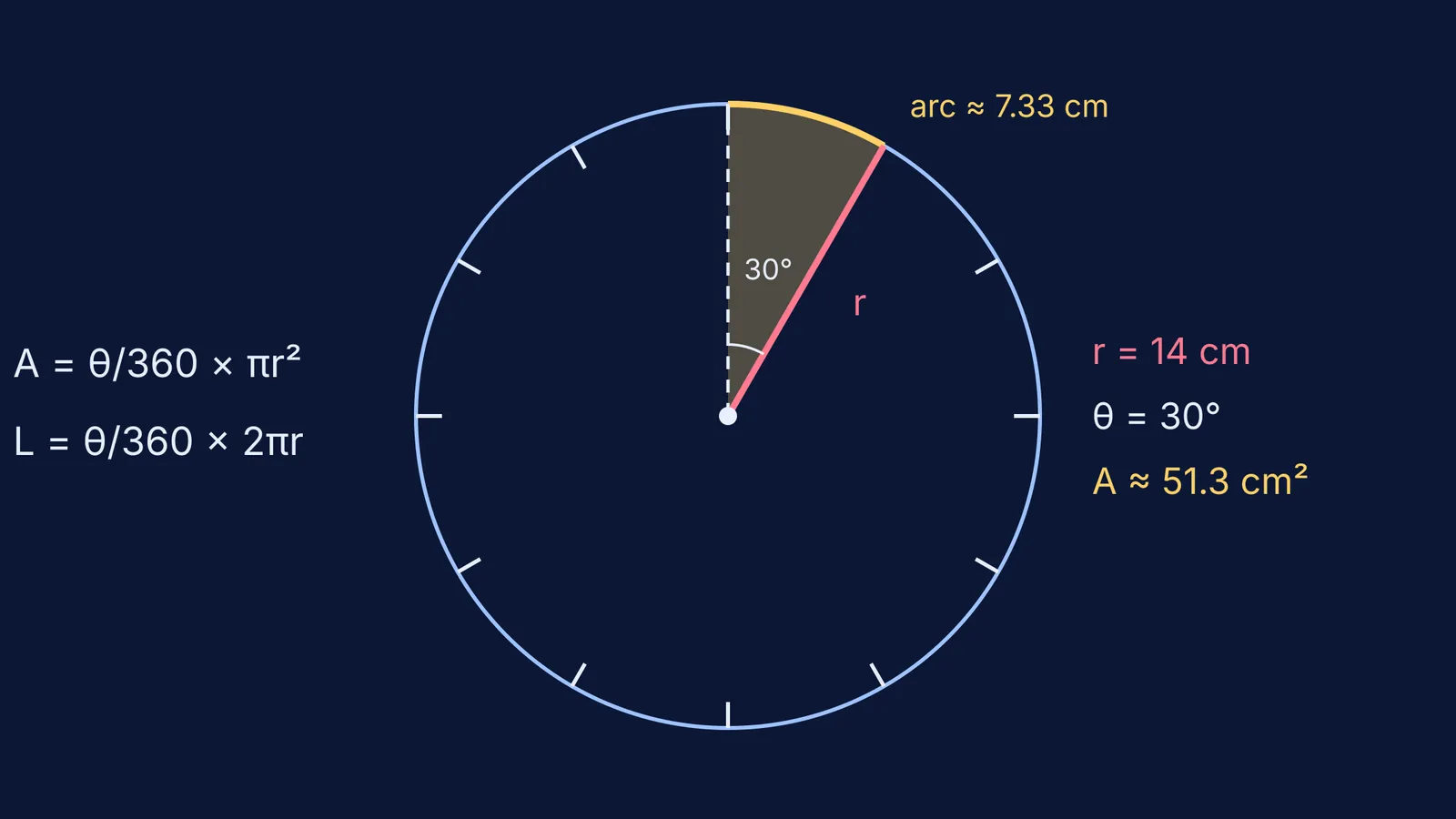
Exercise 11.1 in the NCERT chapter asks: the minute hand of a clock is 14 cm long; find the area it sweeps in 5 minutes.
Find the angle. The minute hand turns 360° in 60 minutes, which is 6° a minute. In 5 minutes it turns 30°.
Find the fraction. 30/360 = 1/12.
Area swept = 1/12 × 22/7 × 14 × 14 = 1/12 × 616 = 154/3 cm², about 51.33 cm².
If the question asks how far the tip travels, that is the arc: 1/12 × 2 × 22/7 × 14 = 22/3 cm, about 7.33 cm.
The hour hand is the trap: it turns 30° an hour, or 0.5° a minute, so in the same 5 minutes it turns only 2.5°. Ask which hand moves, and for how long.
How do you find the area cleaned by car wipers?
The same NCERT exercise has a car with two non-overlapping wipers, each with a 25 cm blade sweeping 115°. Find the total area cleaned in one sweep.
One wiper sweeps a sector with r = 25 cm and θ = 115°.
Two wipers that do not overlap clean twice that, so the total fraction is 2 × 115/360 = 23/36.
Total area = 23/36 × 22/7 × 25 × 25 = 158125/126 cm², about 1254.96 cm².
"Do not overlap" is what lets you simply double; overlapping sectors would count the shared part twice.
Should you use degrees or radians for arc length?
Class 10 works in degrees. In Class 11, the NCERT chapter Trigonometric Functions defines the radian: in a circle of radius r, an arc of length r subtends 1 radian at the centre. That chapter gives π radian = 180°, and for an angle θ in radians, arc length l = rθ.
Put θ in radians into the Class 10 formula and the 360 and the π cancel. θ/360 × 2πr becomes rθ, and θ/360 × πr² becomes ½r²θ. Check this with the clock: 30° is π/6 radian, so the arc is 14 × π/6 = 7π/3 cm, about 7.33 cm, and the area is ½ × 196 × π/6 = 49π/3 cm², about 51.3 cm². Same answers.
Never mix them: put π/6 into θ/360 and the clock's arc comes out at about 0.13 cm. A tiny answer usually means the wrong angle unit.
To see why the radian works, read what a radian is, shown by wrapping the radius round a circle; for unit conversion, degrees to radians, arc length and sector area, explained; and for where πr² comes from, how to derive the area of a circle with a definite integral.
A four-step checklist for any sector question
Angle: what is θ, in degrees or radians? For clocks, turn time into angle first.
Quantity: area (cm²) or length (cm)? Swept, cleaned and grazed usually mean area; distance travelled or length of wire means arc or perimeter.
Pieces: one sector, several equal ones (double for two wipers), or the major sector with angle 360° − θ?
Which π: NCERT's default is 22/7 unless the question says 3.14. Keep the answer as a fraction until the last line.
If you know the formulas but keep picking the wrong θ or the wrong quantity, the Fermi Problem Library has worked problems with a step-by-step solver that explains the reasoning rather than printing an answer. If the gap is the idea of a radian itself, the Fermi Concept Library gives each mathematics concept its own lesson.
Next, try question 5 from NCERT Exercise 11.1: a 60° arc in a circle of radius 21 cm. You should get an arc of 22 cm and a sector of 231 cm².


