

On this page
Arc length and sector area questions look easy. Marks usually go in two places: an angle left in degrees inside a radian formula, or a calculator still set to the wrong angle unit. Here is the method, two worked examples and a checklist that catches both slips.
How do you convert degrees to radians?
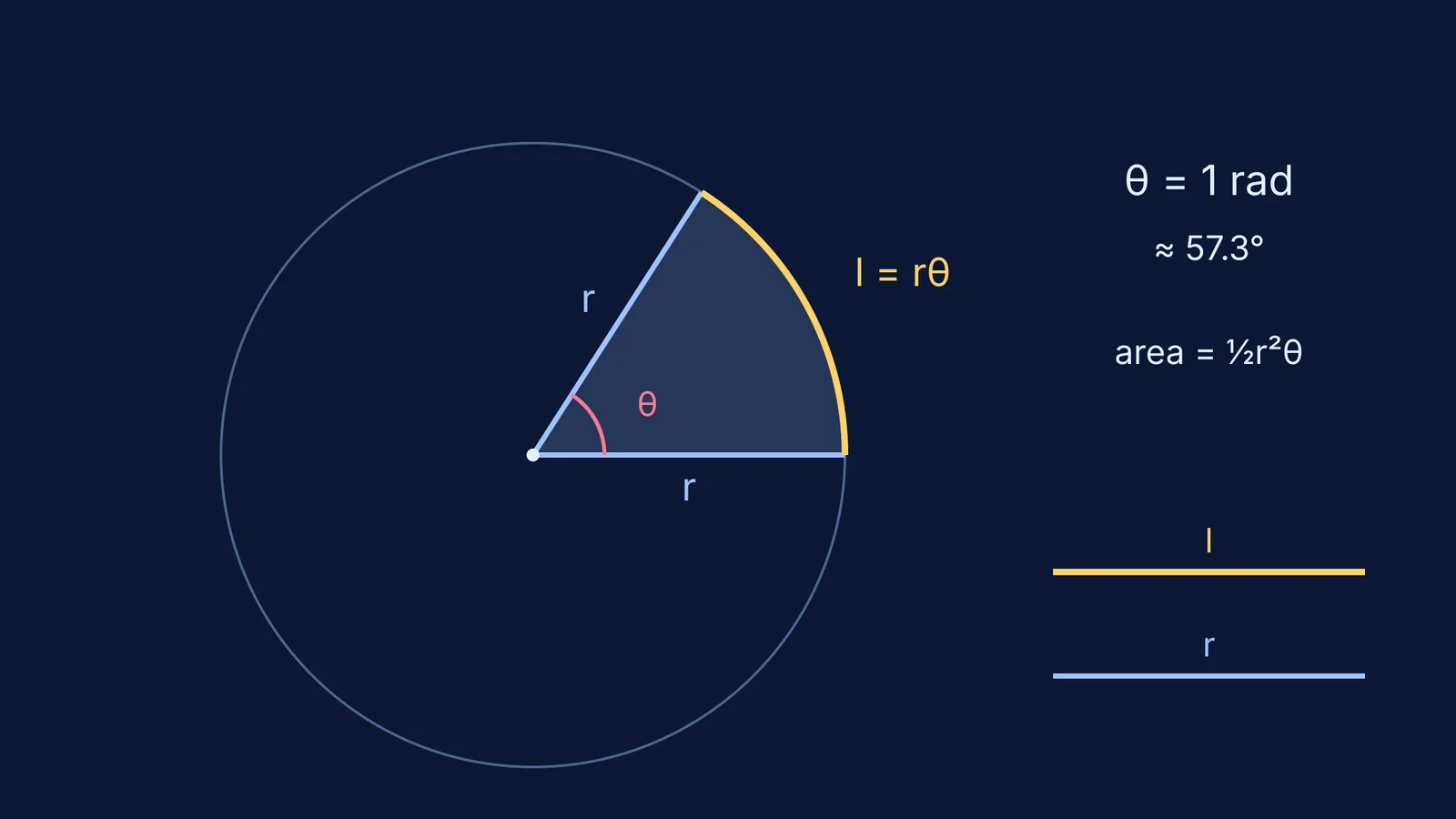
The NCERT Class 11 Mathematics textbook (Chapter 3, Trigonometric Functions) defines one radian as the angle at the centre subtended by an arc of length 1 unit in a circle of radius 1 unit.
A full turn is 2π radian = 360°, so π radian = 180°, according to the same NCERT chapter.
That gives the two conversion rules:
Radians = degrees × π/180
Degrees = radians × 180/π
The chapter also gives the approximate values: 1 radian ≈ 57° 16′, and 1° ≈ 0.01746 radian. So one radian is nearly 60°, a useful sense check.
Keep the common ones in your head: 30° = π/6, 45° = π/4, 60° = π/3, 90° = π/2, 180° = π. For minutes and seconds, see converting radians to degrees, minutes and seconds.
Why is arc length l = rθ?
In a circle of radius r, an arc of length r subtends 1 radian, so an arc of length l subtends l/r radian; that is, θ = l/r or l = rθ (NCERT, Chapter 3).
The sector area follows the same idea. A sector with angle θ is the fraction θ/2π of the whole circle, so its area is (θ/2π) × πr² = ½r²θ. OpenStax's Algebra and Trigonometry gives the same two formulas, s = rθ and A = ½θr², both with θ measured in radians, and warns that the sector-area formula only applies if θ is in radians.
Worked example: radius 6 cm, angle 60°
Find the arc length, the sector area and the area of the minor segment (the region between the chord and the arc).
Convert: θ = 60 × π/180 = π/3.
Arc length: l = rθ = 6 × π/3 = 2π ≈ 6.28 cm.
Sector area: ½r²θ = ½ × 36 × π/3 = 6π ≈ 18.85 cm².
Triangle formed by the two radii and the chord: ½r² sin θ = 18 × sin 60° ≈ 18 × 0.866 = 15.59 cm².
Segment = sector − triangle ≈ 18.85 − 15.59 = 3.26 cm².
Step 4 is where the calculator bites. If you type sin(π/3) while the calculator is in degree mode, it reads π/3 as 1.047 degrees and returns about 0.018. The triangle shrinks to 0.33 cm² and the segment comes out as 18.52 cm², almost the whole sector. Your method was right; the answer is wrong.
How far does a clock hand travel?
NCERT's own example asks how far the tip of a 1.5 cm minute hand moves in 40 minutes. The hand turns through 2/3 of a revolution, which is 4π/3 radian, so l = 1.5 × 4π/3 = 2π ≈ 6.28 cm (NCERT, Example 4).
Try one yourself: a 7 cm minute hand, 25 minutes.
The minute hand turns 360° in 60 minutes, so 6° per minute: 25 × 6° = 150°.
150° = 150 × π/180 = 5π/6 radian.
l = 7 × 5π/6 = 35π/6 ≈ 18.33 cm.
The hour hand turns 360° in 12 hours, which is 0.5° per minute. At 3:40 the minute hand is at 240° from 12 and the hour hand is at 90° + 40 × 0.5° = 110°, so the angle between them is 130°, or 13π/18 ≈ 2.27 radian. There is a full method for any time in finding the angle between clock hands.
Why does calculator mode turn right answers wrong?
Scientific calculators keep an angle-unit setting. Casio's fx-991CW user guide lists Degree, Radian and Gradian under Calc Settings > Angle Unit, with Degree as the initial default setting.
The setting only matters when a trig function is involved. l = rθ and ½r²θ are plain multiplication, so the calculator does not care, but sin, cos and tan do. In radian mode, sin 30 gives about −0.988, not 0.5. To see why sin 1 and sin 1° are so different, read sin 1 radian versus sin 1 degree.
A 30-second check before you press equals:
Check the angle-unit setting before the first trig question.
If the angle contains π, you want radian mode.
If the angle has a ° sign, you want degree mode.
Test it: sin 30 should be 0.5 in degree mode.
Sanity-check the size: a segment is always smaller than its sector.
If you want to practise this on real questions, the Fermi Problem Library has worked problems with a step-by-step solver that explains the reasoning rather than printing an answer, so you can see exactly where the angle gets converted. For the definitions behind radians and circular measure, start in the Fermi Concept Library.


