

On this page
When working with angles in mathematics and physics, you will often need to switch between radians and the traditional sexagesimal system of degrees, minutes, and seconds. While radians are the standard dimensionless unit in calculus and analysis, degrees and minutes remain common in astronomy, navigation, and many geometry problems.
This conversion is a standard part of the Class 11 mathematics syllabus, and it bridges the gap between pure mathematics and practical measurement. Here is how to perform the conversion accurately every time.
Why do we use radians instead of degrees?
Degrees are an arbitrary convention. A full circle is divided into 360 degrees, a choice that historical sources trace back to the ancient Babylonian numbering system and their approximately 360-day year (Wikipedia)). While 360 is highly divisible and easy to work with in basic geometry, it has no fundamental mathematical significance.
Radians, on the other hand, connect an angle directly to the arc length it subtends on a circle. One radian is defined as the angle made when the arc length equals the radius of the circle. This natural, dimensionless definition means that trigonometric derivatives and series behave cleanly without extra constant factors. For instance, the calculus limit of (sin θ)/θ as θ approaches zero is exactly 1 only when θ is measured in radians.
How to convert radians to degrees?
The conversion relies on the fundamental relationship that a full circle (360°) is equal to 2π radians (Wikipedia). Therefore, to convert any radian value to degrees, you multiply it by 180/π.
For example, 1 radian = 180/π degrees, which is approximately 57.2958° (Wikipedia)).
If the problem provides π in the radian measure (like π/6 radians), the π terms will cancel out nicely during the multiplication. However, if the radian measure is a pure number or a fraction like 11/16, you will typically use the approximation π ≈ 22/7 and be left with a decimal or fractional degree.
How do you split decimal degrees into minutes and seconds?
When your degree measure is not a whole number, you must break the fractional part down into minutes and seconds (Wikipedia)). The mathematical relationship is:
1° = 60' (arcminutes)
1' = 60'' (arcseconds)
The step-by-step process is:
Extract whole degrees: The integer part of your decimal degree is the degree (°) value.
Find the minutes: Multiply the remaining decimal by 60. The integer part of this new number is the minute (') value.
Find the seconds: Take any remaining decimal from the minutes calculation and multiply it by 60. The result is the second ('') value.
What are common mistakes in angular conversion?
The most common trap students fall into is confusing decimal notation with sexagesimal notation. For example, an angle of 39.5° is not 39 degrees and 50 minutes. Because there are 60 minutes in a degree, 0.5 degrees is exactly half a degree, which equals 30 minutes. Always remember to multiply the decimal part by 60 rather than simply reading the numbers after the decimal point.
Another mistake happens during early calculation steps. Always cancel common factors like 11, 22, and multiples of 10 as early as possible. Multiplying large numbers out (such as 11 × 180 × 7 = 13860) before dividing increases the chance of arithmetic errors.
The NCERT 11/16 radian example, solved step by step
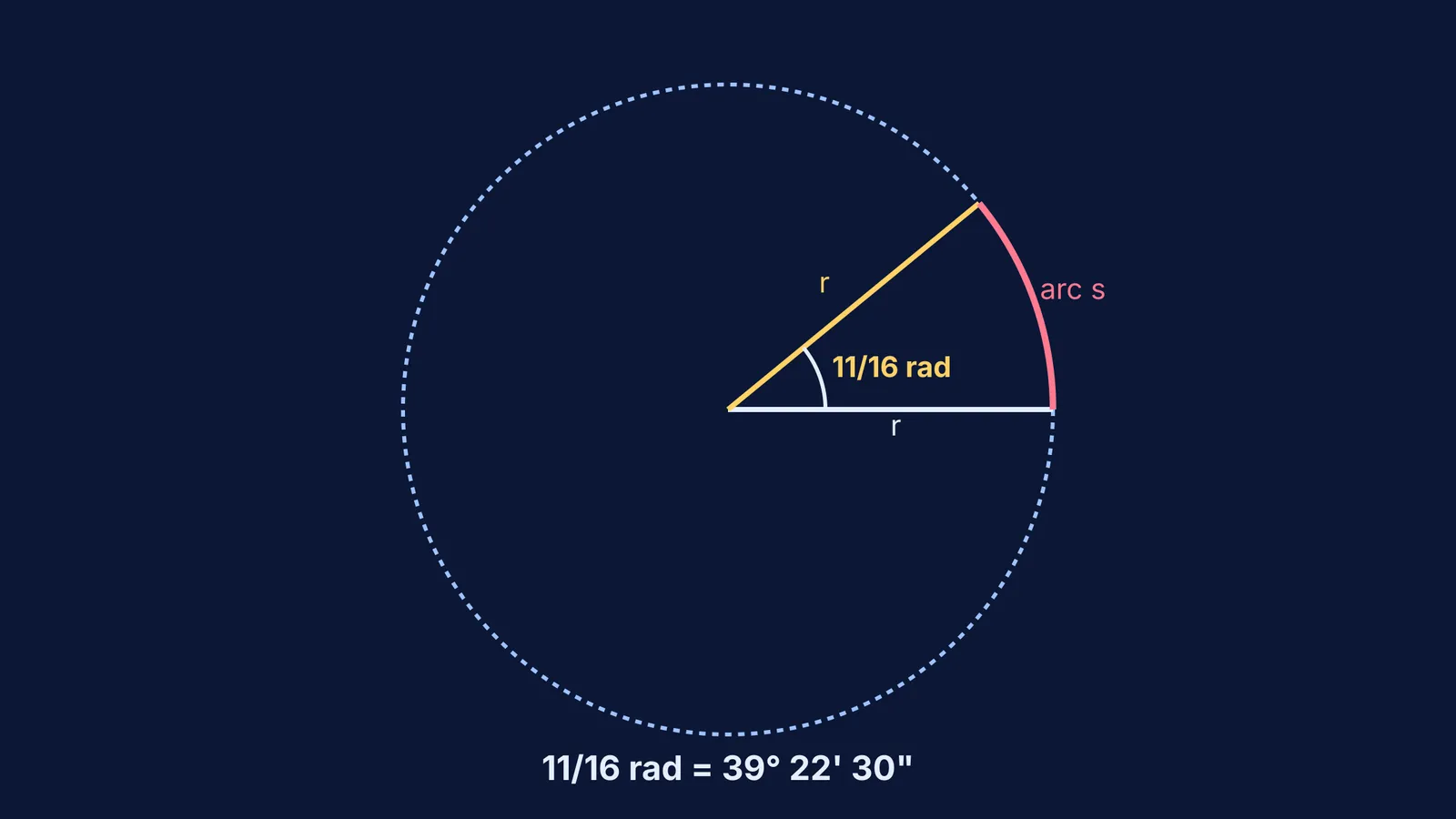
The NCERT Class 11 Mathematics textbook includes a classic problem: convert 11/16 radians into degree measure, using π = 22/7.
Step 1: Multiply by 180/π Degrees = 11/16 × 180/π Substitute π = 22/7: Degrees = 11/16 × 180 × 7/22
Step 2: Simplify the expression Cancel 11 and 22 to leave 2 in the denominator: = 1/16 × 180 × 7/2 Cancel 180 and 2 to leave 90 in the numerator: = (90 × 7) / 16 = 630 / 16 = 315 / 8 Dividing 315 by 8 gives 39.375°.
Step 3: Convert the decimal to minutes and seconds
Degrees: The whole number is 39°.
Minutes: Multiply the decimal remainder (0.375) by 60.
0.375 × 60 = 22.5'. The whole number is 22'.
Seconds: Multiply the new decimal remainder (0.5) by 60.
0.5 × 60 = 30''.
Combining these parts, 11/16 radians is exactly 39° 22' 30''.
If you find yourself frequently stuck on the algebraic steps of such conversions, the Fermi Concept Library holds every concept in physics, chemistry, biology, mathematics and computing, each with its own lesson and its place in the map. For further reading, see Trigonometric ratios of allied angles in Class 11: the ASTC rule or SHM and the reference circle: finding phase and time quickly to see how radians simplify physics calculations. When you need guided practice, the Fermi Problem Library offers worked problems with a step-by-step solver that explains the reasoning rather than printing an answer.


