

On this page
How do you set up the definite integral for a circle?
The equation of a circle centred at the origin with radius r is: x² + y² = r²
To find the exact area using integration, you first need y as a function of x. Solving for y gives: y = ±√(r² - x²)
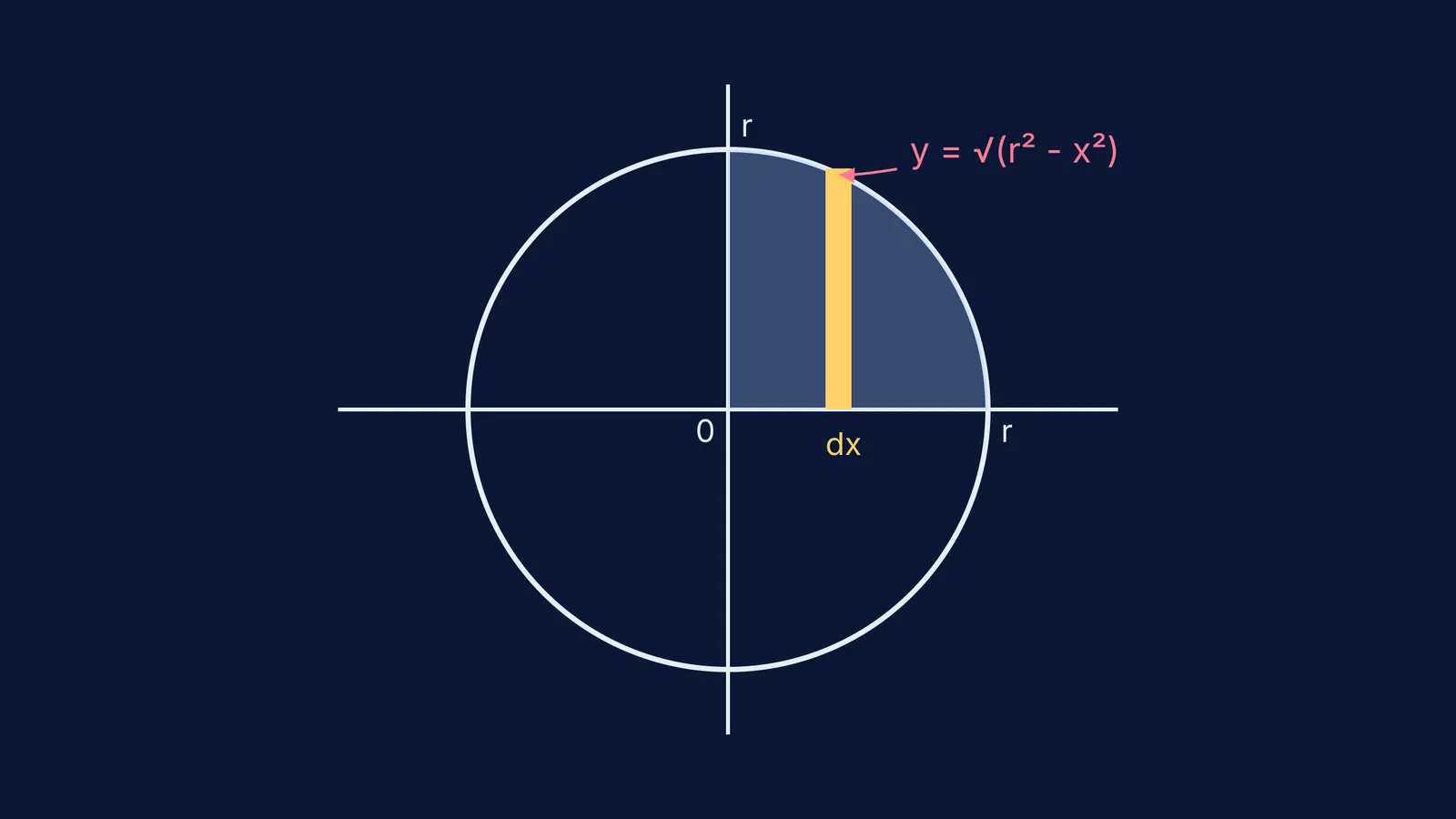
The positive root, y = √(r² - x²), represents the top half of the circle. The negative root represents the bottom half. If you want to find the area of the entire circle, it is easiest to look at just one quarter of it—the top-right section (the first quadrant) where the x-value goes from 0 to r.
As Archimedes first proved with his method of polygons, the area enclosed by a circle of radius r is always πr² (Wikipedia). We can derive this standard formula directly by summing the areas of vertical rectangles in that first quadrant. Each rectangle has a height of y and a tiny width of dx.
How do you integrate √(r² - x²) from 0 to r?
The area of the top-right quarter of the circle is the definite integral of √(r² - x²) from the lower limit x = 0 to the upper limit x = r: Quarter Area = ∫ √(r² - x²) dx (from 0 to r)
To evaluate this integral, you use the standard formula for radicals: ∫ √(a² - x²) dx = (x/2)√(a² - x²) + (a²/2) arcsin(x/a)
In our specific case, the constant a is the radius r. Substitute r for a: ∫ √(r² - x²) dx = (x/2)√(r² - x²) + (r²/2) arcsin(x/r)
Now, apply the limits of integration (from 0 to r).
First, substitute the upper limit (x = r): (r/2)√(r² - r²) + (r²/2) arcsin(r/r) = (r/2)(0) + (r²/2) arcsin(1)
Since arcsin(1) is the angle whose sine is 1, which is exactly π/2: = 0 + (r²/2) × (π/2) = πr²/4
Next, substitute the lower limit (x = 0): (0/2)√(r² - 0²) + (r²/2) arcsin(0/r) = 0 + (r²/2)(0) = 0
Subtract the lower limit result from the upper limit result: Quarter Area = πr²/4 - 0 = πr²/4
Why do you multiply the integral by 4?
The definite integral from 0 to r only calculates the area under the curve y = √(r² - x²) strictly in the first quadrant. Because a perfect circle is symmetrical across both the x-axis and y-axis, it is divided into four completely equal quadrants.
To get the total area of the circle, you simply multiply the area of this one isolated quarter by 4: Total Area = 4 × (πr²/4) = πr²
This simple multiplication gives you the final area formula. If you try to integrate from -r to r instead, you would get a full semicircle (πr²/2) and only need to multiply that result by 2. This concept is identical to finding the Area of an Ellipse by Integration Explained, where symmetry also lets you calculate just one quadrant and multiply by 4.
How do you use symmetry in integration?
When calculating areas of symmetric shapes like circles or ellipses, using symmetry saves precious time and reduces calculation errors. Follow this straightforward checklist to correctly set up your definite integral:
Identify the axes of symmetry (the x-axis, y-axis, or both).
Choose the simplest quadrant (usually the first quadrant where both x and y are positive).
Set your lower limit to 0 and your upper limit to the maximum x-value.
Integrate to find the exact area of that single symmetric section.
Multiply by the total number of identical sections (4 for a full circle, 2 for a semicircle).
If you struggle with setting up limits or deciding which specific quadrant to integrate, the Fermi Concept Library can help you build a solid foundation in calculus. Fermi's AI tutor can work out what you already know and build a plan for the session, so you sit down to a clear next step instead of staring at a blank page. You can even ask it to explain advanced tools, such as how Integration by parts visualised as the area of a rectangle works in practice.


