

On this page
In standard calculus problems for university exams, finding the area of an ellipse is a classic exercise. Memorizing the final formula is easy, but solving it step-by-step builds fundamental mathematical skills that translate to complex physics and engineering problems. This active practice is critical, as a landmark study in the *Proceedings of the National Academy of Sciences* found that failure rates under traditional, passive lecturing increase by 55% compared to active learning methods (10.1073/pnas.1319030111). Taking out a pen and calculating the integral yourself is the active practice you need to truly understand the geometry.
How do you find the area of an ellipse by integration?
The standard equation of an ellipse centered at the origin is $(x^2/a^2) + (y^2/b^2) = 1$, where $a$ is the semi-major axis and $b$ is the semi-minor axis.
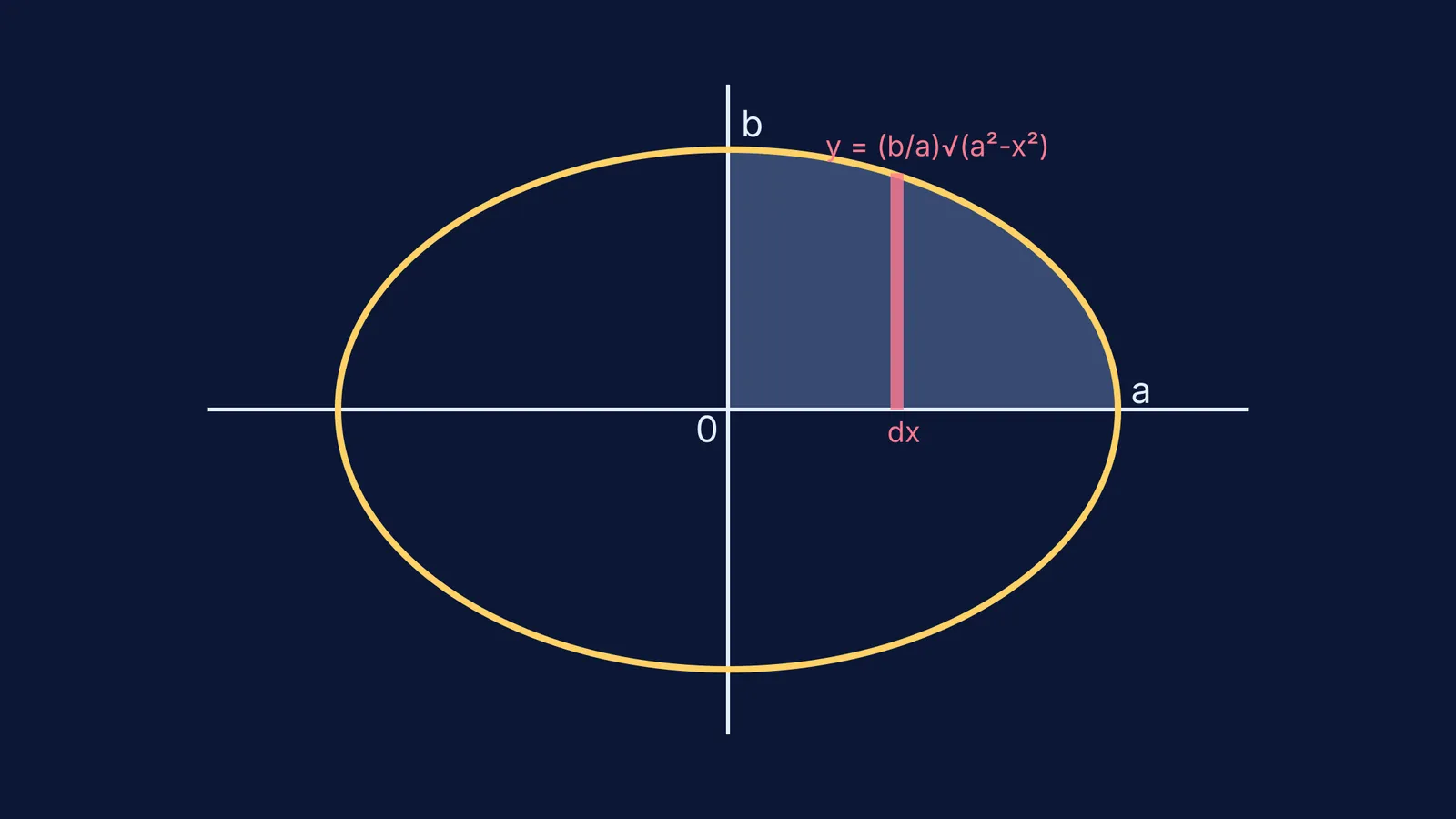
To find the area using integration, we first isolate $y$ to get the equation of the upper boundary curve. This turns the algebraic equation into a function that we can graph and measure.
$y^2 / b^2 = 1 - (x^2 / a^2)$
$y = (b/a)\sqrt{a^2 - x^2}$
This function gives the height of the ellipse at any horizontal point $x$. We can find the area of the top-right quarter of the ellipse (the first quadrant) by integrating this function from $x = 0$ to $x = a$.
Why do we multiply by 4 in the integration?
An ellipse is perfectly symmetrical across both the x-axis and the y-axis. This four-fold symmetry is a powerful tool in calculus. The integral from $0$ to $a$ only gives us the area of the top-right section, or the first quadrant. To find the total area of the ellipse, we take this single quadrant's area and multiply it by 4. This is much simpler than trying to integrate the entire shape at once, which would involve managing positive and negative bounds simultaneously.
Total Area = $4 \times \int_{0}^{a} (b/a)\sqrt{a^2 - x^2} \, dx$
We can pull the constant $(b/a)$ outside the integral:
Total Area = $4(b/a) \int_{0}^{a} \sqrt{a^2 - x^2} \, dx$
Now, apply the standard integration formula for $\sqrt{a^2 - x^2}$:
$\int \sqrt{a^2 - x^2} \, dx = (x/2)\sqrt{a^2 - x^2} + (a^2/2)\sin^{-1}(x/a)$
Evaluating this from $0$ to $a$:
At the upper limit ($x = a$): $(a/2)\sqrt{a^2 - a^2} + (a^2/2)\sin^{-1}(1) = 0 + (a^2/2)(\pi/2) = \pi a^2 / 4$.
At the lower limit ($x = 0$): The entire expression evaluates to $0$.
Subtract the lower limit result from the upper limit result to get the area of one quadrant, which is $\pi a^2 / 4$.
Finally, multiply by the constant outside the integral:
Total Area = $4(b/a) \times (\pi a^2 / 4) = \pi a b$.
How does this compare to the area of a circle?
The circle is just a special case of an ellipse. In a circle, the horizontal radius ($a$) and the vertical radius ($b$) are exactly the same size ($a = b = r$).
If you substitute $r$ for both $a$ and $b$ in the ellipse area formula ($\pi a b$), you get $\pi r r$, which simplifies perfectly to $\pi r^2$. This symmetry check is a great way to verify your integration answer during an exam. To explore more mathematical derivations, you can use Fermi concept library.
What is an active practice plan for integration?
Reading the derivation above is just the first step. To make it stick and avoid the passivity trap, use this active learning sequence:
Derive from memory: Close this page and write down the standard equation of the ellipse. Try to isolate $y$ and set up the integral without looking.
Shift the center: Re-calculate the area by shifting the ellipse so its center is at $(h, k)$. Does the area change? The area should still be $\pi a b$, though the integral setup requires a substitution step.
Integrate along the y-axis: Instead of integrating with respect to $x$, rewrite the equation as $x = (a/b)\sqrt{b^2 - y^2}$ and integrate with respect to $y$ from $0$ to $b$. You should arrive at the exact same answer, proving that the math holds up regardless of your perspective.
By actively engaging with the math, you build the resilient problem-solving skills needed for advanced exams.


