On this page
Here are the key terms of "Measuring Space: Perimeter and Area", Chapter 6 of NCERT's Class 9 Ganita Manjari Part I, in chapter order, each with an example. For worked sums, see our Measuring Space Class 9 chapter guide.
What is the difference between perimeter and circumference?
Perimeter: the full distance you cover walking once round the edge of a shape. Example: a rectangle with sides 5 cm and 3 cm has perimeter 2(5 + 3) = 16 cm. Don't confuse with: area. A 10 × 10 and a 15 × 5 rectangle both have perimeter 40 but areas 100 and 75.
Circumference: a circle's perimeter. Example: radius 7 cm gives 2 × 22/7 × 7 = 44 cm.
Radius and diameter: centre to circle is r; across through the centre is d = 2r.
C/D ratio: circumference divided by diameter. The chapter shows it is the same for circles of every size (NCERT Chapter 6).
π (pi): the C/D ratio, so C = πd = 2πr. Example: Āryabhaṭa used 3.1416 and called it asanna, "approaching" (NCERT Chapter 6).
Stagger: the gap between starting points of neighbouring lanes, since outer bends have larger radii. Example: lanes on the chapter's 400 m track are 1.22 m wide, so each semicircular bend is π × 1.22 ≈ 3.83 m longer one lane out.
Is π equal to 22/7?
No. π is close to 22/7 but not equal to it, so you write π ≈ 22/7 and π ≠ 22/7 (NCERT Chapter 6).
Rational number: a number that can be written as a/b, where a and b are integers and b ≠ 0. Example: 1.4 = 7/5.
Irrational number: a number with no a/b form using integers a and b. Example: π and √2; their decimals never end and never repeat.
Approximation: a value near the true one (≈). Example: Zu Chongzhi's 355/113 beats 22/7.
Infinite series: a never-ending sum. Example: Mādhava's exact π/4 = 1 − 1/3 + 1/5 − 1/7 + ...
What is the difference between a sector and a segment?
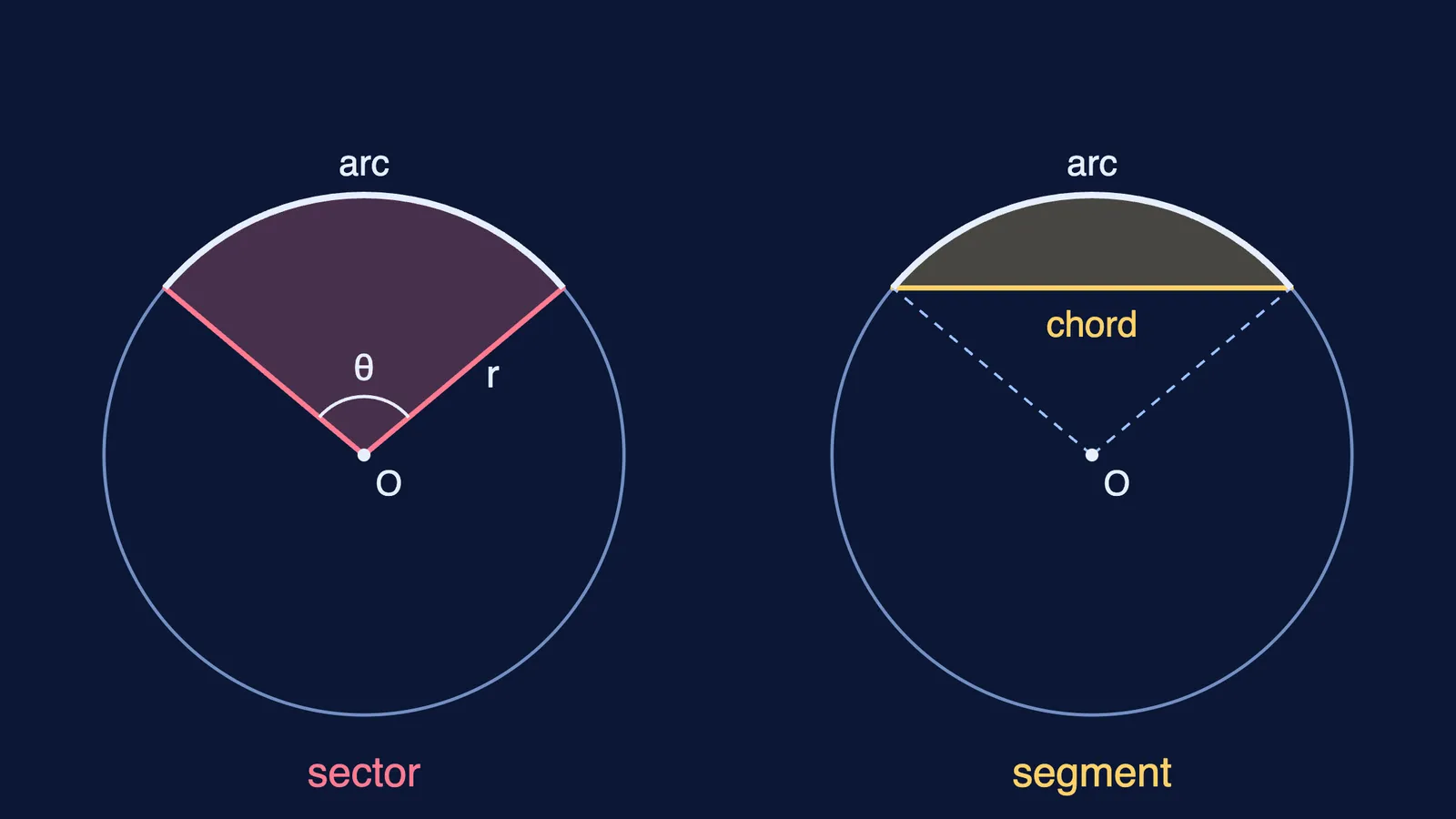
Arc: a piece of a circle between two points on it. Example: a semicircle.
Central angle (angle subtended): the angle θ an arc makes at the centre. Example: a quarter circle subtends 90°.
Arc length: l = 2πr × θ/360°. Example: radius 6 cm and θ = 60° gives 2π × 6 × 60/360 = 2π ≈ 6.28 cm.
Sector: the slice of a disc cut off by two radii and the arc between them, with area πr² × θ/360°. Example: a quadrant of radius 7 cm has area 154 ÷ 4 = 38.5 cm².
Chord: a straight line joining two points of a circle, such as a diameter.
Segment: the part of a disc lying between a chord and the arc it cuts off. Example: r = 10 cm, θ = 90° gives sector 78.5 cm² (π ≈ 3.14) minus triangle 50 cm² = 28.5 cm². Don't confuse with: a sector, which is bounded by radii, not by a chord.
Which area words come before Heron's formula?
Area: the amount of space a flat region takes up. Example: an a × b rectangle has area ab sq. units.
Square unit: the unit of area, the area of a 1 × 1 square, written 1 unit² or 1 sq. unit.
Base and height: height is the perpendicular distance to the base, not a slanted side. Example: a parallelogram with base 8 cm and height 5 cm has area 40 cm².
Median: a line segment drawn from one corner of a triangle to the middle of the side facing it. Example: a triangle of base 10 cm and height 6 cm has area ½ × 10 × 6 = 30 cm², and the median to that base splits it into two 15 cm² triangles. Don't confuse with: the height, which is perpendicular to the base.
Semi-perimeter: half the perimeter, s = (a + b + c)/2. Example: sides 13, 14, 15 give s = 21.
Heron's formula: area = √[s(s − a)(s − b)(s − c)] (NCERT Chapter 6). Example: √(21 × 8 × 7 × 6) = √7056 = 84 sq. units.
Circumcircle and incircle: the circle through all three vertices (radius R) and the circle inside touching all three sides (radius r). Example: for a 3-4-5 triangle, R = 2.5 and r = 1; abc/4R and r(a + b + c)/2 both give area 6.
Cyclic 4-gon: a four-sided figure with all four vertices on one circle. Example: any rectangle.
Brahmagupta's formula: for a cyclic 4-gon with sides a, b, c, d and s = (a + b + c + d)/2, area = √[(s − a)(s − b)(s − c)(s − d)]. Example: a 3 × 4 rectangle gives √(4 × 3 × 4 × 3) = 12.
What do special case, generalisation and squaring mean?
Special case: a general result with an extra condition added. Example: put d = 0 in Brahmagupta's formula and you get Heron's formula.
Generalisation: the broader result containing a special case. Example: 2(a + b) for rectangles generalises 4a for squares.
Squaring a shape: constructing a square of equal area. Example: Baudhāyana's Śhulbasūtra method squares a 9 × 4 rectangle into a square of side 6, since ((9 + 4)/2)² − ((9 − 4)/2)² = 42.25 − 6.25 = 36.
Area of a circle: A = πr², which equals ½ × circumference × radius. Example: radius 7 cm gives 22/7 × 49 = 154 cm².
The CBSE 2026-27 Class IX Mathematics curriculum lists perimeter of a circle, π and its irrationality, arc length, Heron's formula, squaring a rectangle, area of a circle and of a sector, and Brahmagupta's formula under Mensuration: Area and Perimeter.
How to learn these terms
Draw a circle; shade a sector and a segment in two colours and label arc, chord, radius and θ.
Arc length and sector area are θ/360° of 2πr and πr².
Quiz yourself on the pairs: perimeter or area, sector or segment, median or height, ≈ or =.
If an idea stays fuzzy, the Fermi Concept Library explains each mathematics concept; for algebra slips, see common algebra mistakes and 10-second checks.