On this page
Chapter 7 of Exploration, NCERT's new Class 9 Science textbook, uses everyday words like work, energy, power, load and effort with exact meanings. Each term below is in our own words, with an example and, where students slip, a "Don't confuse with" note. For the full walk-through, read our Work, Energy and Simple Machines Class 9 chapter guide.
What does work mean in physics?
Work: what a force does when the object it acts on moves along the force; for a constant force, W = F × s. Only movement in the direction of the force counts. Example: lifting a 20 N bag by 1.5 m is 30 J of work. Don't confuse with: feeling tired. Pushing a wall that does not move is zero work.
Joule (J): the SI unit of work; 1 J = 1 N × 1 m.
Zero work: no force, no movement, or force at right angles to the movement. Example: holding a box up while walking.
Positive work: force and displacement point the same way. Example: pushing a wheelchair forward.
Negative work: force points opposite to the displacement. Example: a goalkeeper stopping a ball.
Force-displacement graph: the area under it equals the work, even when the force changes.
What is the work-energy theorem?
Energy: an object's capacity to do work; it has the same SI unit as work, the joule (J).
Work-energy theorem: the change in the energy of an object (or of a system of objects) is equal to the work done on it. Example: a throw does positive work on a ball, so the ball gains energy it can pass to the wicket.
Forms of energy: mechanical, thermal, light, sound, electrical, nuclear and chemical.
Energy conversion: energy changing form. Example: a bulb turns electrical energy into light.
What are kinetic, potential and mechanical energy?
Mechanical energy: kinetic plus potential energy.
Kinetic energy (K): energy of motion, K = ½mv². Example: a 50 kg cyclist at 4 m/s has 400 J; double the speed and it becomes four times bigger.
Potential energy: energy stored because of shape (a bent bow, a compressed spring) or the positions of objects in a system.
System of objects: objects that interact through forces, treated together, like the Earth and a lifted ball.
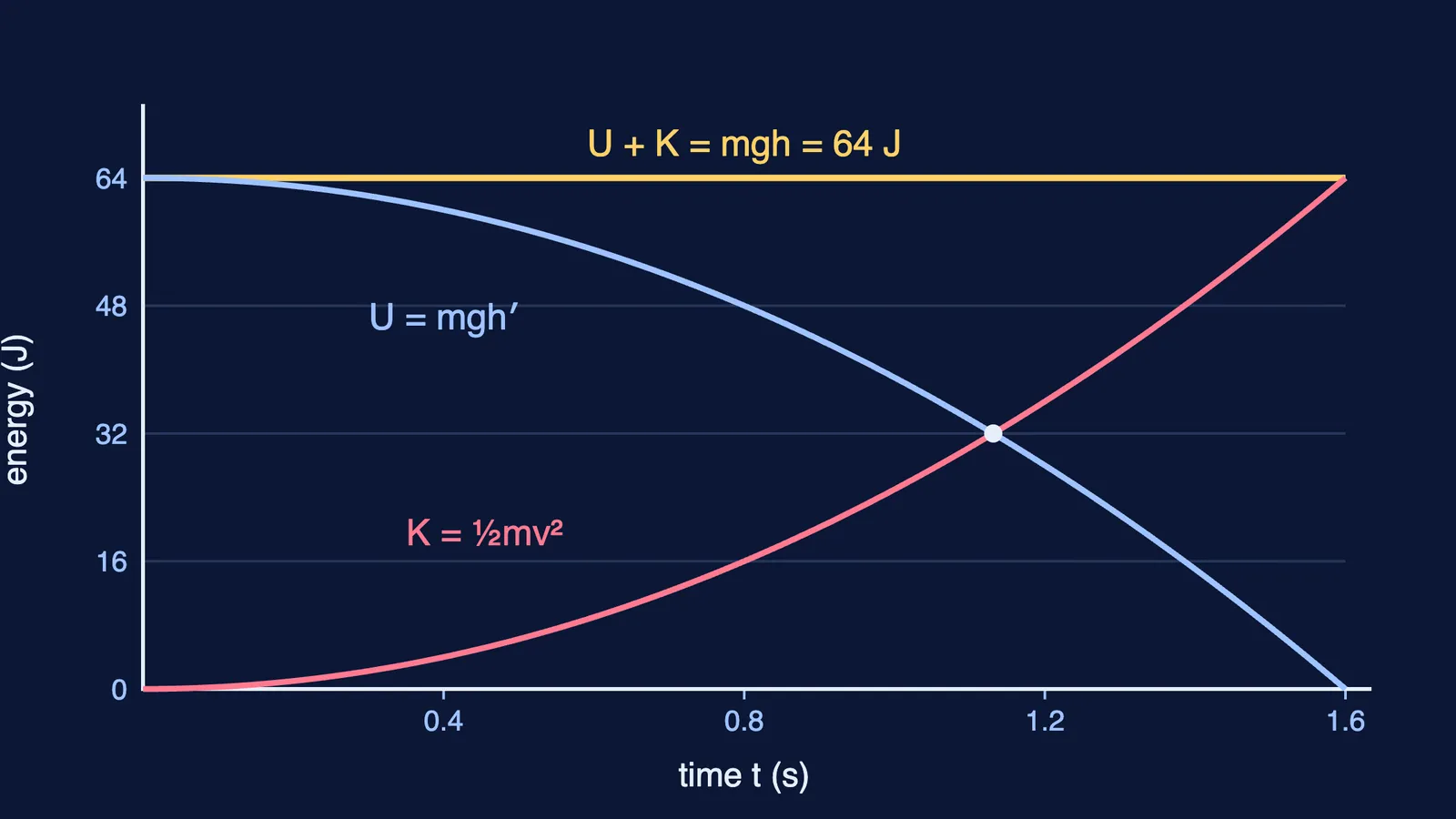
Gravitational potential energy (U): U = mgh near the Earth's surface. Example: a 2 kg bag on a 1.5 m shelf has 30 J (g = 10 m/s²). Don't confuse with: kinetic energy. A ball held still up high has potential energy but no kinetic energy.
Free fall: falling under gravity alone, as potential energy turns into kinetic energy.
Conservation of mechanical energy: when gravity is the only force doing work on an object, K + U stays the same. Example: on a frictionless slide of height h, a child reaches speed √(2gh), whatever the slide's shape or the child's mass.
Simple pendulum: a bob on a string; at the extreme points it has only potential energy, at the lowest point only kinetic energy. Air resistance and friction at the support make a real one slowly stop.
Conservation of energy: the total energy of a system with no external forces stays constant, though it may change form. Don't confuse with: conservation of mechanical energy, which holds only when forces such as friction can be ignored.
What is power, and how is it different from energy?
Power: the rate of doing work; average power P = W ÷ t. Example: 600 J in 3 s is 200 W. Don't confuse with: energy. Running and walking up the same stairs take the same work but different power.
Watt (W): the SI unit of power, 1 joule per second. Don't confuse with: the symbol W for work.
Horsepower (hp): an older unit for engines and pumps; the NCERT chapter gives 1 hp as 746 W.
Simple machines: load, effort and mechanical advantage
Simple machine: a device that makes a task easier by changing the size or direction of the force needed. It cannot reduce the total work.
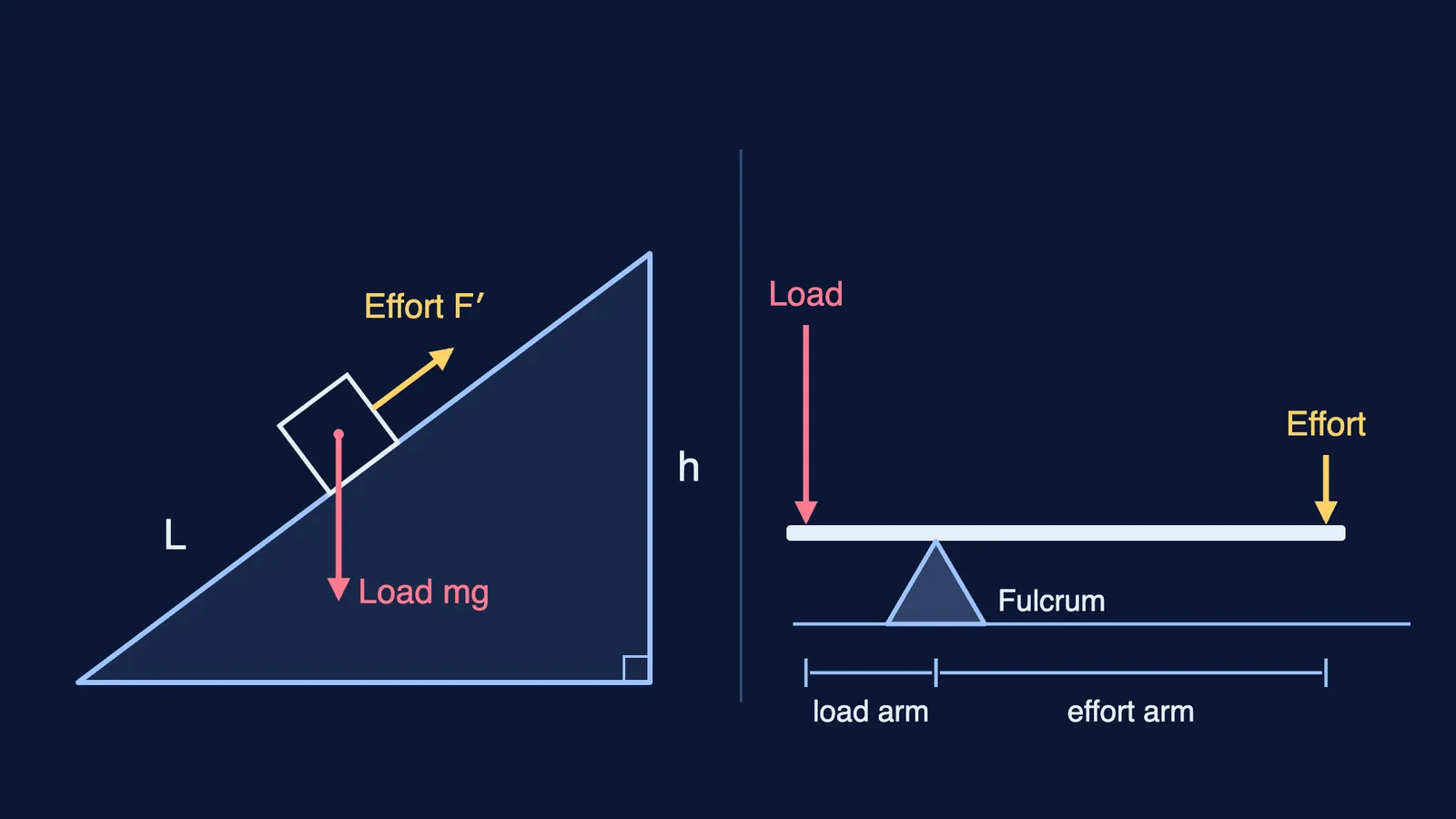
Effort: the force you apply to the machine.
Load: the force the machine must overcome, often a weight.
Mechanical advantage (M.A.): load ÷ effort, a number with no unit.
Fixed pulley: a wheel with a rope running in its grooved rim, fixed in place; it only changes the direction of the force, so M.A. = 1. Example: raising a flag by pulling down.
Movable pulley: a pulley that rises with the load; a system of pulleys can give M.A. above 1 (a "Ready to Go Beyond" idea).
Inclined plane: a slope for moving a heavy load up (or down) to another level; ignoring friction, M.A. = L ÷ h. Example: a 3 m ramp to a 1 m platform has M.A. = 3.
Lever: a rigid bar that turns about a fixed point.
Fulcrum: that fixed point, like the middle of a seesaw.
Effort arm and load arm: the distances of the effort and the load from the fulcrum. At balance, effort × effort arm = load × load arm, so M.A. = effort arm ÷ load arm. Example: arms of 1.2 m and 0.3 m give M.A. = 4.
Classes of levers: Class I, II or III, by whether the fulcrum, load or effort is in the middle (a "Ready to Go Beyond" idea).
Perpetual motion machine: an imagined machine that works forever without fuel; friction makes every real machine slow down, so none works.
Not in this chapter: work when force and movement are at an angle, which the book leaves for higher grades.
How to learn these terms
Learn in pairs: positive and negative work, kinetic and potential energy, load and effort, energy and power.
Draw a pendulum and mark where its energy is all potential and where it is all kinetic.
Find a lever, a ramp and a pulley at home, and name the load and the effort in each.
If one idea still feels shaky, the Fermi Concept Library has every concept in physics, chemistry, biology, mathematics and computing, each with its own lesson. Later, these terms grow into our Class 11 Work, Energy and Power notes and solved numericals.