

On this page
Molecular mass is only addition, but subscripts, brackets and the dot in a hydrate each change what you add. Here is one method for every Class 9 formula, worked on three that often cost marks.
What is molecular mass, and what unit does it use?
The molecular mass of a substance is the sum of the atomic masses of all the atoms in one molecule of it, written in atomic mass units (u). For ionic compounds such as Ca(OH)2 the same sum is called the formula unit mass; the method is identical. Our explainer on molecular mass vs formula unit mass covers when to use which name.
The atomic masses come from the standard atomic weights set by the Commission on Isotopic Abundances and Atomic Weights. Its abridged table of standard atomic weights lists hydrogen as 1.0080, oxygen as 15.999, sulfur as 32.06, calcium as 40.078 and copper as 63.546. School problems round these to H = 1, O = 16, S = 32, Ca = 40 and Cu = 63.5 u. If your question paper prints atomic masses, always use those.
How do you calculate molecular mass step by step?
Write the formula and list every element in it.
Count the atoms of each element, expanding any brackets first.
Multiply each count by that element's atomic mass.
Add the products and write the unit u.
Read the formula back and check that every count matches.
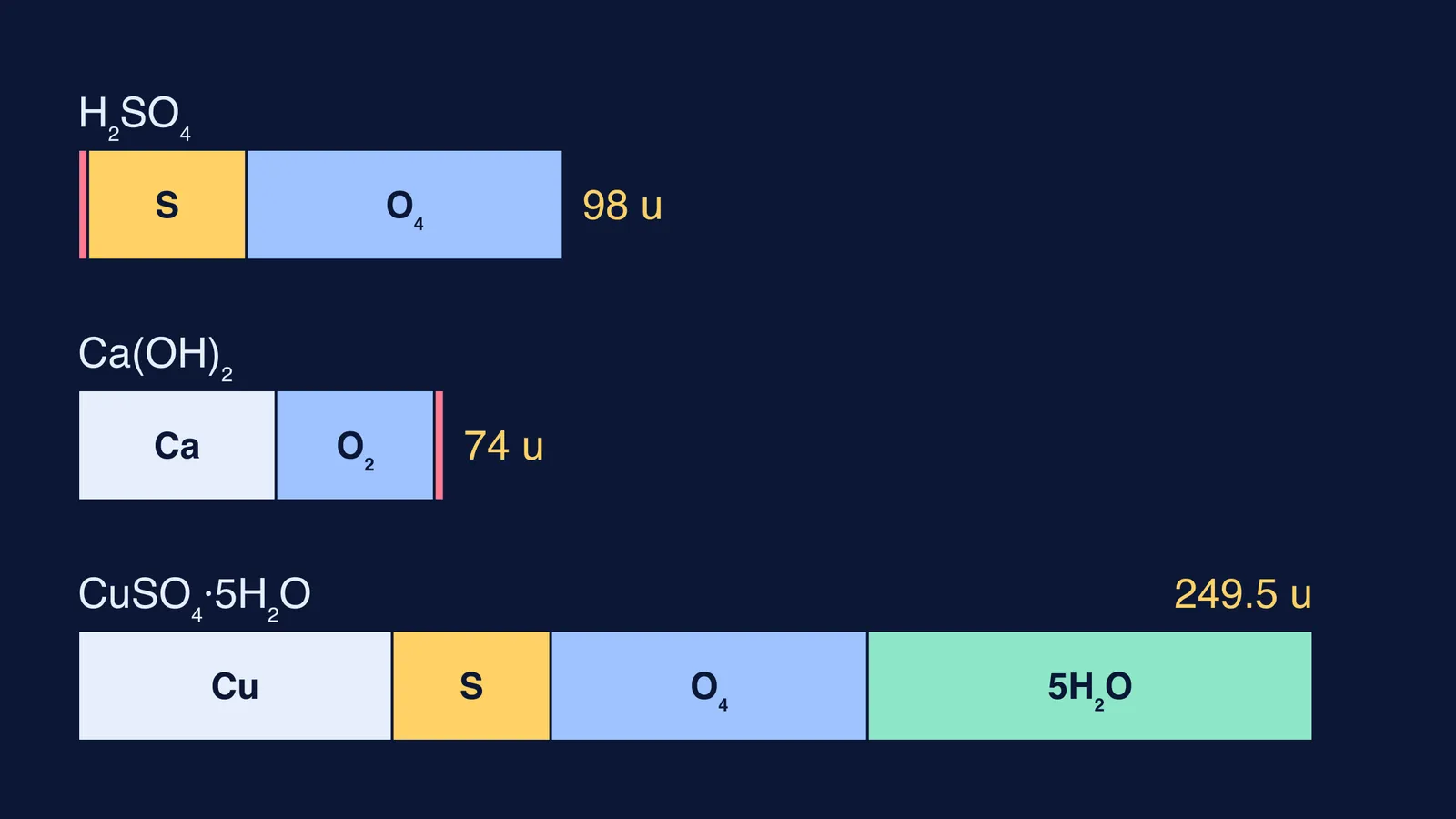
How do you find the molecular mass of H2SO4?
Sulfuric acid has 2 H atoms, 1 S atom and 4 O atoms.
H: 2 × 1 = 2
S: 1 × 32 = 32
O: 4 × 16 = 64
Molecular mass of H2SO4 = 2 + 32 + 64 = 98 u.
The usual slip is reading SO4 as four sulfur-oxygen pairs, which gives 2 + 4 × (32 + 16) = 194. The 4 belongs to O alone.
How do you handle brackets in Ca(OH)2?
The 2 outside the bracket doubles both O and H, so calcium hydroxide has 1 Ca, 2 O and 2 H.
Ca: 1 × 40 = 40
O: 2 × 16 = 32
H: 2 × 1 = 2
Formula unit mass of Ca(OH)2 = 40 + 32 + 2 = 74 u.
A faster way to see it: one OH group is 16 + 1 = 17, two of them make 34, and 40 + 34 = 74. If you got 57, you counted only one OH group. If you got 58, you copied the formula as CaOH2 and doubled only the H. Our guide on writing chemical formulas using valency shows where the bracket comes from.
What does the dot in CuSO4.5H2O mean?
CuSO4·5H2O (often typed CuSO4.5H2O) is copper sulfate pentahydrate, the blue crystals in the school lab. The dot joins the salt to its water of crystallisation: five water molecules per CuSO4 unit. It is not a decimal point or a multiplication sign.
CuSO4: 63.5 + 32 + (4 × 16) = 63.5 + 32 + 64 = 159.5 u
5H2O: one H2O is (2 × 1) + 16 = 18 u, so five are 5 × 18 = 90 u
Add: 159.5 + 90 = 249.5 u
Two wrong answers turn up often: 177.5 u, from adding one water instead of five, and 182.5 u, from adding 5 + 18 instead of multiplying 5 × 18. The same sum is the starting point for heating problems, which our walk-through on finding x in a hydrate from mass-loss data works through.
How can you check your answer?
Compare with a reference database. PubChem, run by the US National Library of Medicine, gives molecular weights of 98.08 g/mol for sulfuric acid, 74.09 g/mol for calcium hydroxide and 249.69 g/mol for copper sulfate pentahydrate. Molar mass in g/mol has the same number as molecular mass in u, so your answers of 98, 74 and 249.5 agree once you allow for rounded atomic masses. If you are off by 10 or more, a count is wrong, not the rounding.
Before you hand in a paper, check every answer:
Did I expand every bracket before multiplying?
Did the dot become a plus, and did the number after it multiply the whole water molecule?
Did I use the atomic masses given in the question?
Did I write the unit u?
If one formula keeps going wrong, the Fermi Problem Library has worked problems with a step-by-step solver that explains the reasoning rather than printing an answer, so you can see which count slipped. If the idea of a formula unit itself feels shaky, the Fermi Concept Library gives each chemistry concept its own lesson.
Tonight, work three formulas from your textbook exercise with the five steps above.


