

On this page
You heat blue copper sulphate crystals, they turn greyish-white, and the mass drops. The board question is nearly always: what is x? It takes two weighings and one division, but small slips can turn a 5 into a 4.
What is water of crystallisation?
Water of crystallisation is water held inside a salt's crystal in a fixed ratio, written after a dot: CuSO₄·5H₂O means five water molecules for every CuSO₄ unit. Heating drives this water off and leaves the anhydrous salt. In the Royal Society of Chemistry's class practical, the crystals fade from blue to greyish-white as the water leaves (RSC Education).
Copper sulphate does not give up all five waters at once; our explainer on why copper sulphate pentahydrate loses water in stages shows the steps.
How do you find x in CuSO₄·xH₂O from heating data?
Use the mole-ratio method:
Weigh the empty crucible.
Add the hydrated salt and weigh again. The RSC practical uses between 2 g and 3 g of crystals (RSC Education).
Heat gently at first, then let it cool and weigh. Repeat heating, cooling and weighing until two readings agree. This is heating to constant mass, the basis of the CLEAPSS method for finding the water in a hydrated salt (CLEAPSS).
Mass of water = mass before heating minus mass after. Mass of anhydrous salt = final mass minus crucible.
Convert each mass to moles using its own molar mass.
x = moles of water ÷ moles of anhydrous salt, rounded to a whole number.
PubChem lists anhydrous copper(II) sulfate at 159.61 g/mol (PubChem). It lists water at 18.015 g/mol (PubChem) and copper sulfate pentahydrate at 249.69 g/mol (PubChem).
What does a worked example look like for copper sulphate?
Illustrative figures, with PubChem molar masses (PubChem).
Empty crucible: 20.00 g
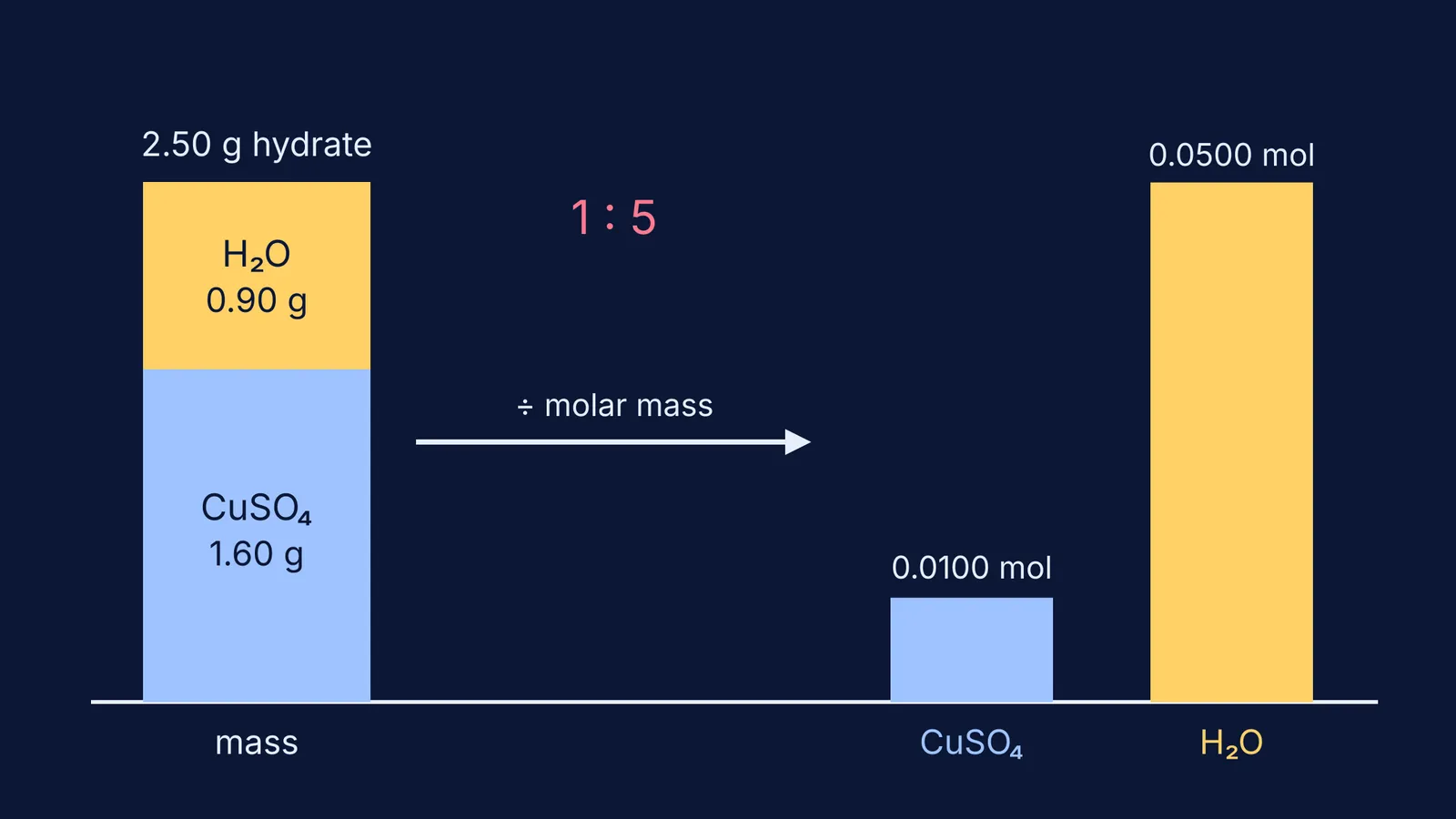
Crucible + hydrated salt: 22.50 g, so the hydrate is 2.50 g
Crucible after heating to constant mass: 21.60 g, so the anhydrous salt is 1.60 g
Water lost: 22.50 − 21.60 = 0.90 g
Moles of CuSO₄ = 1.60 ÷ 159.61 = 0.01002 mol. Moles of water = 0.90 ÷ 18.015 = 0.04996 mol. Ratio = 0.04996 ÷ 0.01002 = 4.98, so x = 5 and the formula is CuSO₄·5H₂O.
To check, compare percentages. Water makes up 5 × 18.015 = 90.08 g of the pentahydrate's 249.69 g (PubChem), which is 36.1%. Your sample lost 0.90 ÷ 2.50 = 36.0%, a close match.
Does the same method work for barium chloride?
A 2.00 g sample of BaCl₂·xH₂O is heated to constant mass and 1.705 g is left, so 0.295 g of water was lost. PubChem gives anhydrous barium chloride as 208.23 g/mol (PubChem). Moles of BaCl₂ = 1.705 ÷ 208.23 = 0.008188 mol and moles of water = 0.295 ÷ 18.015 = 0.01638 mol. The ratio is 2.00, giving BaCl₂·2H₂O, whose molar mass PubChem lists as 244.26 g/mol (PubChem).
Why does my value of x come out wrong?
Every bench mistake pushes the final mass up or down. Work out which way, and you know which way x moves. These figures use the copper sulphate example above.
Not heating to constant mass. Water left behind makes the final mass too high. Stop at 21.70 g and you get 0.80 g of water against 1.70 g of salt, a ratio of 4.17, and you might wrongly write x = 4.
Water taken back in while cooling. PubChem's physical description lists anhydrous copper sulfate as hygroscopic (PubChem), so it takes up moisture from the air. That also makes x too low. Cool it covered and weigh promptly.
Overheating. The RSC notes warn that over-heating may cause further decomposition and say to stop if the solid starts to blacken (RSC Education). The extra mass lost is not water, so x comes out too high. A final reading of 21.55 g gives 5.43.
Using the wrong mass. Dividing the hydrate's 2.50 g by 159.61 instead of the residue's 1.60 g gives a ratio of 3.19.
A ratio such as 4.17 or 5.43 is a signal to check your weighings, not a number to round quietly.
How do you check your answer before writing it down?
Your last two weighings agree.
The residue's moles use the anhydrous molar mass.
Your ratio is close to a whole number; if not, name the likely error and which way it pushes x.
Your percentage of water lost matches the theoretical value for your formula.
The same divide-then-compare logic gives empirical formulas from combustion analysis, and the mistakes to check in mole concept numericals covers conversion slips.
If your x keeps landing at 4.17 and you can't see why, the Fermi Problem Library has worked problems with a step-by-step solver that explains the reasoning rather than printing an answer.


