

On this page
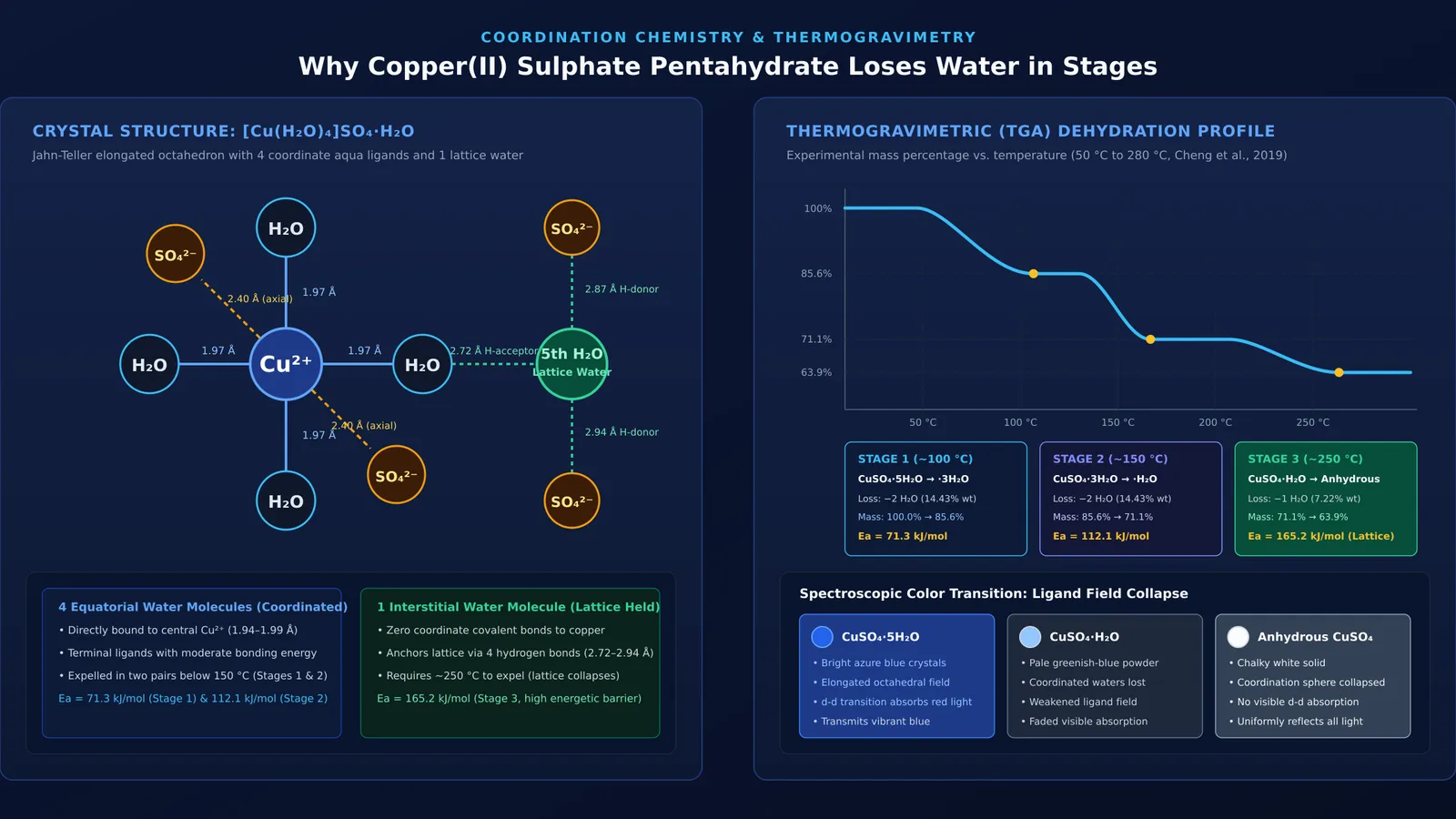
Copper(II) sulphate pentahydrate is written empirically as CuSO4·5H2O, but its true structural formula is [Cu(H2O)4]SO4·H2O. This formula reflects a fundamental structural division discovered by crystallographers C. A. Beevers and H. Lipson in 1934: the five water molecules do not share identical chemical environments. Instead, four molecules reside inside the primary coordination sphere of the central copper ion, while the fifth molecule sits outside as an interstitial lattice component.
How are the water molecules arranged in copper sulphate?
Neutron diffraction measurements by G. E. Bacon and N. A. Curry in 1962 established the exact geometry of this coordination complex. The Cu²⁺ cation sits in an octahedron elongated along one axis by the Jahn-Teller effect. Four aqua ligands occupy the equatorial plane, bound directly to copper by coordinate covalent bonds with bond lengths between 1.94 Å and 1.99 Å (Bacon and Curry, 1962). Two oxygen atoms from neighbouring sulphate anions coordinate at the axial positions, held at longer distances between 2.38 Å and 2.45 Å (Bacon and Curry, 1962).
The fifth water molecule does not bond to the copper ion at all. As shown in the neutron diffraction analysis by Bacon and Curry (1962), it occupies an interstitial cavity where it forms four separate hydrogen bonds. It donates two hydrogen bonds to oxygen atoms of nearby sulphate ions at distances of 2.87 Å and 2.94 Å, and its oxygen atom accepts two hydrogen bonds from coordinated equatorial water molecules (Bacon and Curry, 1962). This network locks together the anionic sulphate layers and the cationic copper complexes.
Distinguishing between water molecules inside the coordination sphere and those held in the lattice is essential for coordination chemistry problems, much like counting ionisable chlorides in Werner complexes. The Fermi Concept Library covers every concept in physics, chemistry, biology, mathematics and computing, each with its own lesson and its place in the map.
Why does heating remove water in three separate steps?
When you heat solid copper sulphate pentahydrate, the water molecules detach in discrete thermodynamic stages rather than evaporating simultaneously. A thermogravimetric study by Long Cheng and colleagues in 2019 demonstrated that the salt undergoes three mass-loss transitions between 50 °C and 260 °C:
Stage 1 (around 100 °C): The pentahydrate loses two equatorial coordinated water molecules to form copper(II) sulphate trihydrate: CuSO4·5H2O(s) → CuSO4·3H2O(s) + 2 H2O(g) (Cheng et al., 2019).
Stage 2 (around 150 °C): The trihydrate loses the remaining two coordinated water molecules to yield copper(II) sulphate monohydrate: CuSO4·3H2O(s) → CuSO4·H2O(s) + 2 H2O(g) (Cheng et al., 2019).
Stage 3 (above 250 °C): The monohydrate loses its fifth water molecule to yield pure anhydrous copper sulphate: CuSO4·H2O(s) → CuSO4(s) + H2O(g) (Cheng et al., 2019).
The substantial temperature difference between Stage 2 (150 °C) and Stage 3 (250 °C) stems from lattice energetics (Cheng et al., 2019). The first four water molecules are terminal ligands attached to individual Cu²⁺ centres; breaking their coordinate bonds requires moderate thermal energy. In contrast, the fifth water molecule anchors the entire crystal framework through four hydrogen bonds. Expelling this final water molecule forces a complete restructuring of the crystalline lattice into anhydrous CuSO4. This high barrier illustrates how strong intermolecular networks govern phase transitions, a principle seen in intramolecular hydrogen bonding and volatility.
Each dehydration step represents a reversible equilibrium where solid phases coexist with water vapour, serving as a textbook illustration of heterogeneous equilibria where solids drop out of the equilibrium quotient.
Why does the anhydrous salt lose its blue colour?
The visible colour change from deep blue to white reflects the loss of the ligand field around the copper ion. In copper(II) sulphate pentahydrate, Cu²⁺ has a 3d⁹ electron configuration. The four equatorial aqua ligands and two axial sulphate oxygens create an elongated octahedral coordination field that splits the degenerate 3d orbitals into different energy levels.
When white light passes through the hydrated crystal, an electron absorbs the red portion of the visible spectrum and is promoted between these split d-orbitals. The unabsorbed wavelengths transmit to the eye as the characteristic blue colour.
When thermal dehydration expels the water ligands above 250 °C (Cheng et al., 2019), the coordination sphere collapses. Without coordinated water molecules providing an asymmetric ligand field, d-orbital splitting decreases and transitions no longer fall within the visible spectrum. Anhydrous copper sulphate reflects visible light uniformly, appearing white.
How do you calculate the mass loss at each heating stage?
Competitive examinations such as JEE Main and NEET-UG regularly test this three-stage dehydration through stoichiometry and thermogravimetric calculations. Thermogravimetric measurements by Long Cheng and colleagues in 2019 establish the exact mass-loss percentages at each heating threshold. You can calculate the expected residue using standard atomic weights: Cu = 63.55 g/mol, S = 32.06 g/mol, O = 16.00 g/mol, and H = 1.008 g/mol.
The molar mass of CuSO4·5H2O is 249.69 g/mol, while anhydrous CuSO4 has a molar mass of 159.61 g/mol (Cheng et al., 2019). Heating a 10.00 g sample yields predictable intermediate masses:
Stage 1 (loss of 2 H2O): Removing two water molecules sheds 36.03 g/mol, an initial mass loss of 14.43% (Cheng et al., 2019). The remaining CuSO4·3H2O weighs 8.56 g.
Stage 2 (loss of 2 H2O): Removing the next two water molecules sheds another 36.03 g/mol, bringing cumulative loss to 28.86% (Cheng et al., 2019). The remaining CuSO4·H2O weighs 7.11 g.
Stage 3 (loss of 1 H2O): Driving off the final water molecule removes 18.02 g/mol, bringing total mass loss to 36.08% (Cheng et al., 2019). The final mass of white anhydrous CuSO4 is 6.39 g.
For multi-step stoichiometry and hydrate calculations, the Fermi Problem Library provides worked problems with a step-by-step solver that explains the reasoning rather than printing an answer. When revising coordination chemistry, Fermi's AI tutor can work out what you already know and build a plan for the session, noticing where you are stuck and deciding whether to explain, ask, or show.


