

On this page
When you discover a new chemical compound, one of the first questions you must answer is: what is it made of? A technique called combustion analysis provides the answer by burning the unknown sample and capturing the products.
In this article, we explain the mass-to-mole method behind the technique, how to find the empirical formula from combustion data, and why visualising the reaction can make the abstract math feel real.
How does combustion analysis work?
Combustion analysis is a quantitative method used to find the elemental composition of hydrocarbons and related organic compounds. You start with a weighed sample of the unknown substance and heat it to a high temperature under a steady stream of oxygen gas.
According to *OpenStax Chemistry 2e* (OpenStax), the compound reacts completely with oxygen during this process. The reaction forces all the carbon atoms in your original sample to convert into carbon dioxide (CO₂). At the same time, all the hydrogen atoms are converted into water vapour (H₂O).
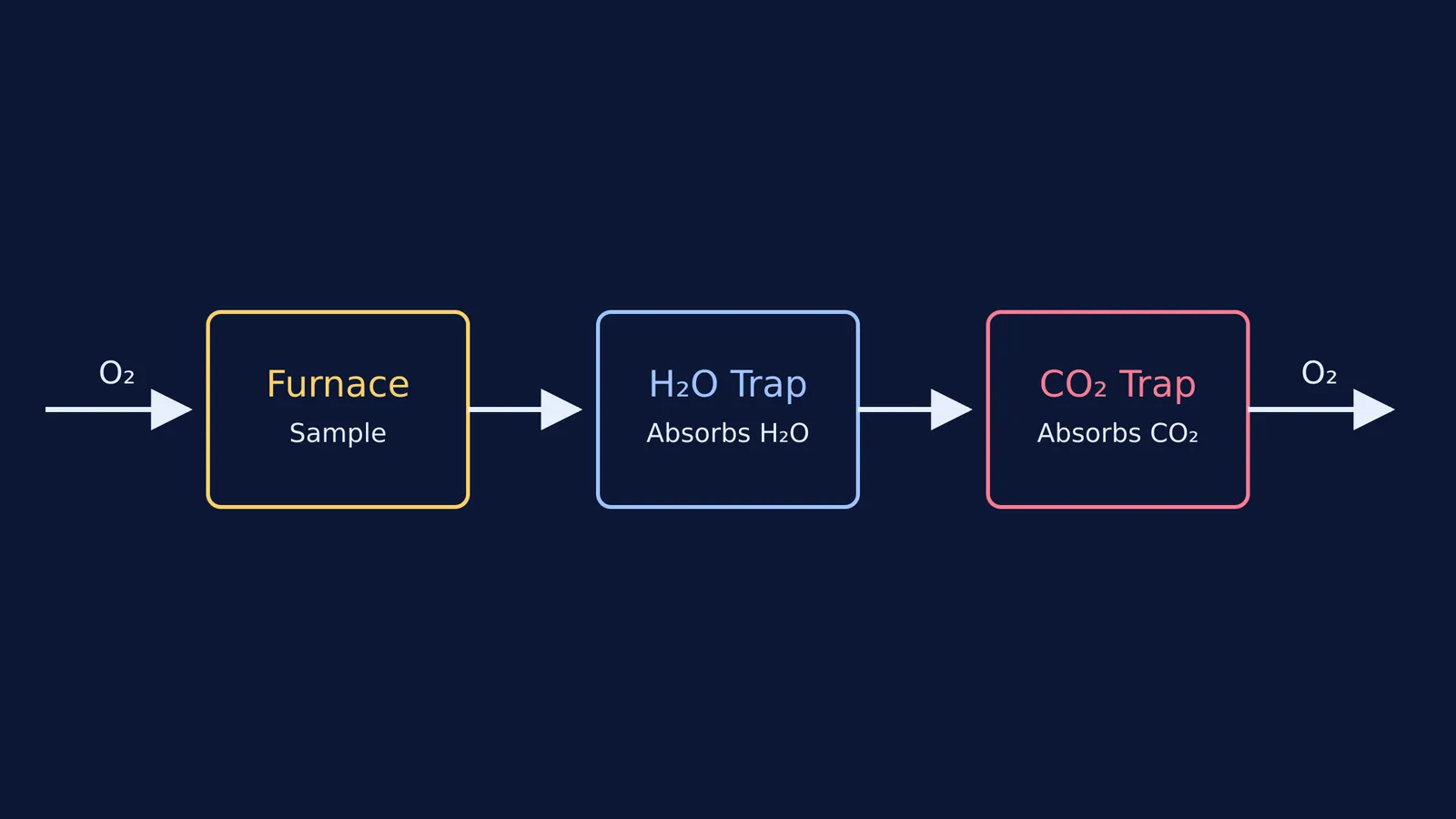
The gaseous products are then swept through two separate, pre-weighed collection devices. One device contains a substance that absorbs only water, and the second contains a substance that absorbs carbon dioxide. By weighing these devices after the reaction, you can measure exactly how much CO₂ and H₂O was produced.
How to find the empirical formula from combustion analysis?
Once you have the masses of the products, finding the empirical formula is a matter of tracking the atoms back to their source. Since all the carbon in the CO₂ came from the sample, and all the hydrogen in the H₂O came from the sample, you can calculate the moles of each element.
Let us look at a worked example from *OpenStax Chemistry 2e* (OpenStax). Suppose you burn a 0.00126 g sample of polyethylene, a common plastic. The analysis yields 0.00394 g of CO₂ and 0.00161 g of H₂O.
Find the moles of Carbon: Multiply the mass of CO₂ by the ratio of one mole of carbon to the molar mass of CO₂ (44.01 g). 0.00394 g CO₂ × (1 mol C / 44.01 g CO₂) = 8.95 × 10⁻⁵ mol C.
Find the moles of Hydrogen: Multiply the mass of H₂O by the ratio of two moles of hydrogen to the molar mass of H₂O (18.02 g). 0.00161 g H₂O × (2 mol H / 18.02 g H₂O) = 1.79 × 10⁻⁴ mol H.
Determine the mole ratio: Divide each molar amount by the smallest number obtained. (1.79 × 10⁻⁴ mol H) / (8.95 × 10⁻⁵ mol C) = 2 mol H for every 1 mol C.
The empirical formula for polyethylene is therefore CH₂. This same logic works when determining structural isomers or naming carbon compounds; the ratio of atoms defines the foundational building block.
Why are interactive simulations effective for chemistry?
Translating grams of soot and gas into molecular ratios can feel like pure algebra, disconnected from the physical atoms. This is where virtual environments help bridge the gap.
A 2008 study published in *Science* by Carl Wieman and colleagues (DOI) investigated how interactive tools change the way students learn. The researchers found that interactive simulations enhance learning by making abstract, subatomic concepts visible. Instead of just following lab procedures by rote, students using these tools approach problems like working scientists, deducing scientific concepts through their own exploration.
Running a virtual combustion allows you to watch the bonds break and reform. You can observe the oxygen molecules colliding with the hydrocarbon, see the carbon dioxide and water molecules emerge, and directly track the conservation of mass.
If you want to test these ideas beyond the textbook, the Fermi Simulation Lab provides interactive simulations for the ideas that are easier to see than to read. You can predict the empirical formula on paper, then run the virtual combustion to watch the atoms redistribute and check if your mole ratio holds true.


