

On this page
When you first learn stoichiometry, calculating the mass of a substance seems straightforward. For water (H₂O), you get roughly 18 u; for table salt (NaCl), you get 58.5 u. Yet textbooks following the NCERT Science and Chemistry curriculum call one a "molecular mass" and the other a "formula unit mass." This reflects a fundamental difference in how chemical bonds hold matter together.
What is the difference between molecular mass and formula unit mass?
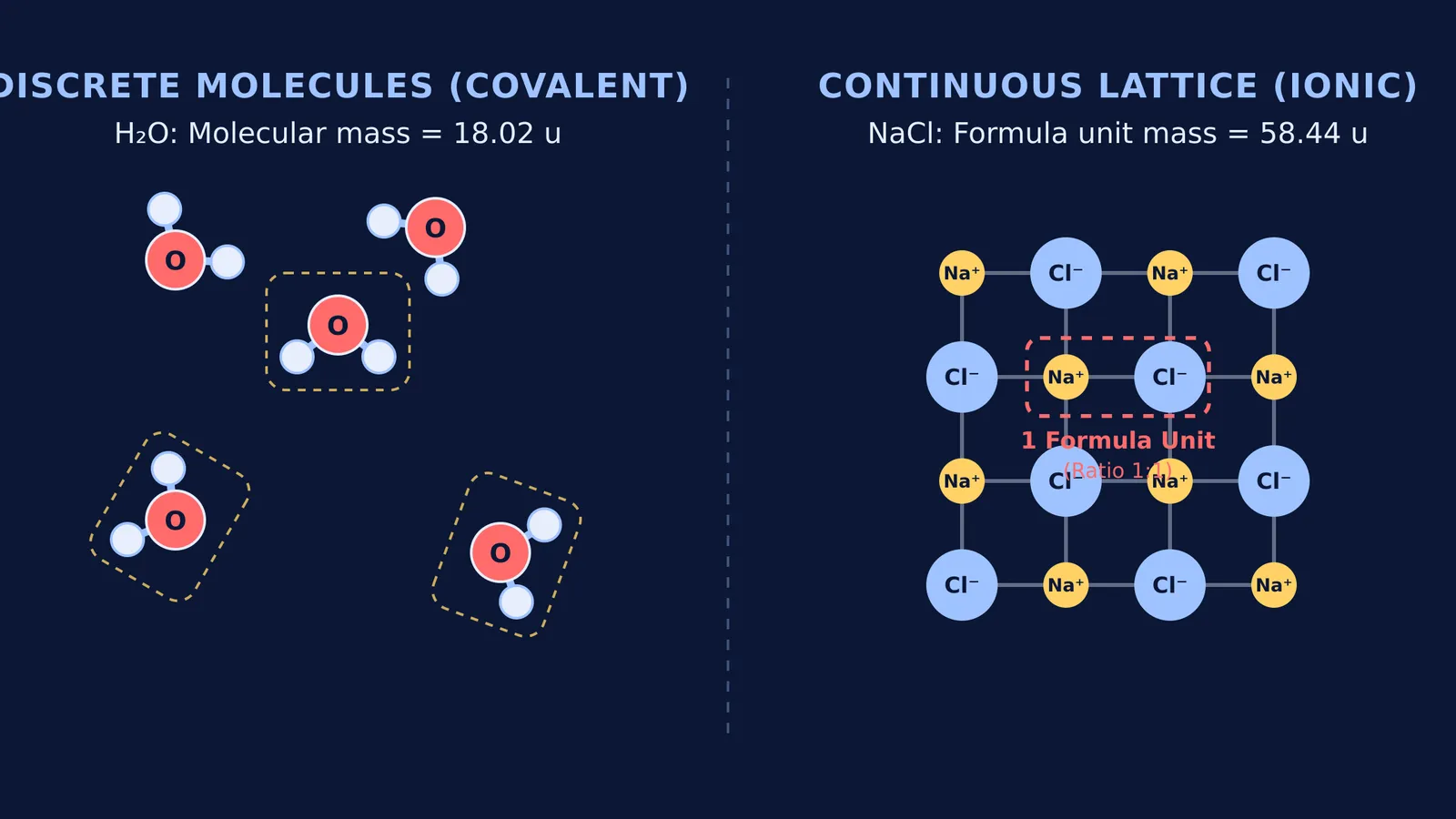
Molecular mass is the sum of the atomic masses of all atoms present in a single, discrete molecule of a covalent substance, according to OpenStax Chemistry 2e. Substances like water (H₂O) and methane (CH₄) consist of independent units bound by covalent sharing of electrons.
Formula unit mass is the sum of the atomic masses in the simplest ratio of an ionic compound. In ionic compounds, positive and negative ions assemble into an extended three-dimensional crystal lattice rather than individual molecules.
The BIPM SI Brochure defines the unified atomic mass unit (symbol u) as exactly 1/12 of the mass of an unbound carbon-12 atom. Both masses use this identical unit. If you are revising core chemical terms, our guide on Class 9 foundations on atoms and molecules walks through standard symbols.
Why does sodium chloride get a formula unit mass?
Solid sodium chloride does not contain discrete NaCl molecules. As documented in the NCERT Science and Chemistry curriculum, a grain of common salt exists as a continuous crystal lattice of sodium cations (Na⁺) and chloride anions (Cl⁻).
Because the alternating electrostatic attractions extend indefinitely, you cannot point to any single pair of ions and call it an independent molecule. The formula "NaCl" indicates only that the ratio of sodium to chloride ions is 1:1. That minimal whole-number ratio is the formula unit.
How do you calculate both values from atomic masses?
Both quantities share the exact same mathematical formula, as detailed in OpenStax Chemistry 2e: multiply the relative atomic mass of each element by its subscript and add the terms together.
Molecular mass of water (H₂O): Hydrogen is 1.008 u and oxygen is 16.00 u, yielding (2 × 1.008 u) + (1 × 16.00 u) = 18.02 u.
Formula unit mass of sodium chloride (NaCl): Sodium is 22.99 u and chlorine is 35.45 u, yielding (1 × 22.99 u) + (1 × 35.45 u) = 58.44 u.
Formula unit mass of aluminium sulphate (Al₂(SO₄)₃): Multiplying each by its atomic mass gives (2 × 26.98 u) + (3 × 32.06 u) + (12 × 16.00 u) = 342.14 u.
Reviewing calculating average atomic mass from isotopes clarifies where standard atomic weights come from.
If you struggle to identify whether a compound forms discrete molecules or an extended lattice, the Fermi Concept Library maps every concept across chemistry so you can trace bonding types back to first principles.
Why do electron gains and losses not change the formula mass?
When sodium transfers an electron to chlorine, does the resulting formula unit mass differ from the sum of neutral atoms? As explained in OpenStax Chemistry 2e, using neutral atomic masses remains accurate for two reasons:
Electron mass is tiny: An electron's mass is negligibly small with respect to a typical atom, falling well within rounding variations.
Conservation of charge: In any neutral ionic compound, every electron lost by a cation is captured by an anion. The total number of electrons in the formula unit equals the sum of electrons in the original neutral atoms.
Our walkthrough on empirical and molecular formulas from percentage data demonstrates how to convert experimental mass ratios into correct formula units.
How can you test your understanding before exam day?
To avoid losing marks in board exams, use this three-step routine:
Check the bonding: If the compound contains a metal bonded to a non-metal or polyatomic ions (such as NaCl or CaCO₃), write "formula unit mass." If it consists solely of non-metals bonded covalently, write "molecular mass."
Expand all parentheses: For polyatomic salts like Ca(NO₃)₂, expand the subscripts to 1 calcium, 2 nitrogen, and 6 oxygen atoms before multiplying by atomic weights.
Match mass to scale: At atomic scales, express answers in unified atomic mass units (u). At macroscopic scales, one mole equals the numerical value in grams per mole (g/mol).
When tackling complex numerical problems in physical chemistry, the Fermi Problem Library provides worked problems with a step-by-step solver that explains the reasoning rather than printing an answer.


