On this page
If you are in Class 9 in 2026-27, your science book is the new NCERT textbook Exploration, first published in April 2026, and Chapter 9 is called Atomic Foundations of Matter (NCERT, Chapter 9 PDF). It follows Chapter 8, Journey Inside the Atom: once you know how electrons sit in shells, this chapter shows how atoms join, how to write formulas and how to add up masses (NCERT contents). Guides written for the old book's Atoms and Molecules chapter often include the mole concept; this chapter does not, and neither do CBSE's 2026-27 key concepts for it (CBSE curriculum 2026-27).
What is in Atomic Foundations of Matter class 9?
The chapter runs from page 162 to 183 in eight sections (NCERT, Chapter 9):
Law of Conservation of Mass, credited to Antoine Lavoisier in 1789.
Law of Constant Proportions: purified water from any source holds hydrogen and oxygen in a 1:8 mass ratio.
Dalton's Atomic Theory, presented in 1808.
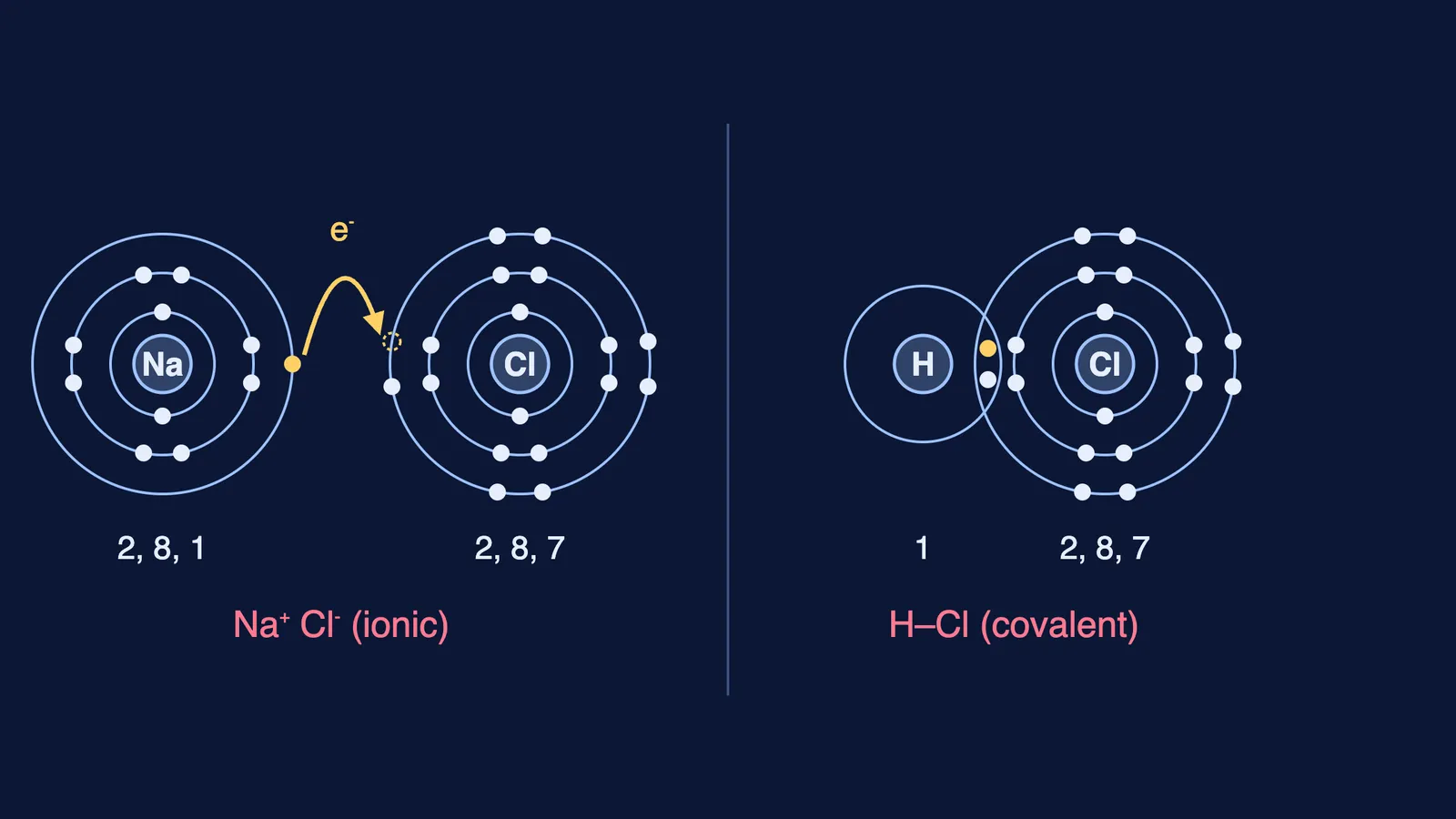
How atoms combine: covalent bonds (shared electrons) and ionic bonds (transferred electrons), plus naming rules.
Writing chemical formulae by crossing over valencies or charges.
Properties of ionic and covalent compounds.
Molecular mass of covalent compounds.
Formula unit mass of ionic compounds.
How many marks does this chapter carry in CBSE 2026-27?
CBSE does not give Chapter 9 marks of its own. It sits in Unit II, Matter: Its Nature and Behaviour, with Chapters 5 and 8, and that unit carries 25 of the 80 theory marks (CBSE curriculum 2026-27). The same document allots 14 periods to Atoms and Molecules, lists verifying the law of conservation of mass as a Chapter 9 practical, and includes assertion-reason and case-based questions in the paper. Our guide to recording observations in Class 9 science practicals helps with writing it up.
How do you write a chemical formula from valencies?
Write the symbols (cation first for ionic compounds), write each valency or charge underneath, cross the numbers over as subscripts, and divide by any common factor. Bracket a polyatomic ion when there is more than one. Valencies here come from the chapter's Table 9.1 (NCERT, Chapter 9).
Magnesium nitrate: Mg²⁺ and NO₃⁻. Crossing over gives one Mg and two NO₃, so Mg(NO₃)₂.
Ferrous sulfate: Fe²⁺ and SO₄²⁻. Crossing over gives Fe₂(SO₄)₂; divide by 2 to get FeSO₄.
Ammonium carbonate: NH₄⁺ and CO₃²⁻. Two ammonium ions balance one carbonate, so (NH₄)₂CO₃.
If your formulas keep coming out wrong, the Fermi Problem Library has worked problems with a step-by-step solver that explains the reasoning rather than printing an answer.
How do you calculate molecular mass and formula unit mass?
Add the atomic masses of every atom in the formula, using the values the chapter gives: H = 1 u, C = 12 u, N = 14 u, O = 16 u, Mg = 24 u (NCERT, Chapter 9). Covalent compounds form molecules, so you find a molecular mass. Ionic compounds form crystals, not molecules, so the book calls their sum the formula unit mass.
Ammonia, NH₃ (covalent): 14 u + (3 × 1 u) = 17 u molecular mass.
Magnesium nitrate, Mg(NO₃)₂ (ionic): 24 u + 2 × (14 u + 3 × 16 u) = 24 u + 2 × 62 u = 148 u formula unit mass.
Ammonium carbonate, (NH₄)₂CO₃ (ionic): 2 × (14 u + 4 × 1 u) + 12 u + 3 × 16 u = 36 u + 60 u = 96 u formula unit mass.
The laws give ratio sums too. Since water is hydrogen and oxygen in a 1:8 mass ratio, 3 g of hydrogen needs 3 × 8 = 24 g of oxygen, and conservation of mass says 3 g + 24 g = 27 g of water forms. For more practice with brackets, see how to calculate molecular mass in Class 9, written before the new book (skip its hydrate example, which this chapter does not cover).
Which mistakes cost marks in this chapter?
Saying "molecular mass of NaCl". NaCl is ionic, so it has a formula unit mass.
Leaving out brackets: Al(OH)₃, not AlOH₃.
Writing ion charges inside a compound's formula.
Forgetting to simplify an ionic formula: Mg₂O₂ is written MgO.
Prefix slips: CO is carbon monoxide, and H₂S is hydrogen sulfide, never dihydrogen sulfide.
Mixing up O and O₂: O is one oxygen atom; O₂ is a molecule of two atoms joined by a double bond.
Thinking mass is lost when a reaction fizzes in an open flask. The gas escaped; a sealed set-up reads the same before and after.
For the next step, read why ionic compounds dissolve in water but not in kerosene.
Many of these slips come from shaky electron shells in Chapter 8, so revise valence electrons first. The Fermi Concept Library covers every concept in physics, chemistry, biology, mathematics and computing, each with its own lesson.