On this page
Sound Waves: Characteristics and Applications is Chapter 10 of Exploration, the new NCERT Class 9 Science textbook (First Edition, April 2026). The CBSE Class IX Science curriculum for 2026-27 lists its key concepts. Here are 34 terms in five groups, in our own words. For notes and solved examples, read our Sound waves Class 9 chapter guide.
How is sound produced and how does it travel?
Sections 10.1 and 10.2 of the NCERT chapter.
Vibration: a repeated to-and-fro movement of an object; every sound starts with one. Example: a plucked rubber band.
Source: whatever vibrates to make the sound, such as a sitar string.
Vocal cords: two tight muscular flaps in the larynx (voice box) that vibrate when you speak or sing.
Tuning fork: a U-shaped steel or aluminium bar on a stem whose prongs, struck on a rubber pad, give a nearly single-frequency sound.
Medium: the solid, liquid or gas that sound passes through. Example: a desk carries a knock to your ear.
Vacuum: a space with no matter, which sound cannot cross. Example: a bell in a jar goes almost silent as the air is pumped out. Don't confuse with: light, which can cross a vacuum.
What is a sound wave made of?
Section 10.3 of the NCERT chapter.
Compression (C): a region where the medium is squeezed, so its density is above average. Example: air just ahead of a piston pushed forward.
Rarefaction (R): a region where the medium is spread out, so its density is below average. Don't confuse with: compression; crowded is C, spread out is R.
Mean position: the rest position each particle vibrates about. Only the disturbance moves on.
Sound wave: a travelling disturbance in which squeezed and stretched regions take turns, while the medium itself stays in place. Example: pulses along a slinky.
Longitudinal wave: particles vibrate parallel to the direction the wave travels. Sound is one.
Transverse wave: particles vibrate at right angles to the direction of travel. Example: light. Earthquakes make both kinds: see seismic waves and the Earth's interior.
Mechanical wave: a wave that needs a material medium. Sound is mechanical; light is not.
What do wavelength, frequency and amplitude mean?
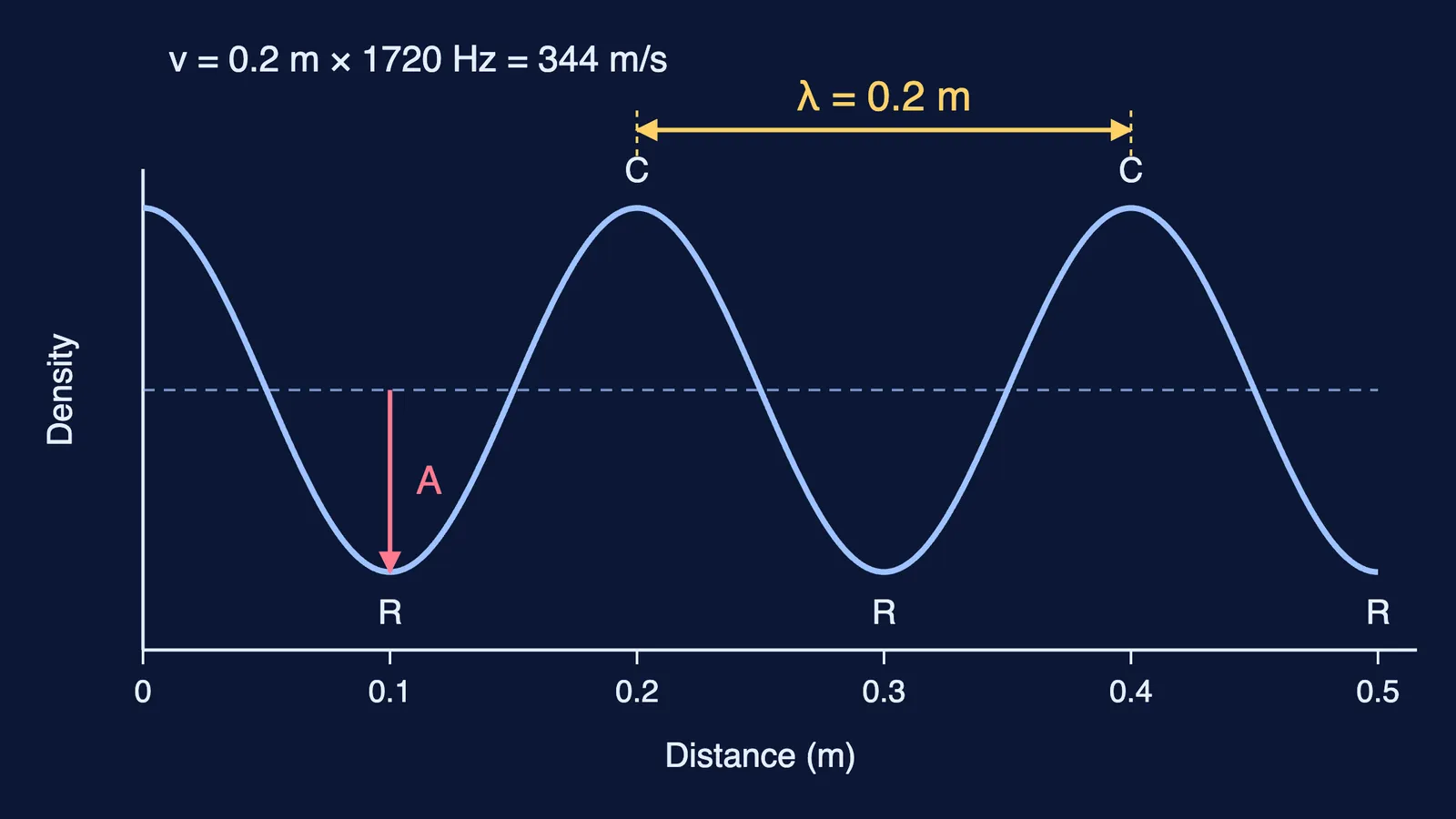
Sections 10.5 and 10.6 of the NCERT chapter, where the graph plots density against distance.
Crest: the highest point of the graph, the maximum density at the middle of a compression.
Trough: the lowest point, the minimum density at the middle of a rarefaction. Don't confuse with: compression and rarefaction, which are regions of the medium, not points on a graph.
Wavelength (λ): the distance between two neighbouring crests or two neighbouring troughs. SI unit: metre (m).
Frequency (ν): the number of complete density oscillations (maximum to minimum and back) at one fixed point per second. SI unit: hertz (Hz), meaning per second.
Time period (T): the time for one complete oscillation. SI unit: second (s). Since ν = 1/T, 5 Hz gives T = 0.2 s. Don't confuse with: frequency; higher frequency means shorter time period.
Amplitude: the biggest change in density, in a compression or rarefaction, from the average density. Larger amplitude carries more energy. Don't confuse with: wavelength, measured along the distance axis.
Intensity: how much sound energy flows each second through each unit of area facing the wave head-on. It falls with distance.
Speed of sound (v): how far a crest moves per second; v = λ × ν. NCERT's Table 10.1 gives about 340 m/s in air, 1500 m/s in water and 5000 m/s in steel at 15 °C.
What is the difference between pitch and loudness?
Section 10.6.4 of the NCERT chapter.
Pitch: how we hear frequency; higher frequency generally sounds shriller. Example: a whistle versus thunder.
Loudness: how we hear amplitude; larger amplitude sounds louder. Don't confuse with: intensity, which is measurable, while loudness depends on the listener's hearing.
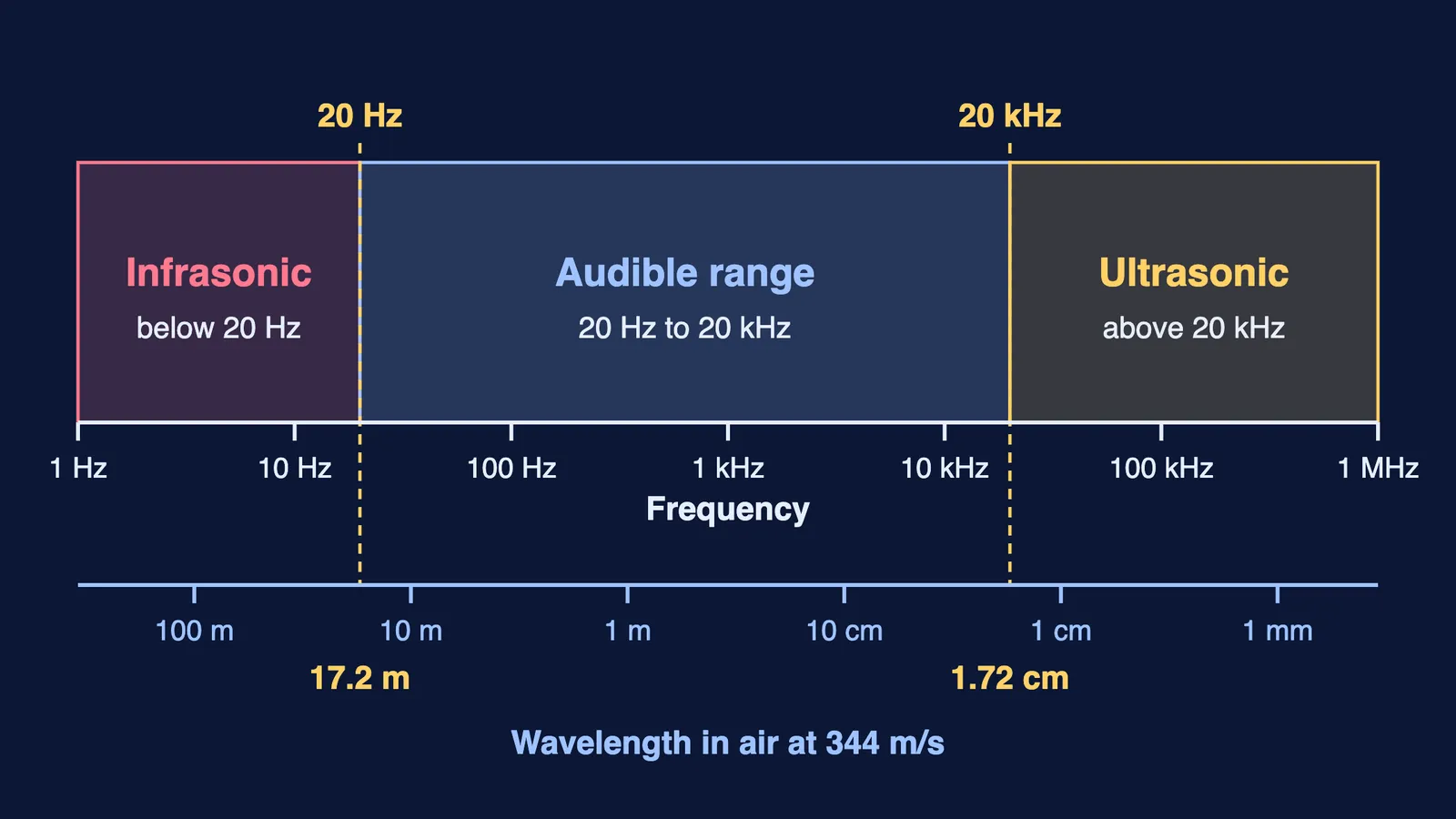
Audible range: the frequencies humans hear, about 20 Hz to 20,000 Hz; it narrows with age.
Infrasonic waves: sound below 20 Hz. Example: elephants detect it.
Ultrasonic waves: sound above 20 kHz. Example: bats and dolphins detect it; ultrasonography uses it to image internal organs. Don't confuse with: infrasonic; infra is below hearing, ultra above.
Tone: a sound of one frequency. Example: a tuning fork.
Timbre: the quality that makes a flute and a tabla sound different on the same note at the same loudness. It comes from each instrument's pattern of overtones above the fundamental (lowest) frequency.
Octave: the gap between two notes when one has twice the frequency of the other, such as 200 Hz and 400 Hz.
How do echo, reverberation and sonar work?
Sections 10.7 and 10.8 of the NCERT chapter.
Reflection of sound: sound bouncing off a surface by the same laws as light.
Echo: a reflection heard separately from the original sound. The ear needs a gap of at least 0.1 s, so at 340 m/s the surface must be at least 17 m away. Example: an echo after 0.5 s means a wall 85 m away.
Reverberation: sound lingering after the source stops, from many reflections in a large hall arriving less than 0.05 s apart. Don't confuse with: echo, one distinct repeat.
Echolocation: locating objects by sending out sound and sensing the reflections. Example: bats hunting with ultrasound.
Sonar: sound navigation and ranging; a ship sends ultrasound into water and uses echoes to find the distance, direction and speed of underwater objects.
How to learn these terms
Learn the pairs together: compression and rarefaction, crest and trough, frequency and time period, loudness and intensity, echo and reverberation.
Draw bunched and spread-out dots with the density graph below; label C, R, crest, trough, λ and amplitude.
Tie each quantity to its unit: λ in m, ν in Hz, T in s, v in m/s, with ν = 1/T and v = λ × ν.
If a term feels abstract, the Fermi Concept Library gives every concept in physics its own lesson and its place in the map.
Want to go further with waves? Try our assertion-reason traps on waves and oscillations.