On this page
Exploring Algebraic Identities is Chapter 4 of Ganita Manjari Part I, the new NCERT Class 9 maths book. Here are its key terms from the chapter text, each with an example. For worked problems, see our Exploring Algebraic Identities chapter guide.
What is an algebraic identity?
Algebraic identity: an equation that is true for every value of the variables in it (NCERT, Ch. 4). Example: (x + y)² = x² + 2xy + y² holds for any x and y.
Equation: a statement of equality that may be true only for some values. Example: x² − 1 = 24 holds only for x = 5 or x = −5. Don't confuse with: an identity, which never fails.
Distributive property: a(b + c) = ab + ac. Checking a few numbers is not a proof; the book proves identities this way: (a + b)(a + b) = a(a + b) + b(a + b) = a² + 2ab + b².
Expand: rewrite a product as a sum of terms. Example, for the binomial (two-term expression) 5x + 2y: (5x + 2y)² = 25x² + 20xy + 4y².
Coefficient and constant term: in x² + 7x + 12, the coefficient of x is 7 and the constant term is 12.
Square of a sum versus sum of squares: (a + b)² is not a² + b². Counter-example: a = 10, b = 2 gives 144 against 104.
Squares of sums and differences
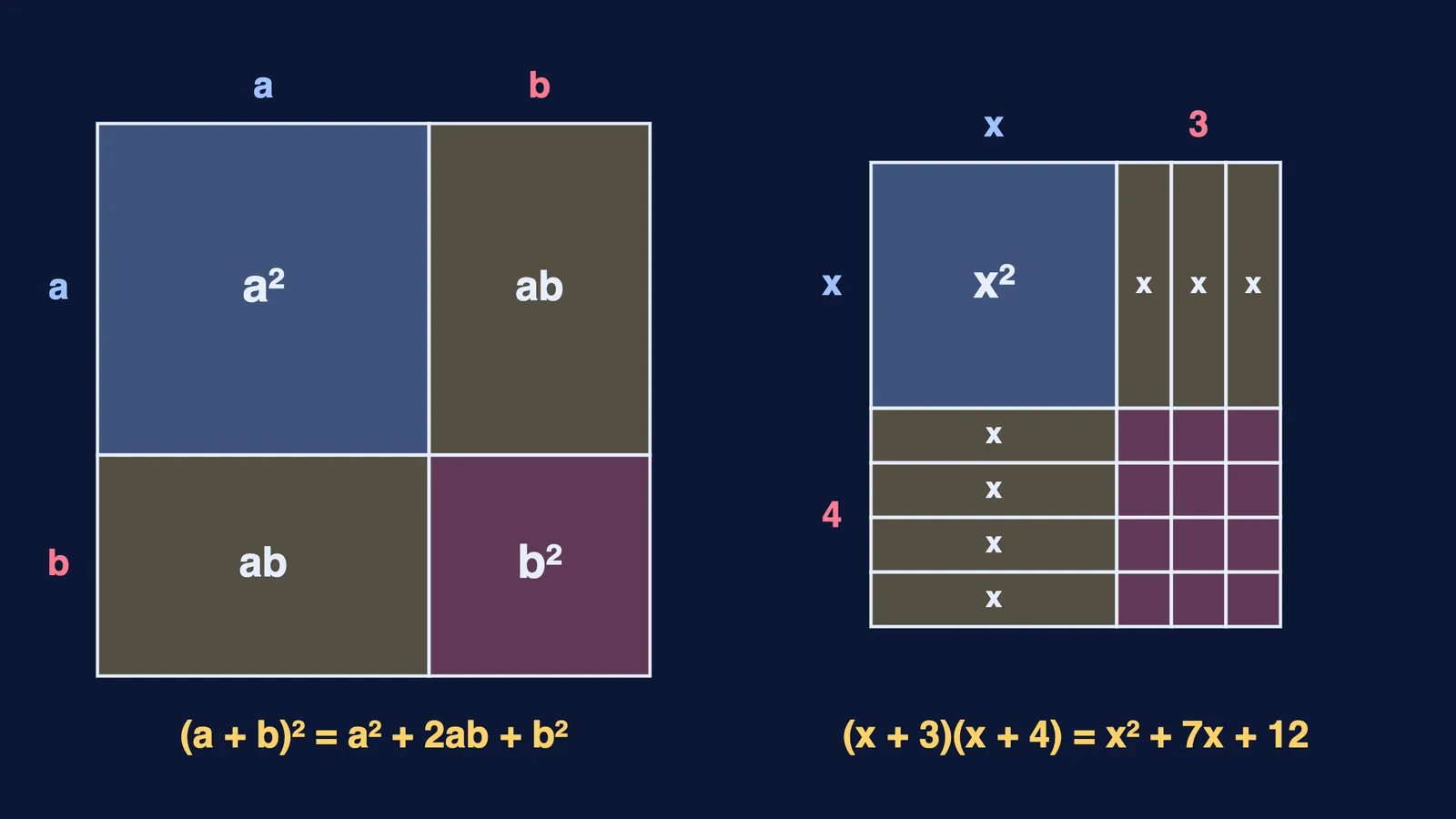
Geometric model: a picture whose areas match the terms, like the (a + b) square in the diagram above.
(a − b)² = a² − 2ab + b²: comes from replacing b with −b in the (a + b)² identity. Example: 29² = (30 − 1)² = 900 − 60 + 1 = 841.
(a + b + c)² = a² + b² + c² + 2ab + 2bc + 2ca. Example: 119² = (100 + 10 + 9)² = 14161.
Difference of squares: a² − b² = (a + b)(a − b). Example: 52 × 48 = (50 + 2)(50 − 2) = 2500 − 4 = 2496.
Śhrīdharāchārya's squaring rule: a² = (a + b)(a − b) + b², proposed in 750 CE according to the chapter (NCERT, Ch. 4). Example: 55² = 60 × 50 + 25 = 3025.
How do you factorise using identities and algebra tiles?
Factorisation: writing an expression as a product of factors. Example: 36x² + 12x + 1 = (6x + 1)², so 6x + 1 is a factor.
Common factor: shared by every term; take it out first: 50p² + 60pq + 18q² = 2(25p² + 30pq + 9q²) = 2(5p + 3q)².
Quadratic expression: highest power of the variable is 2, such as x² + 7x + 12. Its factors here are linear factors (power 1), such as x + 3.
(x + a)(x + b) = x² + (a + b)x + ab: behind most factorising here.
Splitting the x term: find a and b with a + b equal to the coefficient of x and ab equal to the constant. Example: x² + 11x + 30 needs a + b = 11, ab = 30, so 5 and 6: (x + 5)(x + 6).
(ax + b)(cx + d) = acx² + (ad + bc)x + bd. Example: (2x + 3)(3x + 1) = 6x² + 11x + 3.
Algebra tiles: an x²-tile (square of side x), x-tiles (x by 1) and unit tiles (1 by 1), showing products as areas.
Rectangular arrangement: all tiles of an expression laid into one rectangle; its sides are the factors. Example: x² + 7x + 12 forms an (x + 3) by (x + 4) rectangle, as in the diagram.
Cube identities and new identities
(a + b)³ = a³ + 3a²b + 3ab² + b³: a cube of edge (a + b) splits into two cubes and six cuboids. Example: p³ + 6p²q + 12pq² + 8q³ = (p + 2q)³.
(a − b)³ = a³ − 3a²b + 3ab² − b³: the signs alternate. Example: 8n³ − 60n²m + 150nm² − 125m³ = (2n − 5m)³.
Difference of cubes: x³ − y³ = (x − y)(x² + xy + y²). Check: x = 3, y = 1 gives 26 on both sides.
Sum of cubes: x³ + y³ = (x + y)(x² − xy + y²). Don't confuse with: (x + y)³. At x = 2, y = 1, x³ + y³ = 9 but (x + y)³ = 27.
x³ + y³ + z³ − 3xyz = (x + y + z)(x² + y² + z² − xy − xz − yz). Example: if x + y + z = 10, xyz = 25 and x² + y² + z² = 38, then x³ + y³ + z³ = 145 (NCERT, Ch. 4).
Simplifying rational expressions
Rational expression: one algebraic expression divided by another, denominator not zero. Example: (x² − 7x + 12) ÷ (5x² + 5x − 100).
Cancelling a common factor: factorise, then cancel a shared non-zero factor. The one above becomes (x − 3)(x − 4) ÷ [5(x − 4)(x + 5)] = (x − 3) ÷ [5(x + 5)], with x − 4 cancelled because it is not zero. Don't confuse with: cancelling terms. (x² + 1) ÷ (x² + 2) is not 1 ÷ 2; at x = 1 it is 2/3.
How to learn these terms
Derive, don't memorise. Rebuild (a − b)², (a + b + c)² and (a + b)³ from (a + b)².
Draw the area models. Sketch the (a + b)² square and the tile rectangle for x² + 8x + 15, labelling every piece.
Learn in confusable pairs. (a + b)² with a² + b², (x + y)³ with x³ + y³, equation with identity, cancelling factors with cancelling terms.
Test every answer with a number. Put x = 1 or 2 into both sides; if they differ, there is a slip.
Revise the groundwork. If coefficients feel shaky, see our linear polynomials guide. The Fermi Concept Library has a lesson on each mathematics concept.