On this page
Exploring Algebraic Identities is Chapter 4 of Ganita Manjari Part I, the new NCERT Class 9 maths book (first edition, April 2026) for the 2026-27 session. Guides for the old textbook will not match it. Here is what the chapter covers, worked with our own numbers.
What is in Exploring Algebraic Identities in Class 9?
The chapter runs from page 68 to page 91 of the Chapter 4 PDF and covers:
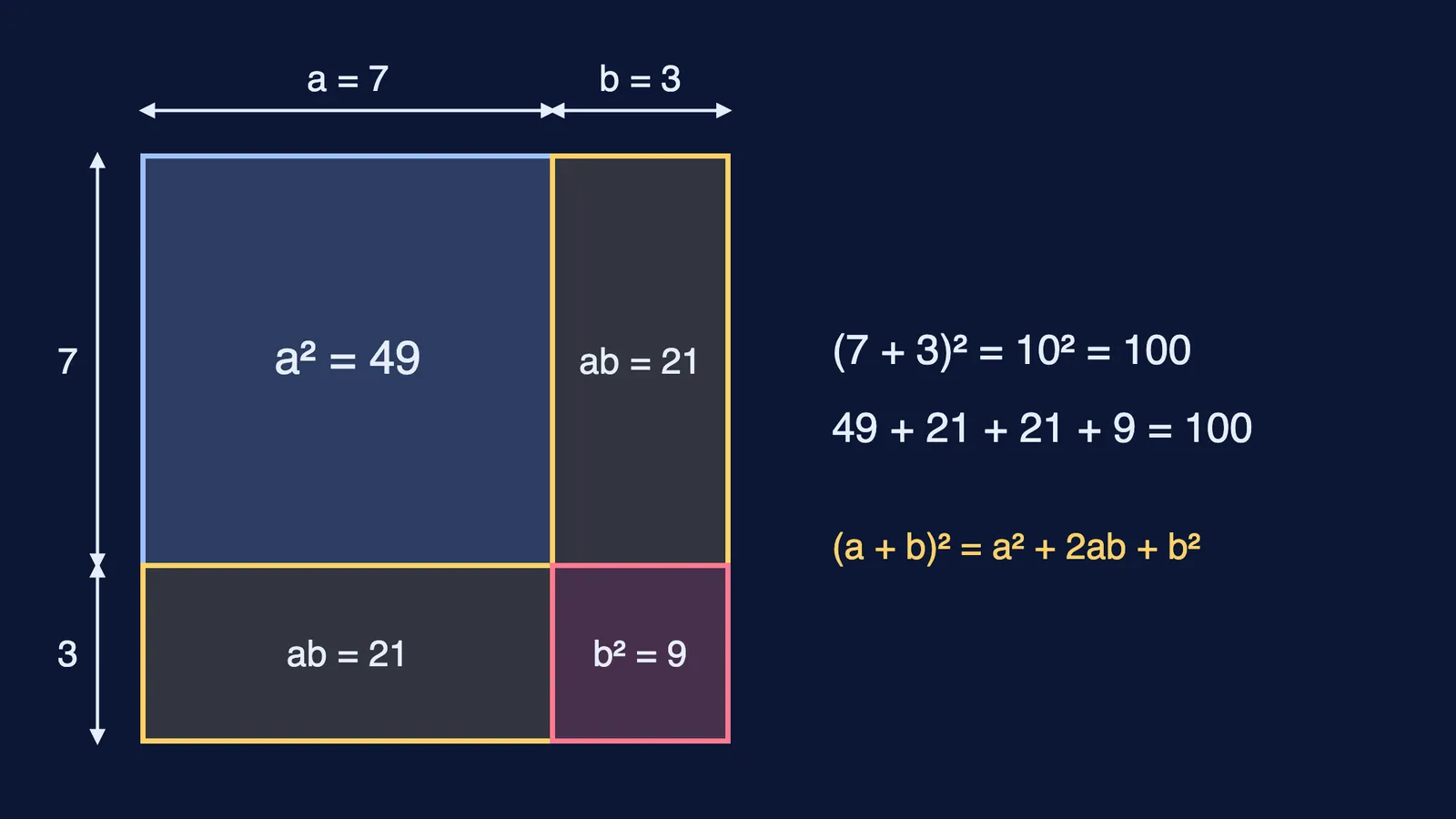
Identities as pictures: squares and rectangles for (a + b)², (a − b)² and (a + b + c)².
Factorising with identities, then with algebra tiles, then without tiles.
New identities for cubes: a cube cut into smaller cubes and cuboids for (a + b)³, then x³ + y³ + z³ − 3xyz.
Simplifying rational expressions by cancelling common factors.
The chapter credits Śrīdharāchārya with using a² = (a + b)(a − b) + b² around 750 CE to square numbers quickly (NCERT, Chapter 4). For 45: (50)(40) + 25 = 2025, and 45 × 45 is indeed 2025.
What is the difference between an equation and an identity?
An identity is an equation that holds for every value of its variables, while an ordinary equation may hold for only a few (NCERT, Chapter 4). x² = 49 is true only for x = 7 or −7. But (x + 1)² = x² + 2x + 1 is true for any x: at x = 4, both sides are 25.
The diagram above shows why (a + b)² = a² + 2ab + b². With a = 7 and b = 3, the big square has side 10 and area 100. Inside are a 7 × 7 square (49), two 7 × 3 rectangles (21 each) and a 3 × 3 square (9): 49 + 21 + 21 + 9 = 100. The two rectangles are the 2ab that students forget. For a warm-up, see our guide to using (a + b)² for quick squares.
How do you use the identities? Worked examples
Each result is checked by plain multiplication.
(a + b)²: 62² = (60 + 2)² = 3600 + 240 + 4 = 3844.
(a − b)²: 48² = (50 − 2)² = 2500 − 200 + 4 = 2304.
(a + b + c)²: 213² = (200 + 10 + 3)² = 40000 + 100 + 9 + 4000 + 1200 + 60 = 45369.
(a + b)(a − b): 46 × 54 = (50 − 4)(50 + 4) = 2500 − 16 = 2484.
(a + b)³: 102³ = (100 + 2)³ = 1000000 + 3(10000)(2) + 3(100)(4) + 8 = 1061208.
Factorising x² + 9x + 20: find two numbers adding to 9 and multiplying to 20: 4 and 5. So it equals (x + 4)(x + 5). At x = 1, both sides are 30. More on this in our post on the (x + a)(x + b) identity.
x³ + y³ + z³ − 3xyz: at x = 1, y = 2, z = 3 the left side is 1 + 8 + 27 − 18 = 18, and (x + y + z)(x² + y² + z² − xy − yz − zx) = 6 × (14 − 11) = 18.
Rational expression: (x² − 9) ÷ (x² + 5x + 6) = (x − 3)(x + 3) ÷ [(x + 2)(x + 3)] = (x − 3) ÷ (x + 2), when the denominator is not zero. At x = 1, both give −2/3.
Which mistakes cost marks in this chapter?
Dropping the middle term. (7 + 3)² is 100, but 7² + 3² is only 58.
Wrong sign in (a − b)². The last term is always +b².
Missing brackets. (3x)² is 9x², not 3x².
Treating (a + b)³ as a³ + b³. At a = b = 1, that gives 2 instead of 8.
Cancelling terms, not factors. Factorise first, cancel a common bracket, and state that the denominator is not zero.
If one of these keeps coming back, the Fermi Problem Library has worked problems with a step-by-step solver that explains the reasoning rather than printing an answer, so you can see which line went wrong.
How many marks does algebra carry in CBSE Class 9 2026-27?
In the CBSE Class IX Mathematics curriculum for 2026-27, the Algebra unit carries 20 of the 80 theory marks. It shares those marks across four chapters: Introduction to Polynomials, Sequences and Progressions, Exploring Algebraic Identities, and Linear Equations in Two Variables. For this chapter, the curriculum expects you to visualise identities with geometric models, factor expressions, read factors of quadratics from models and simplify rational expressions.
A five-day plan:
Draw area models for (a + b)², (a − b)² and (a + b + c)² with your own numbers.
Square ten numbers using identities; check each by multiplying.
Factorise quadratics, first with tiles sketched on paper, then without.
Practise the cube identities and rational expressions.
Attempt the end-of-chapter exercises unaided, then redo every mistake.