On this page
You can multiply 103 × 104 in your head in a few seconds. The trick is one identity, and the same identity, read backwards, is how you factorise quadratics of the form x² + px + q in Class 9.
What is the (x + a)(x + b) identity?
(x + a)(x + b) = x² + (a + b)x + ab. In words: the coefficient of x is the sum of the two numbers, and the constant term is their product.
It is not a separate rule to memorise. NCERT's Class 8 textbook, Ganita Prakash, derives the general form (a + m)(b + n) = ab + mb + an + mn from the distributive property, calls it Identity 1, and pictures it as an array of dots split into four blocks (NCERT Ganita Prakash, Grade 8, chapter 6, "We Distribute, Yet Things Multiply"). Put x in place of both a and b, and a and b in place of m and n, and you get x² + ax + bx + ab. Add the two middle terms and you have the identity. The same chapter notes that Brahmagupta stated the distributive property explicitly in the Brahmasphuṭasiddhānta (verse 12.55), calling it khaṇḍa-guṇanam, multiplication by parts.
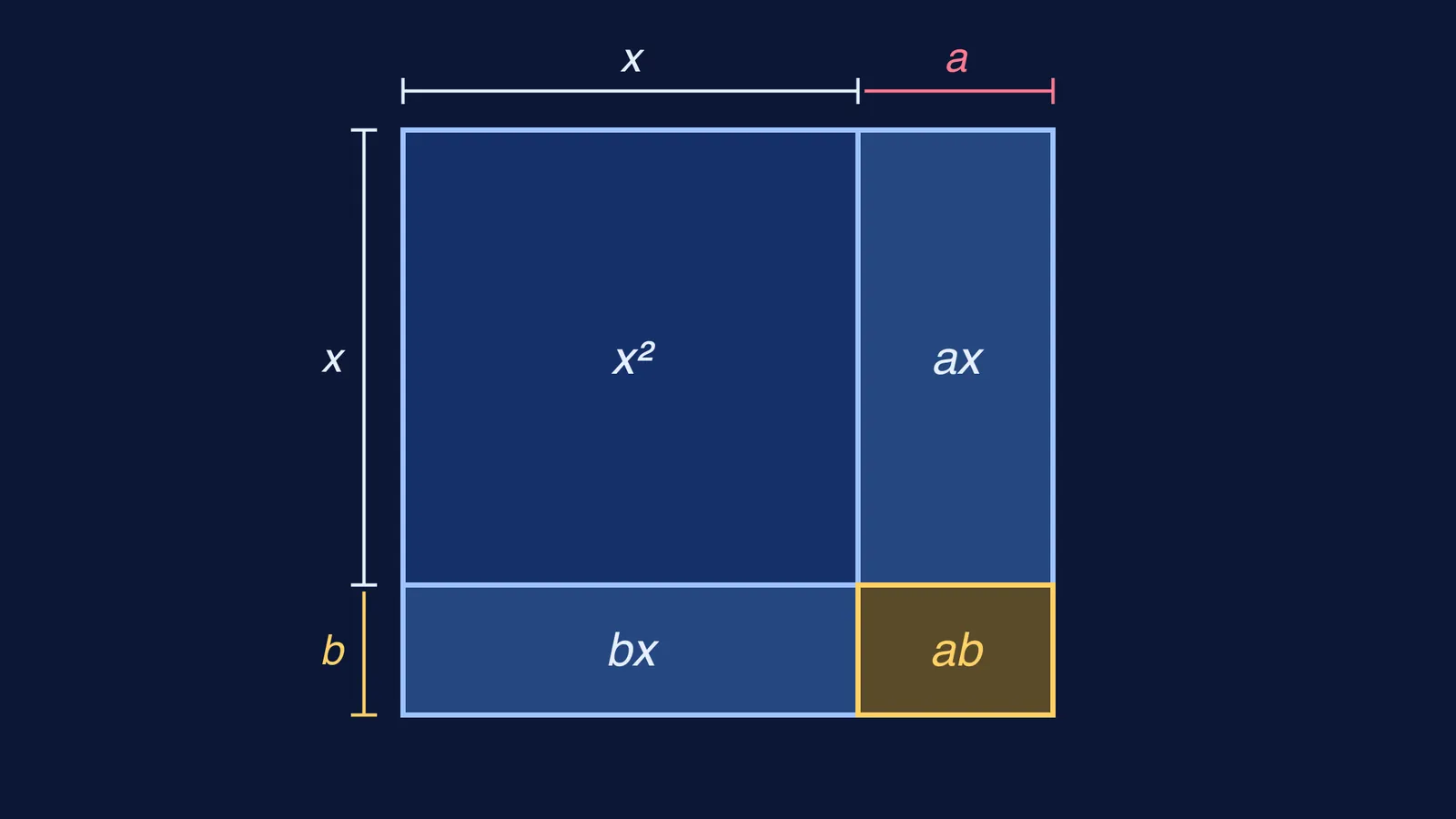
The picture at the top draws the same idea as a rectangle: a square of side x, strips x by a and x by b, and a corner a by b. The two strips are the middle term.
The numbers a and b can be negative; the chapter shows the signs follow the ordinary rules of integer multiplication. So for (x − 3)(x − 8), take a = −3 and b = −8 to get x² − 11x + 24.
How do you use it to multiply numbers quickly?
Write both numbers as a round base plus or minus a small number, then use the identity with x as the base.
103 × 104 = (100 + 3)(100 + 4) = 10,000 + 7 × 100 + 12 = 10,712.
97 × 104 = (100 − 3)(100 + 4) = 10,000 + 1 × 100 − 12 = 10,088.
52 × 47 = (50 + 2)(50 − 3) = 2,500 − 1 × 50 − 6 = 2,444.
(x + 4)(x − 7) = x² + (4 − 7)x + 4 × (−7) = x² − 3x − 28.
When both numbers are the same, a = b and you are squaring; that case has its own post on using (a + b)² to find 103² and 98 × 102.
How do you factorise x² + px + q with this identity?
Read the identity right to left. If x² + px + q = (x + a)(x + b), then a + b = p and ab = q. Your job is to find two numbers whose product is q and whose sum is p.
Worked example: factorise x² + 7x + 12.
List the factor pairs of 12: 1 and 12, 2 and 6, 3 and 4.
Pick the pair that adds to 7: 3 and 4.
Write the answer: (x + 3)(x + 4).
Expand to check: x² + 4x + 3x + 12 = x² + 7x + 12.
The signs of p and q tell you where to look before you list anything:
q positive, p positive: both numbers are positive. x² + 7x + 12 = (x + 3)(x + 4).
q positive, p negative: both numbers are negative. x² − 5x + 6 = (x − 2)(x − 3).
q negative: one number is positive and one negative, and the one with the larger size carries the sign of p. x² + 2x − 15 = (x + 5)(x − 3), and y² − 7y − 18 = (y − 9)(y + 2).
When x² has a coefficient other than 1, as in 6x² + 5x − 6, this shortcut does not apply directly; see how to factorise by splitting the middle term, signs included. If your two numbers come out equal, you have a perfect square, explained in how to factorise x² + 6x + 9 and spot a perfect square.
What mistakes do students make with (x + a)(x + b)?
Writing x² + ab and dropping the middle term. The area picture shows the two strips that went missing.
Checking only the sum or only the product. In x² + 7x + 12, the pair 5 and 2 adds to 7 but multiplies to 10; only 3 and 4 do both.
Losing a minus sign. Carry a and b with their signs: in (x − 9)(x + 2), a = −9 and b = 2, so the constant is −18, not 18.
Stopping at the factor pair without expanding back. The check is short and catches most sign errors.
If a sign keeps going wrong at the same step, the Fermi Problem Library has worked problems with a step-by-step solver that explains the reasoning rather than printing an answer, so you can see the exact line where it slipped.
What should you practise first?
Do three short rounds, in this order, and check every answer by expanding or by putting x = 1.
Expand: (x + 6)(x + 2), (x − 5)(x + 9), (y − 4)(y − 11), (p + 8)(p − 3), (x − 7)(x − 1).
Multiply in your head: 12 × 13, 98 × 96, 51 × 56, 103 × 97, 49 × 44.
Factorise: x² + 9x + 20, x² − 9x + 20, x² + x − 20, x² − x − 20, x² − 12x + 35.
In round three, the same two numbers, 4 and 5, give four different quadratics; only the signs change.
To see where this identity sits next to (a + b)², (a − b)² and a² − b², each idea in the Fermi Concept Library has its own lesson and its place in the map. Start with round one today.