On this page
Class 9 maths has a new textbook for 2026-27. NCERT's Ganita Manjari Part II (first edition, August 2026) covers linear equations in two variables in Chapter 13, "Two Variables, One Line", as its contents page shows. Notes written for the older NCERT book overlap in ideas but not in order or exercises, so work from the new chapter PDF. Every example below uses our own numbers.
What does Chapter 13 of Ganita Manjari cover?
The chapter builds on linear polynomials from Part I and moves through:
the standard form ax + by + c = 0 and its solutions as ordered pairs
why all the solutions lie on one straight line
slope (rise over run) and the slope-intercept form y = mx + d
solving a pair of equations by substitution, elimination and graphs
when a pair has one, no or infinitely many solutions
In the chapter, a linear equation in two variables is any equation that can be written as ax + by + c = 0, where a, b and c are real numbers and a and b are not both zero.
How do you find solutions of ax + by + c = 0?
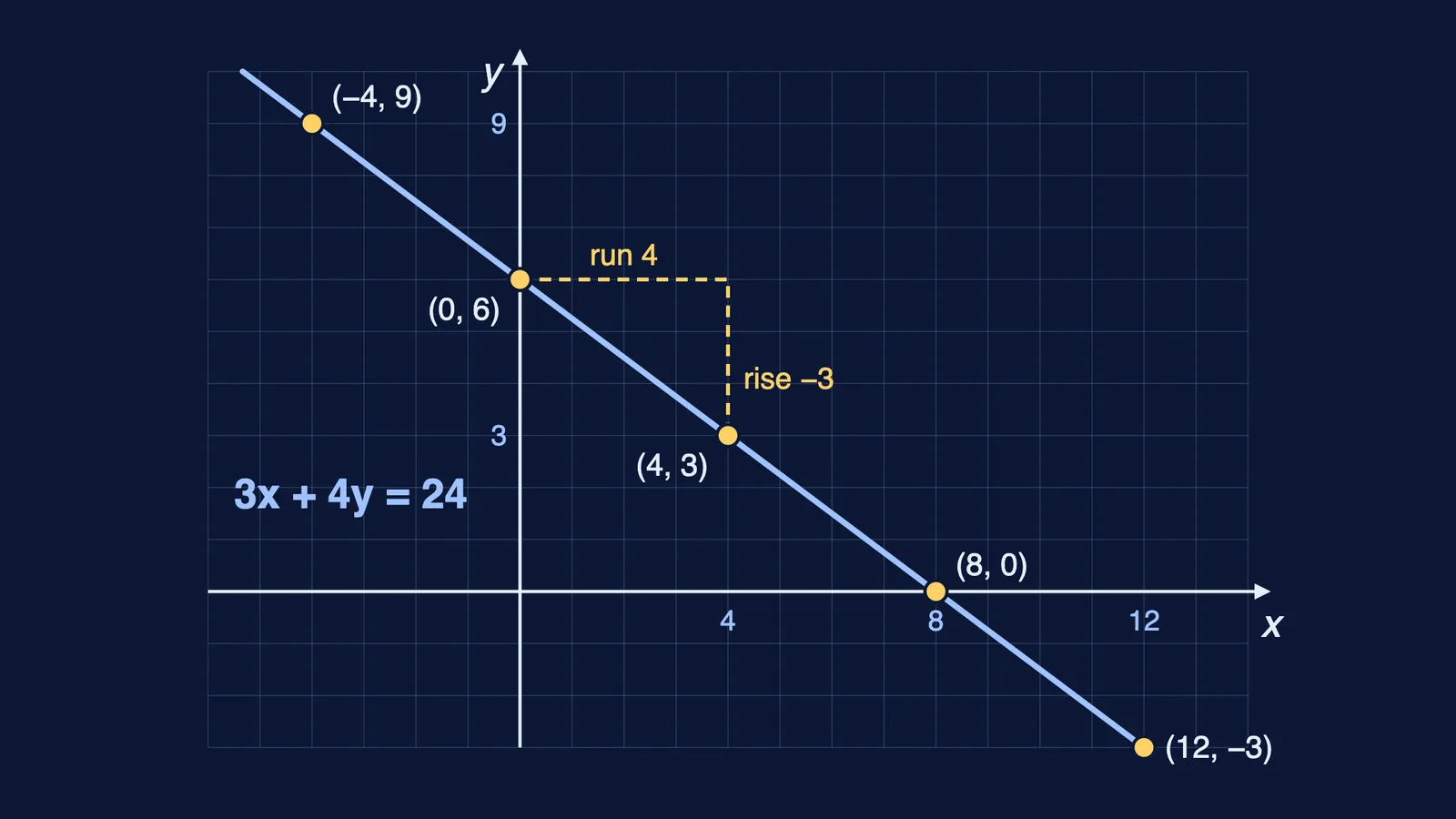
A samosa costs ₹15, a juice ₹20, and you spend exactly ₹120. With x samosas and y juices, 15x + 20y = 120. Divide by 5: 3x + 4y = 24, or 3x + 4y − 24 = 0 in standard form.
Put x = 0: 4y = 24, so y = 6. Solution (0, 6).
Put y = 0: 3x = 24, so x = 8. Solution (8, 0).
Check with x = 4: 4y = 12, so y = 3. Solution (4, 3).
These are the yellow points in the graph above. Any x gives a matching y, which is why a linear equation in two variables has infinitely many solutions. But (2, 4.5) means half a juice. With whole numbers only, just (0, 6), (4, 3) and (8, 0) fit. The CBSE 2026-27 syllabus lists graphs where x and y take only certain values as a key concept.
What do the slope and y-intercept tell you?
Rearrange: 4y = −3x + 24, so y = −(3/4)x + 6. The slope is m = −3/4 and the line crosses the y-axis at (0, 6).
Check with rise over run: from (0, 6) to (4, 3) the rise is −3 and the run is 4, giving −3/4. From standard form, m = −a/b gives the same. The line falls left to right: each extra samosa means three-quarters of a juice less, because 15/20 = 3/4.
How do you solve a pair of linear equations?
Suppose you also bought 7 items in all: x + y = 7.
Substitution: y = 7 − x, so 3x + 4(7 − x) = 24, giving 28 − x = 24, x = 4 and y = 3.
Elimination: 3 × (x + y = 7) gives 3x + 3y = 21. Subtract from 3x + 4y = 24: y = 3, then x = 4.
Check: 3(4) + 4(3) = 24 and 4 + 3 = 7. On a graph the lines meet at (4, 3).
So 3x + 4y = 24 with 6x + 8y = 48 (ratios 1/2, 1/2, 1/2) is one line counted twice, while 6x + 8y = 30 (c ratio 4/5) is parallel and has no solution.
Which mistakes cost marks in this chapter?
Swapping the pair. (3, 4) gives 9 + 16 = 25, not 24, so it is not a solution.
Losing the minus sign. m = −a/b, not a/b.
Special lines. y = 5 has slope 0; x = 2 is vertical with undefined slope. See why x = 2 is a line parallel to the y-axis.
Plotting only two points. A third point catches a slip.
Ignoring the story. Negative or fractional answers may not fit tickets or samosas.
If a pair keeps going wrong and you cannot see where, the Fermi Problem Library has worked problems with a step-by-step solver that explains the reasoning rather than printing an answer.
How many marks does this chapter carry in CBSE 2026-27?
The CBSE 2026-27 Class IX maths curriculum gives the Algebra unit 20 marks out of 80 in the 3-hour paper. Those 20 marks are shared by four chapters: Introduction to Polynomials, Sequences and Progressions, Exploring Algebraic Identities, and Linear Equations in Two Variables (CBSE's name for this one). There is no separate figure per chapter.
Practise (answers in brackets):
Three solutions of 5x + 2y = 20. [(0, 10), (2, 5), (4, 0)]
Slope and y-intercept of 2x − 5y + 10 = 0. [m = 2/5, d = 2]
Solve x − y = 1 and 2x + 3y = 12. [x = 3, y = 2]
Does 4x − 6y = 8 with 6x − 9y = 10 have a solution? [No: ratios 2/3, 2/3, 4/5]