On this page
Circles, Chapter 10 of NCERT Class 10 Mathematics (Reprint 2026-27), is short, but its vocabulary carries every proof in it. The CBSE Class X Mathematics syllabus for 2026-27 lists two tangent theorems under this unit, both marked "(Prove)". Each term below is in our own words and checked against the chapter. For theorems and solved problems, read our Class 10 circles guide to tangent theorems.
Which Class IX circle terms does this chapter assume?
NCERT recalls these first; nearly every proof uses them.
Circle: all points in a plane at a fixed distance from a fixed point. Example: every point on a bangle's rim is the same distance from its middle.
Centre: that fixed point, usually named O.
Radius: the fixed distance, or a segment joining the centre to a point on the circle. All radii of one circle are equal, which is the step "OQ = OR" in many proofs.
Chord: a segment joining two points of the circle. Don't confuse with: secant, which is the whole line through those two points.
Diameter: a chord through the centre; it is twice the radius.
Arc: a piece of the circle between two of its points.
Segment: the region between a chord and its arc. Don't confuse with: sector.
Sector: the region between two radii and the arc they cut off, like a pizza slice. Areas of both are worked in areas related to circles, Class 10.
Concentric circles: circles with the same centre and different radii. Example: radii 10 cm and 6 cm; a chord of the larger one that touches the smaller one has length 2 × √(100 − 36) = 16 cm.
What is the difference between a tangent and a secant?
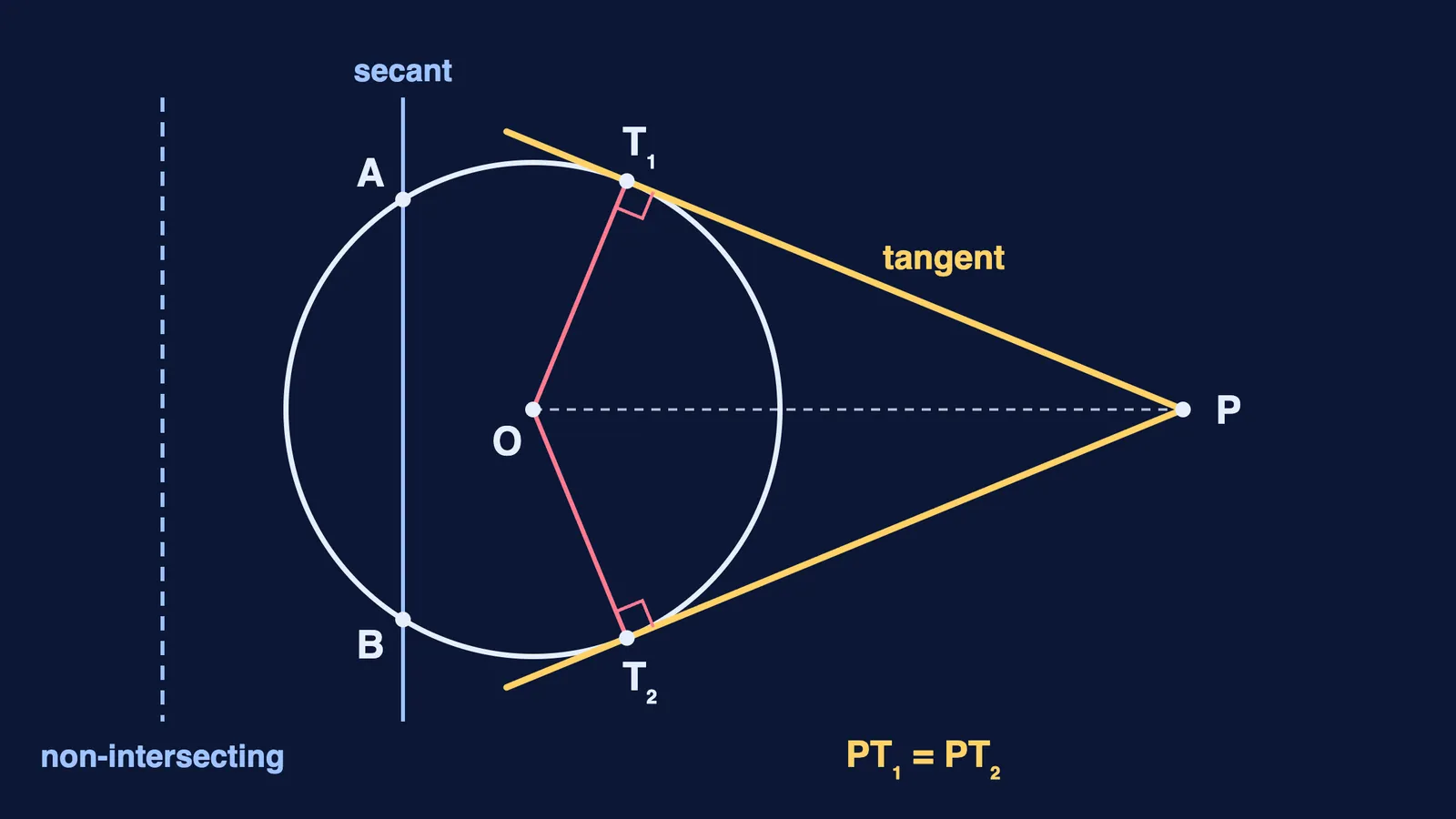
A line and a circle in one plane meet in exactly three ways.
Non-intersecting line: a line with no point in common with the circle. Example: a line 7 cm from the centre of a circle of radius 5 cm.
Secant: a line that cuts the circle at two points. Example: a line 3 cm from the centre of that circle.
Tangent: a line that meets the circle at exactly one point. Example: a line exactly 5 cm from the centre.
Point of contact: the one common point of a tangent and the circle; the tangent "touches" the circle there. Don't confuse with: an external point, which lies outside the circle.
Tangent as a limiting secant: turn a secant about one of its points until the second point slides onto the first; the chord shrinks to zero and the secant becomes the tangent.
Parallel tangents: for a given secant, at most two tangents are parallel to it, one on each side. Example: tangents at the two ends of a diameter are parallel.
Normal: the line through the centre and the point of contact, at right angles to the tangent there. Don't confuse with: the tangent, which is at 90° to it.
How many tangents can be drawn from a point?
Point inside the circle: no tangent; every line through it is a secant.
Point on the circle: one and only one tangent, which Theorem 10.1 also implies.
External point: a point outside the circle; exactly two tangents pass through it.
Length of a tangent: how far the external point is from the point of contact, measured along the tangent. Don't confuse with: OP, the distance from the external point to the centre. Example: radius 6 cm, OP = 10 cm gives tangent length √(100 − 36) = 8 cm.
What do the two tangent theorems say?
Theorem 10.1: the radius drawn to the point of contact is at 90° to the tangent at that point.
Theorem 10.2: from a point outside a circle, the two tangent segments to their points of contact have the same length. Example: if PA = 12 cm, then PB = 12 cm too.
Angle bisector property: the line from the external point to the centre bisects the angle between the two tangents, so the centre lies on that bisector.
Angle between two tangents: it is supplementary to the angle that the segment joining the points of contact subtends at the centre. Example: if angle POQ = 110°, the tangents meet at 70°.
Isosceles tangent triangle: the two tangents and the chord joining their points of contact form an isosceles triangle, because the tangents are equal.
Which terms appear in proofs and circumscribed figures?
RHS congruence: two right triangles are congruent if hypotenuse and one side match. Theorem 10.2 uses triangles OQP and ORP.
CPCT: corresponding parts of congruent triangles are equal; it turns the congruence into PQ = PR.
Pythagoras theorem: in the right triangle OTP, PT² = OP² − OT².
Quadrilateral circumscribing a circle: every side touches the circle. Then AB + CD = AD + BC. Example: AB = 6, BC = 7, CD = 8 gives AD = 7.
Triangle circumscribing a circle: each vertex sends two equal tangent segments. Example: segments of 3, 4 and 5 cm from A, B and C give sides AB = 7, BC = 9, CA = 8 cm.
Circumscribing parallelogram: a parallelogram drawn around a circle is a rhombus.
Supplementary angles at the centre: opposite sides of a quadrilateral circumscribing a circle subtend angles adding to 180° at the centre.
Constructing tangents with ruler and compass is not in the current NCERT chapter or the 2026-27 syllabus unit, so it is left out here.
How to learn these terms
Learn in pairs: chord and secant, tangent and normal, segment and sector, length of tangent and distance to the centre.
Draw the hero figure from memory: circle, centre, external point, two tangents, both right angles. Label every term on it.
For each theorem, say which terms the proof uses (radius, right angle, RHS, CPCT) before writing it out.
Test the three line positions with distances: compare the distance from the centre with the radius.
If a term still feels vague, the Fermi Concept Library gives every concept in mathematics its own lesson and its place in the map.