On this page
Triangles is Chapter 6 of the NCERT Class 10 Mathematics textbook (Reprint 2026-27), and it is all about similarity. The CBSE Class X Mathematics syllabus for 2026-27 asks you to prove the basic proportionality theorem and to state its converse and the AAA, SSS and SAS criteria without proof. Below are 24 key terms in five groups, with examples. For a study plan, read our Triangles Class 10 chapter guide.
Not covered: areas of similar triangles and the Pythagoras theorem. The rationalised chapter has no section on either (it runs 6.1 to 6.5), and neither appears in the CBSE 2026-27 Triangles entry.
What are similar figures?
From section 6.2 of the NCERT chapter.
Similar figures: figures with the same shape, whatever their size. Example: any two circles, or any two squares.
Congruent figures: figures with the same shape and the same size. Congruent figures are always similar, not the reverse.
Similar polygons: two polygons with equally many sides are similar when every pair of matching angles is equal and every pair of matching sides has one common ratio. Both conditions are needed: a square and a non-square rectangle have equal angles, and a square of side 2 and a rhombus of side 4 with a 60° angle have proportional sides, yet neither pair is similar.
Corresponding parts: the angles and sides that match when a figure is compared with its scaled copy.
Proportional sides: sides whose ratios are all equal. Example: 3, 4, 5 and 6, 8, 10 give 3/6 = 4/8 = 5/10.
Scale factor (representative fraction): that common ratio of corresponding sides. Example: from 3, 4, 5 to 6, 8, 10 it is 2; above 1 enlarges, below 1 reduces.
How do you write a similarity statement?
Similar triangles: triangles with equal corresponding angles and corresponding sides in one ratio.
The symbol ~: read "is similar to". ΔABC ~ ΔDEF means A matches D, B matches E and C matches F.
Correspondence of vertices: the letter order decides which parts match, so ΔABC ~ ΔDEF gives AB/DE = BC/EF = CA/FD. ΔBAC ~ ΔEDF is also correct; ΔABC ~ ΔEDF is not.
Equiangular triangles: triangles whose corresponding angles are all equal. Don't confuse with: equilateral, meaning three equal sides in one triangle.
What does the basic proportionality theorem say?
From Theorems 6.1 and 6.2, Example 2 and Exercise 6.2 of the NCERT chapter. In ΔABC, D lies on AB and E on AC.
Basic proportionality theorem (BPT), or Thales theorem: a line parallel to one side of a triangle, cutting the other two sides at distinct points, divides those sides in the same ratio. If DE ∥ BC, then AD/DB = AE/EC. Example: AD = 2, DB = 3, AE = 4 gives EC = 6.
Equivalent form: if DE ∥ BC, then AD/AB = AE/AC as well. Example: AD = 2, AB = 5 and AC = 10 give AE = 4. Don't confuse with: AD/DB = AE/AC, a wrong mix of both forms.
Converse of the BPT: if a line divides two sides of a triangle in the same ratio, it is parallel to the third side. Example: AD = 1.5, DB = 3, AE = 2, EC = 4 give 1/2 both times, so DE ∥ BC. Unequal ratios, such as 2/3 and 3/4, mean it is not.
Mid-point result: a line through the mid-point of one side, parallel to a second side, bisects the third side.
Trapezium result: in trapezium ABCD with AB ∥ DC, a line EF parallel to AB cuts the non-parallel sides so that AE/ED = BF/FC.
Which criteria prove two triangles similar?
From section 6.4 of the NCERT chapter. For triangles, unlike other polygons, one condition brings the other.
AAA criterion: equal corresponding angles make corresponding sides proportional, so the triangles are similar (Theorem 6.3).
AA criterion: two pairs of equal angles are enough. Example: 50° and 60° in both triangles force 70° in both. Don't confuse with: AAA, which checks one angle more than needed.
Angle sum property: a triangle's angles add up to 180°, which is why AA works.
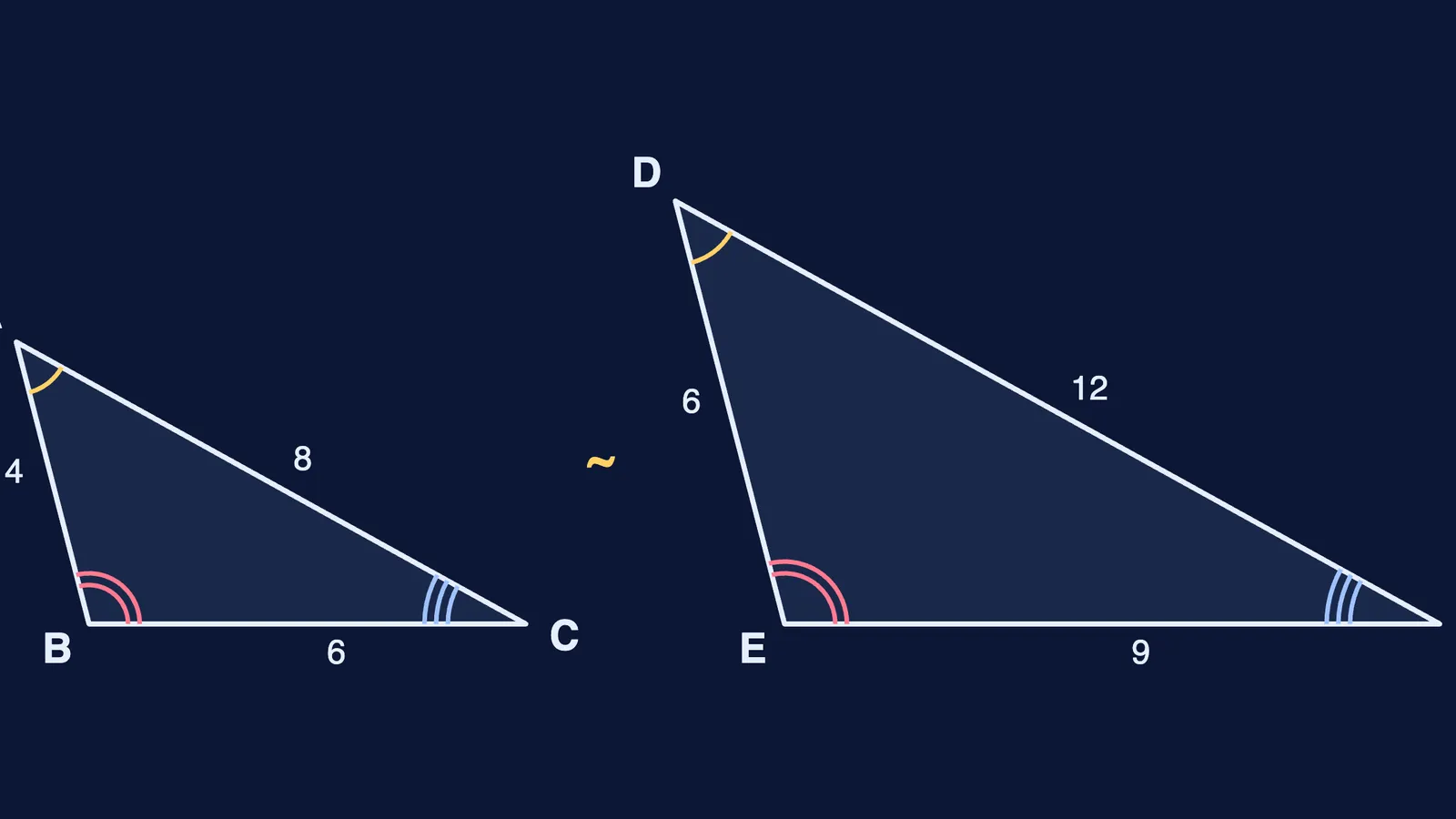
SSS criterion: if all three pairs of corresponding sides are in the same ratio, the triangles are similar (Theorem 6.4). Example: 4, 6, 8 and 6, 9, 12, each pair in the ratio 2 : 3, as in the diagram above. Don't confuse with: SSS congruence, which needs equal sides.
SAS criterion: when one pair of angles is equal and the two sides forming that angle in one triangle are in the same ratio as the two sides forming it in the other, the triangles are similar (Theorem 6.5). Example: AB = 3, AC = 5, ∠A = 40° and DE = 6, DF = 10, ∠D = 40°.
Included angle: the angle between the two sides you compare. An equal angle that is not between the proportional sides proves nothing.
Where is similarity used?
Indirect measurement: finding a height you cannot tape-measure from similar triangles. Shadow example: at the same moment, a pole and a tree make similar triangles with their shadows. Example: a 2 m pole casts 1.5 m and a tree casts 12 m, so the tree is 16 m tall.
Lamp-post shadow: a person 1.6 m tall stands 3 m from the foot of a 4 m lamp-post. By AA, (3 + x)/x = 4/1.6, so the shadow x = 2 m.
Corresponding medians: in similar triangles, corresponding medians follow the scale factor. Example: ΔABC ~ ΔPQR, AB = 6, PQ = 4 and median CM = 4.5 give median RN = 3.
How to learn these terms
Learn pairs together: SSS similarity and SSS congruence, AA and AAA, the BPT and its converse.
Write the similarity statement before any ratio, keeping the letters in order.
Draw the BPT figure from memory and write both ratio forms under it.
Test yourself with our Triangles assertion-reason questions for Class 10, and see similar vs congruent triangles side by side.
If ratio and proportion still feel shaky, the Fermi Concept Library gives every mathematics concept its own lesson and shows where it sits in the map.