On this page
These are the key terms of Chapter 7, Coordinate Geometry, in the NCERT Class 10 Mathematics textbook (Reprint 2026-27), grouped by topic, each with a plain definition, a short example and, where students often slip, a "Don't confuse with" note.
The CBSE Class 10 Mathematics curriculum for 2026-27 lists the distance formula and the section formula (internal division) for this unit. The area-of-a-triangle formula from older editions is not in the current chapter, and external division is left for higher classes. For the chapter plan, see our Class 10 coordinate geometry guide.
What are the basic terms of the coordinate plane?
Coordinate geometry: studying shapes with algebra by giving every point a pair of numbers.
Coordinate axes: two perpendicular number lines, the x-axis and the y-axis.
Origin (O): the point where the axes cross, (0, 0).
Coordinates: the ordered pair (x, y) that fixes a point. Example: (3, −2) is 3 units right of the y-axis and 2 below the x-axis. Don't confuse with: (−2, 3); order matters.
Abscissa (x-coordinate): the first number, giving the point's distance from the y-axis, positive to the right and negative to the left.
Ordinate (y-coordinate): the second number, giving the point's distance from the x-axis, positive above and negative below.
Point on an axis: points on the x-axis have the form (x, 0); points on the y-axis have the form (0, y).
Quadrant: one of the four regions made by the axes, numbered anticlockwise from the top right. Signs: I (+, +), II (−, +), III (−, −), IV (+, −).
What is the distance formula in Class 10?
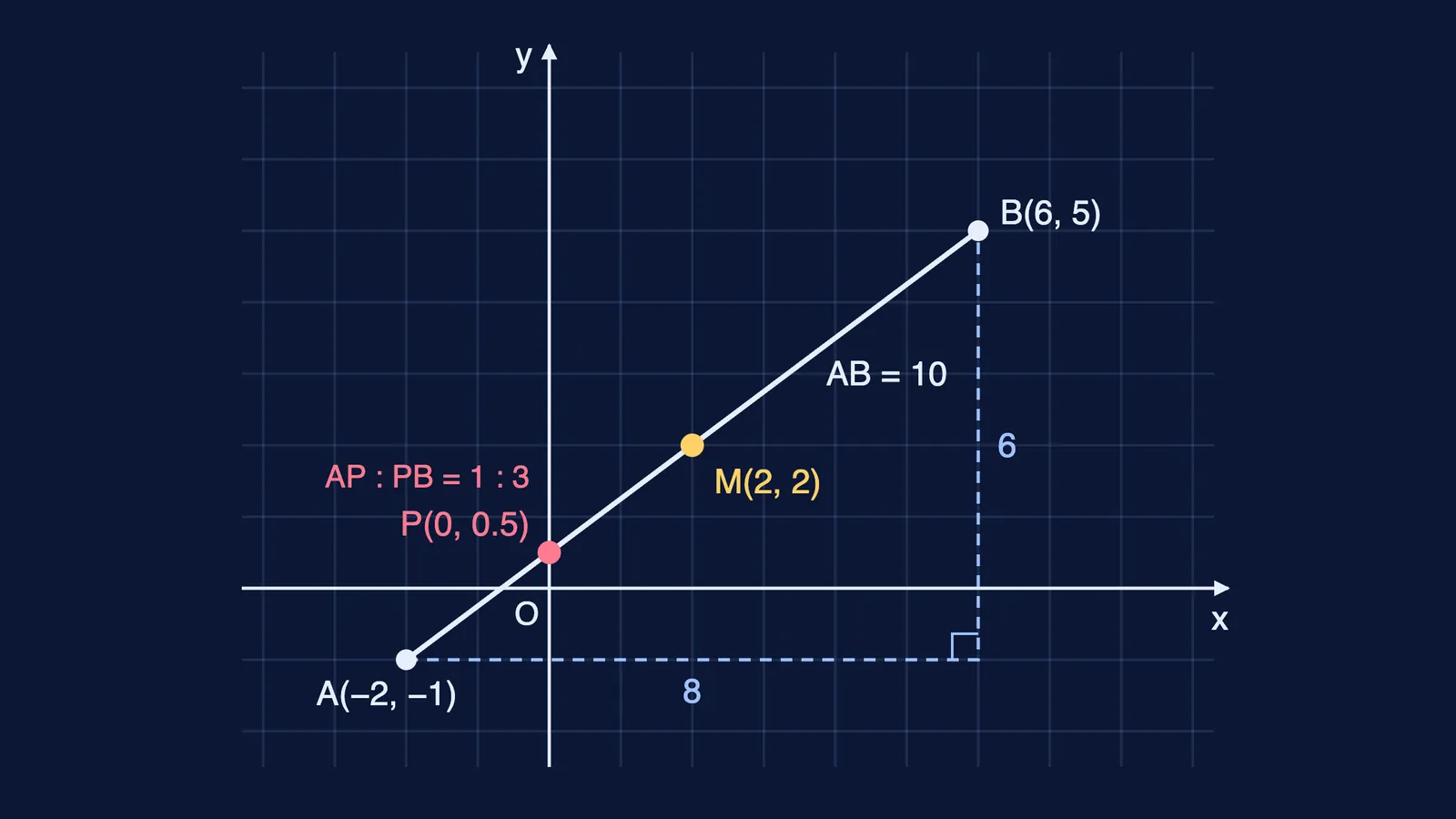
Distance formula: the distance between P(x1, y1) and Q(x2, y2) is PQ = √[(x2 − x1)² + (y2 − y1)²]. It is Pythagoras theorem on a right triangle with legs parallel to the axes. Take the positive root; the order of subtraction does not matter. Example: A(−2, −1) to B(6, 5) has legs 8 and 6, so AB = 10.
Distance from the origin: for P(x, y), OP = √(x² + y²). Example: (5, −12) is √169 = 13 units from O.
Distance between points on the same axis: subtract the changing coordinates: (0, −3) and (0, 7) are 10 units apart.
Collinear points: points on one straight line. Three points are collinear when the two shorter distances add up to the longest. Example: for (1, 1), (3, 5) and (4, 7), the distances are 2√5, √5 and 3√5, and 2√5 + √5 = 3√5.
Equidistant point: a point the same distance from two given points. Set AP² = BP² to avoid square roots. Example: a point (x, y) equidistant from (1, 2) and (5, 2) gives (x − 1)² = (x − 5)², so x = 3.
Perpendicular bisector: the line through a segment's mid-point at right angles to it; every equidistant point lies on it, here x = 3.
Which shapes can you identify with distances?
Triangle test: three points form a triangle when any two distances add up to more than the third. Don't confuse with: collinear, where one sum equals the third exactly.
Converse of Pythagoras theorem: if the longest side squared equals the sum of the other two squared, the triangle is right-angled. Example: (0, 0), (3, 0) and (0, 4) give sides 3, 4 and 5, and 9 + 16 = 25.
Square (by distances): all four sides equal and both diagonals equal.
Rhombus (by distances): all four sides equal; unequal diagonals mean it is not a square.
How does the section formula divide a line segment?
Internal division: a point P between A and B on segment AB splits it into AP and PB.
Ratio m1 : m2: P divides AB in the ratio m1 : m2 when PA : PB = m1 : m2. Example: in the diagram, PA = 2.5 and PB = 7.5, so the ratio is 1 : 3.
Section formula: for A(x1, y1), B(x2, y2) and internal ratio m1 : m2, P = ((m1x2 + m2x1)/(m1 + m2), (m1y2 + m2y1)/(m1 + m2)). Example: A(−2, −1), B(6, 5), ratio 1 : 3 gives P = ((6 − 6)/4, (5 − 3)/4) = (0, 0.5). Don't confuse with: m1 times x1; m1 multiplies B's coordinates.
k : 1 form: P = ((kx2 + x1)/(k + 1), (ky2 + y1)/(k + 1)), one unknown instead of two; use it to find a ratio.
Point where a segment meets an axis: on the y-axis the abscissa is 0; on the x-axis the ordinate is 0. Example: for A(−2, −1) and B(6, 5), (6k − 2)/(k + 1) = 0 gives k = 1/3, a ratio of 1 : 3. Our section formula walkthrough has more.
Mid-point formula: the 1 : 1 case, ((x1 + x2)/2, (y1 + y2)/2). Example: the mid-point of A(−2, −1) and B(6, 5) is M(2, 2).
Points of trisection: the two points cutting a segment into three equal parts, at ratios 1 : 2 and 2 : 1. Example: for (1, −2) and (7, 4), they are (3, 0) and (5, 2). Don't confuse with: the mid-point, which uses 1 : 1.
Parallelogram (by mid-points): its diagonals bisect each other, so they share a mid-point. Example: A(0, 0), B(4, 1), C(6, 4); the mid-point of AC is (3, 2), so D = (2, 3).
Centre as mid-point of a diameter: a circle's centre is the mid-point of any diameter. Example: centre (3, 1) and one end (1, −2) give the other end (5, 4).
How to learn these terms
Sketch every example on squared paper first; it shows which point is closer to A.
Learn the pairs together: abscissa and ordinate, collinear and triangle, square and rhombus, mid-point and trisection.
In the section formula, m1 goes with B and m2 with A; check the answer lies between A and B.
For equidistant points, square both distances first.
Read our common Class 10 maths answer mistakes and show each substitution as a line of working.
If a term feels shaky, the Fermi Concept Library covers every concept in mathematics, each with its own lesson and its place in the map.