On this page
These are the key terms of Chapter 2, Polynomials, in the NCERT Class 10 Mathematics textbook (Reprint 2026-27), grouped by topic, each with a short worked example. For the full chapter, read our Polynomials Class 10 guide.
The CBSE Class X Mathematics syllabus for 2026-27 lists two topics: zeros of a polynomial, and the relationship between zeros and coefficients of quadratic polynomials. The current NCERT chapter has no section on the division algorithm for polynomials (only its introduction still mentions it), so it is left out.
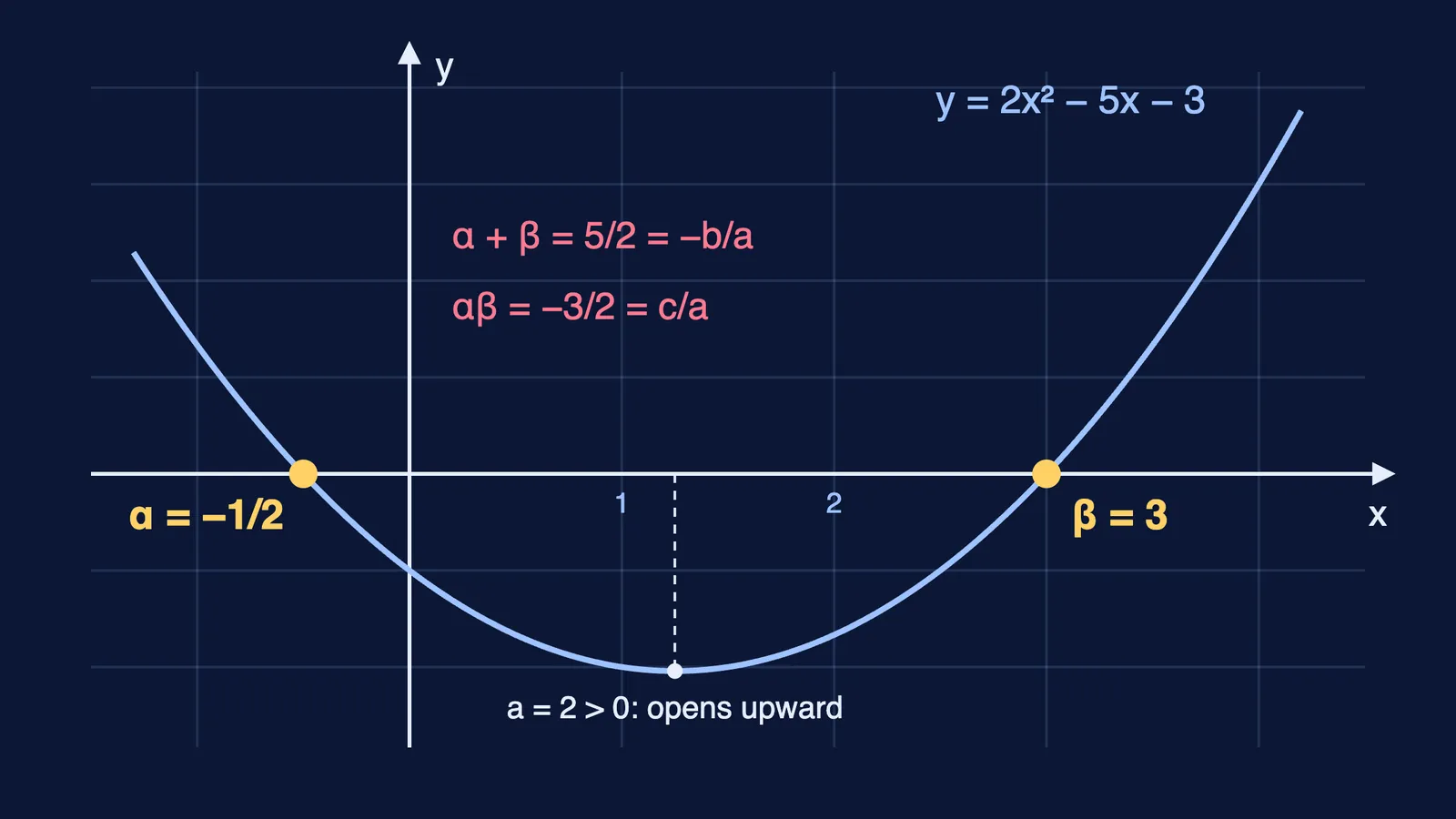
Most examples reuse one polynomial, p(x) = 2x² − 5x − 3.
What is a polynomial, and what is its degree?
Polynomial in one variable: a sum of terms, each a real number times a whole-number power of the variable (x⁰, x¹, x², ...). Example: 2x² − 5x − 3. Counter-example: 1/x + 4 is not one (x has power −1).
Coefficient: the number multiplying a power of x, sign included. Example: in p(x), the coefficient of x² is 2 and of x is −5.
Constant term: the term with no x. Example: −3 in p(x).
Degree: the highest power of x in the polynomial. Example: 5x³ − x has degree 3. Don't confuse with: the number of terms, which is 2 here.
Linear polynomial: degree 1, of the form ax + b with a ≠ 0. Example: 3x − 6.
Quadratic polynomial: degree 2, written ax² + bx + c with real a, b, c and a ≠ 0. Example: p(x), with a = 2, b = −5, c = −3.
Cubic polynomial: degree 3, of the form ax³ + bx² + cx + d, with a ≠ 0. Example: x³ − x.
What is a zero of a polynomial?
Value of p(x) at x = k, written p(k): what you get by putting k in place of x. Example: p(2) = 8 − 10 − 3 = −5.
Zero of a polynomial: a real number k for which p(k) = 0. Example: p(3) = 18 − 15 − 3 = 0, so 3 is a zero. Don't confuse with: p(0), the value at x = 0, which is just the constant term (−3 here).
Zero of a linear polynomial: ax + b has exactly one zero, −b/a. Example: 3x − 6 has zero −(−6)/3 = 2.
Factor (x − k): if k is a zero of p(x), then x − k is a factor of p(x). Example: 2x² − 5x − 3 = (2x + 1)(x − 3).
Splitting the middle term: the Class IX factorising method used to find zeroes. Example: 2 × (−3) = −6, so write −5x as −6x + x: 2x(x − 3) + 1(x − 3) = (2x + 1)(x − 3). The zeroes are −1/2 and 3.
At most n zeroes: the graph of a degree-n polynomial meets the x-axis at no more than n points, so it has no more than n zeroes. Example: a cubic has at most 3.
What do the zeroes look like on a graph?
Graph of a linear polynomial: y = ax + b (a ≠ 0) is a straight line that meets the x-axis at exactly one point, (−b/a, 0). Example: y = 3x − 6 meets it at (2, 0).
Parabola: the curve y = ax² + bx + c. It opens upward when a > 0 and downward when a < 0. Example: y = −x² + 4 opens downward.
Geometrical meaning of zeroes: every point where the graph of y = p(x) crosses or touches the x-axis gives a zero (its x-coordinate), and every zero comes from such a point. Example: y = 2x² − 5x − 3 meets it at (−1/2, 0) and (3, 0).
Two distinct zeroes: the parabola cuts the x-axis at two different points. Example: x² − 4, zeroes −2 and 2.
Two equal (coincident) zeroes: the parabola touches the x-axis at one point, so there is only one zero. Example: x² − 6x + 9 = (x − 3)², zero 3.
No zero: the parabola never reaches the x-axis; it lies entirely on one side of it. Example: x² + 1 is never 0 for real x.
Graph of a cubic: meets the x-axis at no more than 3 points. Example: x³ − x = x(x − 1)(x + 1) meets it at −1, 0 and 1; x³ meets it only at 0.
How are zeroes related to coefficients?
α, β, γ (alpha, beta, gamma): Greek letters NCERT uses for zeroes. Example: for p(x), α = −1/2, β = 3.
Sum of zeroes of a quadratic: α + β = −b/a. Example: −1/2 + 3 = 5/2, and −b/a = −(−5)/2 = 5/2.
Product of zeroes of a quadratic: αβ = c/a. Example: (−1/2) × 3 = −3/2 = c/a. Don't confuse with: the sum, which carries the minus sign; the product does not.
Quadratic from a sum and a product: if the zeroes have sum S and product P, one such polynomial is x² − Sx + P, and every other is k(x² − Sx + P) for a real k ≠ 0. Example: S = 5/2, P = −3/2 gives x² − (5/2)x − 3/2; with k = 2 it becomes 2x² − 5x − 3.
NCERT also states matching relations for cubic polynomials, but the syllabus names "Relationship between zeros and coefficients of quadratic polynomials" only, and NCERT marks its cubic worked example as "Not from the examination point of view", so they are not listed as key terms here.
How to learn these terms
Take one polynomial, such as 2x² − 5x − 3, and find its degree, coefficients, zeroes, sum and product.
Check every zero by putting it back into p(x).
Compare the three parabola cases in NCERT Figs 2.3 to 2.5 (cuts, touches, misses) and say how many zeroes each shows.
Say the signs aloud: sum −b/a, product c/a.
See how the same ideas return in our Quadratic equations Class 10 guide, and avoid slips with these common Class 10 maths mistakes. If a term feels slippery, the Fermi Concept Library gives every concept in mathematics its own lesson and its place in the map.