On this page
These definitions follow NCERT Class 10 Mathematics chapter 4, Quadratic Equations (Reprint 2026-27) and the CBSE 2026-27 Class 10 Mathematics syllabus. For the full chapter, read our Class 10 guide to quadratic equations.
Not included: completing the square. The current NCERT chapter mentions it only in a history note, and the CBSE syllabus lists solutions "(only real roots)" by factorisation and the quadratic formula.
What is a quadratic equation?
Quadratic polynomial: a polynomial of degree 2, written ax² + bx + c with a ≠ 0. Example: 3x² − 5x + 2.
Quadratic equation: a degree-2 polynomial set equal to zero, p(x) = 0. Example: x² − 7x + 10 = 0.
Standard form: ax² + bx + c = 0, with a, b, c real, a ≠ 0, terms in descending powers of x. Example: 5 + 2x − x² = 0 in standard form is −x² + 2x + 5 = 0.
Coefficients a, b, c: the fixed real numbers in standard form; c is the constant term. Example: 4x² − 9 = 0 has a = 4, b = 0, c = −9. Don't confuse with: the variable x, the unknown.
Condition a ≠ 0: if a = 0, the x² term disappears and the equation is not quadratic. Example: kx² + 3x + 1 = 0 is quadratic only when k ≠ 0.
Degree: the highest power of the variable; exactly 2 for a quadratic. Don't confuse with: the number of terms (x² = 9 has two terms, degree 2).
Simplify before deciding: expand and collect terms first. Example: x(x + 2) = x² + 6 becomes 2x − 6 = 0 (linear); (x − 1)³ = x³ + 2 becomes −3x² + 3x − 3 = 0 (quadratic).
What is a root of a quadratic equation?
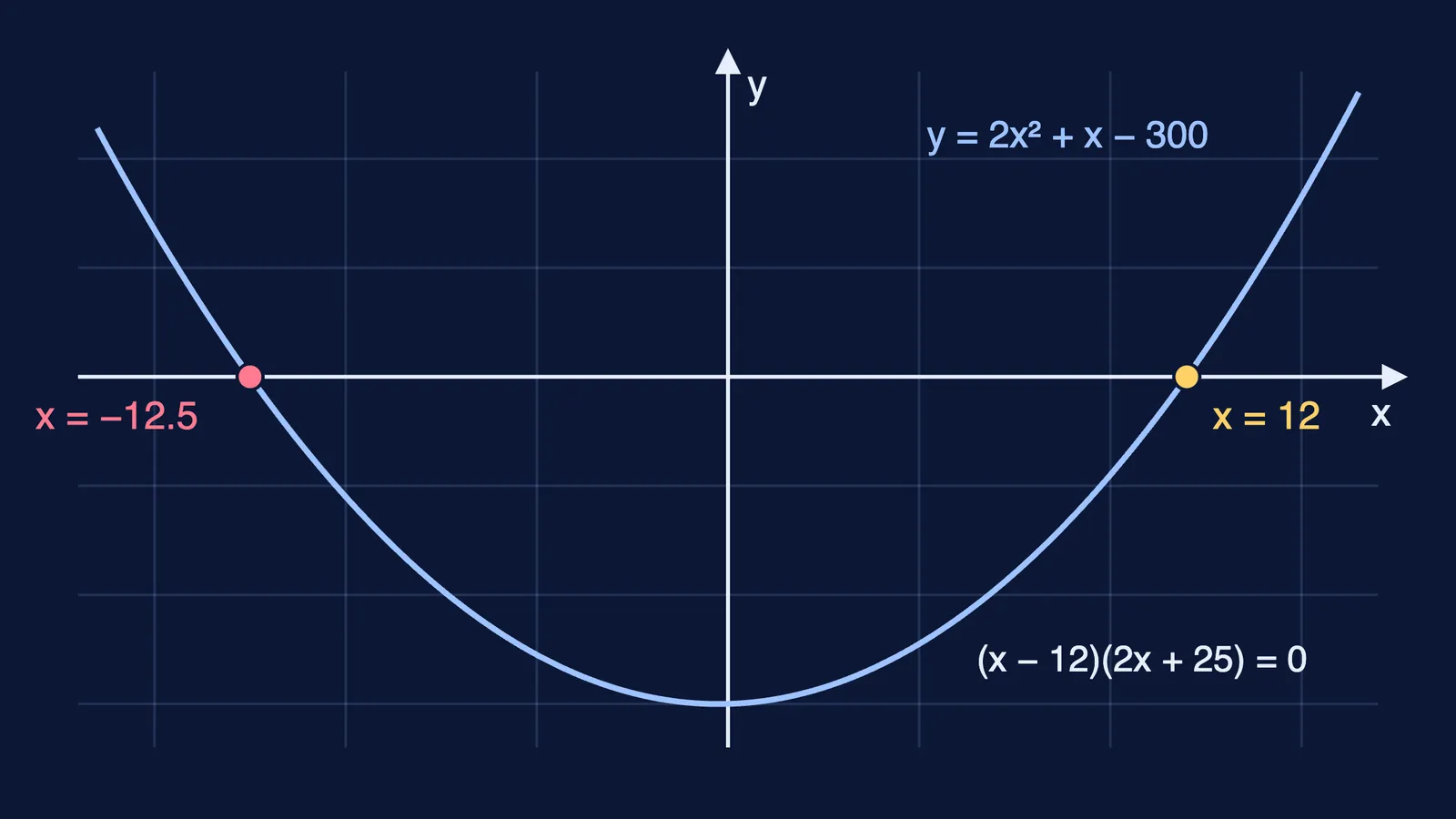
Root (solution): a real number α with aα² + bα + c = 0; putting x = α makes the left side zero. Example: 2 is a root of x² − 5x + 6 = 0 (4 − 10 + 6 = 0).
Satisfies: a number satisfies an equation if substituting it makes both sides equal, as 3 does for x² − 5x + 6 = 0.
Zero of a polynomial: a value of x that makes the polynomial 0; the zeroes of ax² + bx + c are the roots of ax² + bx + c = 0. Don't confuse with: the number 0, which is a root only when c = 0 (x² − 4x = 0 has roots 0 and 4).
At most two roots: a quadratic equation never has more than two roots.
How does factorisation find the roots?
Factorisation: writing ax² + bx + c as a product of two linear factors. Example: x² − 7x + 10 = (x − 2)(x − 5).
Linear factor: a factor of degree 1, such as (x − 2) or (2x + 1).
Splitting the middle term: find two numbers with sum b and product ac, rewrite bx with them, then group. Example: 2x² + 7x + 3 (ac = 6, use 6 and 1): 2x² + 6x + x + 3 = 2x(x + 3) + 1(x + 3) = (2x + 1)(x + 3).
Equating each factor to zero: if a product is 0, at least one factor is 0, so (2x + 1)(x + 3) = 0 gives x = −1/2 or −3.
Repeated root: both factors give the same root. Example: x² − 6x + 9 = (x − 3)², roots 3 and 3. Don't confuse with: no real roots.
What is the quadratic formula?
Quadratic formula: the roots of ax² + bx + c = 0 are x = (−b ± √(b² − 4ac)) / (2a), provided b² − 4ac ≥ 0. Example: x² − 4x + 1 = 0 gives x = (4 ± √12)/2 = 2 ± √3.
The ± sign: + gives one root, − the other. Don't confuse with: dividing only the square root by 2a; 2a divides the whole top line.
How does the discriminant decide the nature of roots?
Discriminant: the number b² − 4ac (often written D) for ax² + bx + c = 0.
Nature of roots: whether the roots are real, and distinct or equal.
Two distinct real roots: when b² − 4ac > 0. Example: x² − x − 6 = 0 has 25 > 0; roots 3 and −2.
Two equal real roots (coincident roots): when b² − 4ac = 0; both roots are −b/(2a). Example: 4x² + 4x + 1 = 0 has 16 − 16 = 0; both roots are −1/2.
No real roots: when b² − 4ac < 0, since no real number squares to a negative. Example: x² + x + 1 = 0 has 1 − 4 = −3. Don't confuse with: "the root is 0".
How are quadratic equations used in word problems?
Representing a situation: let x be one unknown, write the rest in terms of x, and form ax² + bx + c = 0. Example: two consecutive positive integers with product 132 give x(x + 1) = 132, so x² + x − 132 = 0.
Rejecting a root: discarding a root impossible in context. Example: (x + 12)(x − 11) = 0 gives 11 or −12; the integers are positive, so they are 11 and 12. NCERT's prayer-hall example rejects −12.5, since a breadth cannot be negative.
Checking the answer: test it against the story: 11 × 12 = 132.
How to learn these terms
Learn terms in pairs: root and zero, repeated root and no real roots.
Make a three-line card for b² − 4ac > 0, = 0 and < 0, each with an example you made up.
Before solving, write a, b and c with their signs.
In word problems, write "Let x be..." with units and state which root you rejected, and why. Practise on our quadratic equations case study questions for Class 10, with the Class 10 quadratic equations formula sheet beside you.
For a refresher, the Fermi Concept Library covers every concept in mathematics, each with its own lesson and its place in the map.