On this page
These terms come from the NCERT Class 10 Mathematics chapters Introduction to Trigonometry and Some Applications of Trigonometry (Reprint 2026-27), which form Unit V of the CBSE Class 10 Mathematics syllabus for 2026-27. For the full walkthrough, read our Class 10 trigonometry chapter guide.
Examples use one triangle: ABC, right-angled at B, with AB = 12, BC = 5, AC = 13. The current NCERT chapter has no section on complementary-angle ratios such as sin (90° − A) = cos A, so they are left out.
What are the parts of a right triangle in trigonometry?
Trigonometry: the branch of maths that links a triangle's angles to the lengths of its sides.
Acute angle: an angle greater than 0° and less than 90°. Ratios are defined first for the acute angles of a right triangle. Example: angles A and C.
Hypotenuse: the side facing the right angle, and the longest side. Example: AC = 13.
Side opposite to an angle: the side that faces that angle. Example: BC = 5 is opposite angle A.
Side adjacent to an angle: the side, other than the hypotenuse, that forms the angle. Example: AB = 12 for angle A. Don't confuse with: angle C, where AB becomes opposite and BC adjacent.
Trigonometric ratio: a ratio of two sides of a right triangle, taken for one acute angle. It depends only on the angle, not the triangle's size (similar triangles). Example: sides 10, 24, 26 still give sin A = 5/13.
What are the six trigonometric ratios?
Sine (sin A): opposite ÷ hypotenuse. Example: 5/13.
Cosine (cos A): adjacent ÷ hypotenuse. Example: 12/13.
Tangent (tan A): opposite ÷ adjacent, also sin A ÷ cos A. Example: 5/12.
Cosecant (cosec A): 1 ÷ sin A, so hypotenuse ÷ opposite. Example: 13/5.
Secant (sec A): 1 ÷ cos A, so hypotenuse ÷ adjacent. Example: 13/12. Don't confuse with: cosec A, which pairs with sin A.
Cotangent (cot A): 1 ÷ tan A, so adjacent ÷ opposite, also cos A ÷ sin A. Example: 12/5.
The symbol sin A: short for "the sine of angle A", not sin multiplied by A.
sin² A: means (sin A)². Example: 25/169. Don't confuse with: sin⁻¹ A, which is not 1/sin A (that is cosec A); it has a different meaning, met in higher classes.
What values do the ratios take at 0°, 30°, 45°, 60° and 90°?
Specific angles: 0°, 30°, 45°, 60° and 90°. 45° comes from an isosceles right triangle; 30° and 60° from half an equilateral triangle. Example: sin 45° = 1/√2.
Ratios at 0° and 90°: found by shrinking angle A towards 0° or growing it towards 90°: sin 0° = 0, cos 0° = 1, sin 90° = 1, cos 90° = 0.
Not defined: a ratio that would need division by zero. Example: tan 90° = 1 ÷ 0; also cot 0°, cosec 0° and sec 90°. Don't confuse with: zero; tan 0° = 0 is defined.
Limits on the values: sin A and cos A never exceed 1, since the hypotenuse is longest; sec A ≥ 1 for 0° ≤ A < 90° and cosec A ≥ 1 for 0° < A ≤ 90°. Don't confuse with: tan A, which can exceed 1 (tan 60° = √3).
What is a trigonometric identity?
Identity: an equation that holds whatever values its variables take. Example: (x + 1)² = x² + 2x + 1.
Trigonometric identity: an equation in trigonometric ratios that holds for every angle in its stated range. Counter-example: sin (A + B) = sin A + sin B fails at A = B = 45°, since sin 90° = 1 but 1/√2 + 1/√2 = √2.
sin² A + cos² A = 1: divide AB² + BC² = AC² by AC²; true for 0° ≤ A ≤ 90°. Example: 25/169 + 144/169 = 1.
1 + tan² A = sec² A: divide by AB²; true for 0° ≤ A < 90°, as tan 90° and sec 90° are not defined. Example: 1 + 25/144 = 169/144.
1 + cot² A = cosec² A: divide by BC²; true for 0° < A ≤ 90°. Example: 1 + 144/25 = 169/25.
What do line of sight, angle of elevation and angle of depression mean?
Heights and distances: using ratios to find a height or distance you cannot measure directly. Example: a tower top seen at 45° from 20 m away is 20 × tan 45° = 20 m high.
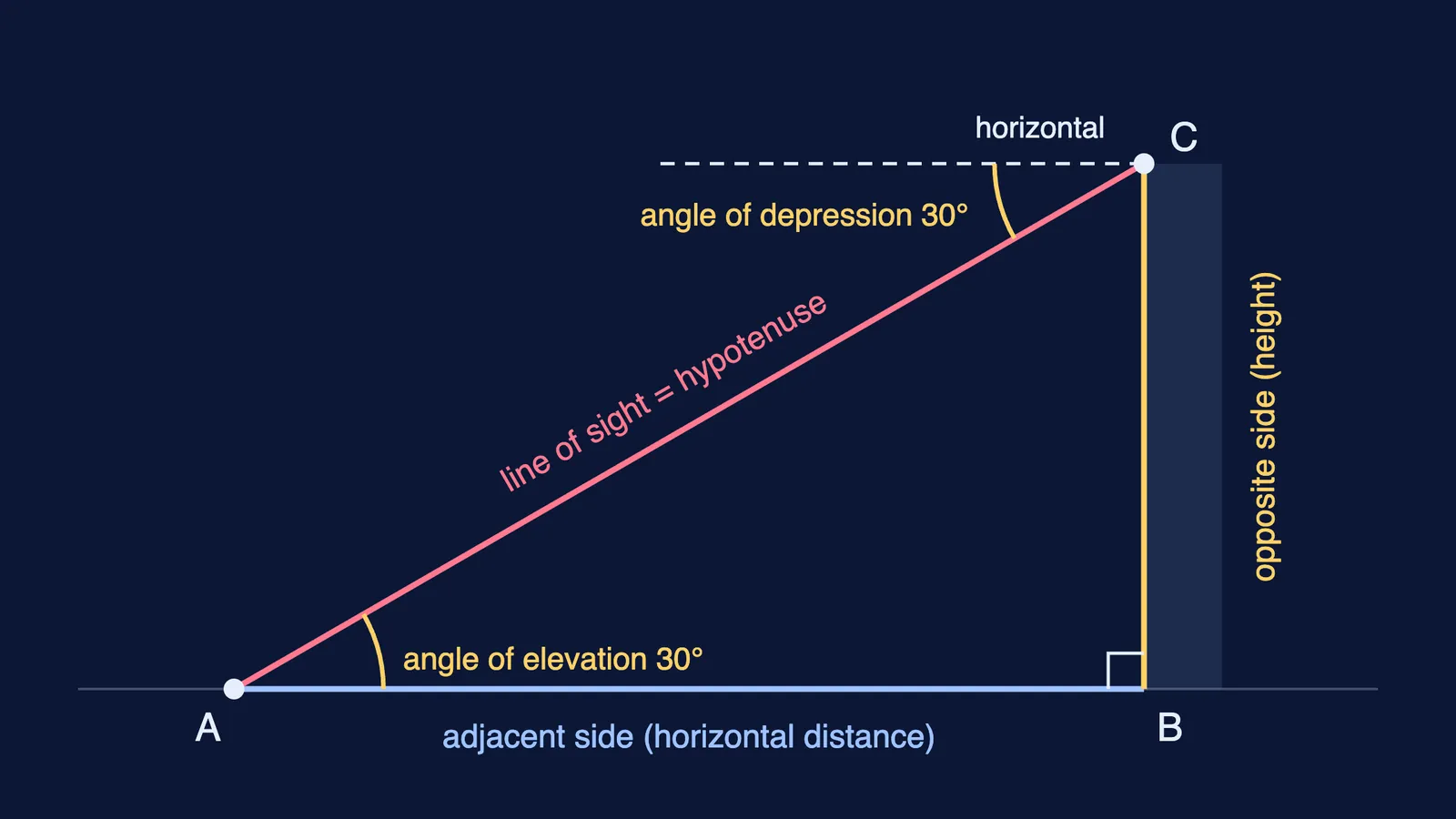
Line of sight: the straight line joining your eye to the point you are looking at.
Horizontal: the level line through the eye; both angles below are measured from it.
Angle of elevation: the angle between line of sight and horizontal when the point is above eye level (you raise your head). Example: looking up at a kite.
Angle of depression: the same angle when the point is below eye level (you lower your head). Example: looking down from a balcony at a car. Don't confuse with: elevation; the depression from P to Q equals the elevation from Q to P, as alternate angles between parallel horizontals.
Observer's height: if the angle is measured from the eye, add eye height to your answer. Example: eye 1.5 m up, the 45° view above gives a 21.5 m tower.
The CBSE 2026-27 syllabus asks only for simple problems with no more than two right triangles and angles of elevation or depression of 30°, 45° or 60° only. Practise with our heights and distances case study questions.
How to learn these terms
Write all six ratios for angle A of the 5-12-13 triangle, then for angle C.
Learn reciprocal pairs: sin with cosec, cos with sec, tan with cot.
Rebuild the 30°, 45° and 60° values from half-square and half-equilateral triangles.
Write each identity with its range and the ratio undefined at the excluded end.
In heights problems, draw the horizontal first, then mark the angle from it. Our trigonometry formulas sheet collects the results.
For a term that still feels abstract, the Fermi Concept Library gives every concept in mathematics its own lesson and its place in the map.