On this page
Some Applications of Trigonometry turns every problem into a right triangle with a known angle, which suits case-study questions. Below are three original cases, easiest first, each with four parts and worked answers.
What do heights and distances case studies test?
The CBSE 2026-27 Maths Standard sample paper puts three case-study questions of 4 marks each in Section E, each with three sub-parts worth 1, 1 and 2 marks. Calculators are not allowed, so use surds or √3 ≈ 1.732.
The CBSE 2026-27 Class 10 maths syllabus limits this topic to angles of elevation and depression of only 30°, 45° and 60°, in problems with no more than two right triangles.
The NCERT chapter defines the angle of elevation as the angle between the line of sight and the horizontal when the object is above the horizontal level, and the angle of depression as the same angle when the object is below it. Our cases add a fourth part for practice. For timing, see our CBSE Class 10 maths paper strategy; for method, how to answer case-based questions in board exams.
Case 1: The metro escalator
A metro station is adding a new escalator from its ticket hall to the platform, which is 7.5 m higher. The escalator is a straight incline that makes an angle of 30° with the horizontal floor of the ticket hall. Its steps move along the incline at 0.5 m/s. Priya, a Class 10 student visiting with her school, is asked to check the plan. She treats the escalator as the hypotenuse of a right triangle whose vertical side is the 7.5 m rise and whose horizontal side is the floor space the escalator covers.
(i) From the top end, Priya looks down at the foot of the escalator along its slope. The angle of depression of the foot is: (a) 30° (b) 45° (c) 60° (d) 90°
(ii) What is the length of the escalator?
(iii) How much horizontal floor length does it cover?
(iv) How long does a passenger take to ride from bottom to top, and how fast does the passenger rise vertically?
Answers.
(i) (a) 30°. The horizontal at the top is parallel to the floor (alternate angles).
(ii) sin 30° = 7.5/L, so L = 7.5 ÷ ½ = 15 m.
(iii) tan 30° = 7.5/x, so x = 7.5√3 ≈ 7.5 × 1.732 ≈ 12.99 m.
(iv) Time = 15 ÷ 0.5 = 30 s. The rise is 7.5 m in 30 s, which is 0.25 m/s.
Case 2: The fire drill ladder
During a fire drill at a housing society in Mumbai, the fire brigade parks a ladder truck in front of a residential tower. The ladder is hinged on a turntable 2.5 m above the ground. The crew extends it to 24 m and raises it until it makes 60° with the horizontal, and its top rests against the vertical wall of the tower at a balcony. A water tanker is parked further out on the same straight road, in line with the truck and the wall. From the top of the ladder, a firefighter sees the tanker at an angle of depression of 45°.
(i) What angle does the ladder make with the wall? (a) 30° (b) 45° (c) 60° (d) 90°
(ii) How far is the turntable hinge from the wall, horizontally?
(iii) How high above the ground is the balcony where the ladder rests?
(iv) How far is the tanker from the wall, and from the point on the ground below the hinge?
Answers.
(i) (a) 30°. 90° − 60° = 30°.
(ii) cos 60° = x/24, so x = 24 × ½ = 12 m.
(iii) 24 sin 60° = 12√3 ≈ 20.78 m; add the hinge: 2.5 + 12√3 ≈ 23.28 m.
(iv) With a 45° angle of depression, horizontal distance equals height, so the tanker is 2.5 + 12√3 ≈ 23.28 m from the wall. From the point below the hinge it is 23.28 − 12 ≈ 11.28 m.
Case 3: The tower beside the school
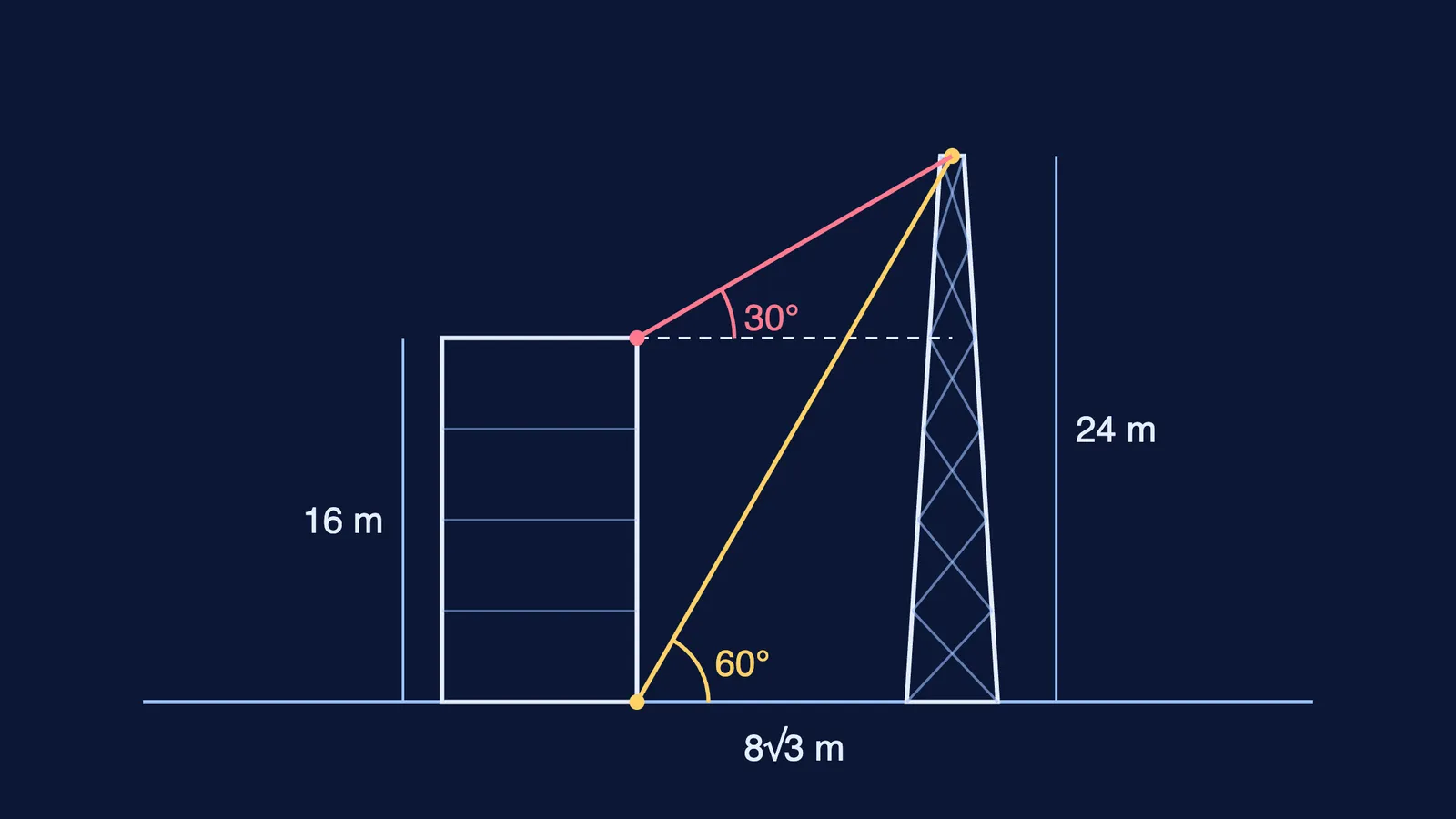
A telecom company has put up a mobile tower near a school in Lucknow. Students measure its height with a clinometer. From the foot of the school building, on level ground, the angle of elevation of the top of the tower is 60°. From the roof of the building, directly above that point and 16 m high, the angle of elevation of the same top is 30°. Ignore the height of the clinometer. Let the tower be H m tall and d m from the building.
(i) Which equation comes from the reading at the foot of the building? (a) H = d/√3 (b) H = d√3 (c) H = d (d) H = 2d
(ii) Write the equation that comes from the reading on the roof.
(iii) Find d and H.
(iv) At what height on the building's wall would the angle of elevation of the tower top be exactly 45°?
Answers.
(i) (b). tan 60° = H/d, so H = d√3.
(ii) tan 30° = (H − 16)/d, so H − 16 = d/√3.
(iii) Subtracting: d√3 − d/√3 = 16, so 2d/√3 = 16 and d = 8√3 ≈ 13.86 m. Then H = 8√3 × √3 = 24 m.
(iv) At 45°, the remaining height equals the distance: 24 − y = 8√3, so y = 24 − 8√3 ≈ 24 − 13.86 = 10.14 m.
How do you solve heights and distances questions?
Draw before you write. Mark the angle at the observer's eye, not at the top of the object.
Turn depression into elevation. The angle of depression from A to B equals the angle of elevation from B to A, because the horizontals are parallel.
Pick the ratio. Use tan for height and distance, sin or cos when a slant length such as a ladder is given.
Watch the offsets. A hinge or a roof changes one side of the triangle, as in Cases 2 and 3.
Keep surds until the last line. Convert to decimals only if asked.
If two-triangle setups keep going wrong, the Fermi Problem Library has worked problems with a step-by-step solver that explains the reasoning rather than printing an answer. For a chapter recap, read our heights and distances guide for Class 10.