On this page
Arithmetic progressions is Chapter 5 of the NCERT Class 10 Mathematics textbook, and the CBSE Class X Mathematics curriculum for 2026-27 covers deriving the nth term and the sum of the first n terms and using them in daily-life problems. Here are its key terms in plain words, with worked examples. For the full chapter, read our arithmetic progressions Class 10 guide.
Left out: Exercise 5.4, which the NCERT chapter marks optional and "not from the examination point of view".
What is an arithmetic progression?
Term: each number in a list. Example: in 4, 9, 14, the second term is 9.
Arithmetic progression (AP): a list of numbers where every term after the first is the term before it plus the same fixed number. Example: 7, 11, 15, 19, … (add 4 each time).
Common difference (d): that fixed number. It can be positive, negative or zero. Example: 30, 25, 20, … has d = −5; 4, 4, 4, … has d = 0.
First term (a): the starting term, also written a₁.
aₖ notation: aₖ is the term in position k. Don't confuse with: k, which is the position, not the value.
General form of an AP: a, a + d, a + 2d, a + 3d, … You need both a and d to fix an AP. Example: a = 10, d = −4 gives 10, 6, 2, −2, …
Consecutive terms: terms next to each other, such as a₄ and a₅.
How do you check whether a list is an AP?
Test for an AP: the list is an AP only if a₂ − a₁, a₃ − a₂, a₄ − a₃, … are all equal. Example: 5, 8, 11, 15 gives 3, 3, 4, so it is not an AP.
Finding d: d = aₖ₊₁ − aₖ, always later minus earlier, even when the later term is smaller. Example: for 20, 17, 14, …, d = 17 − 20 = −3, not +3.
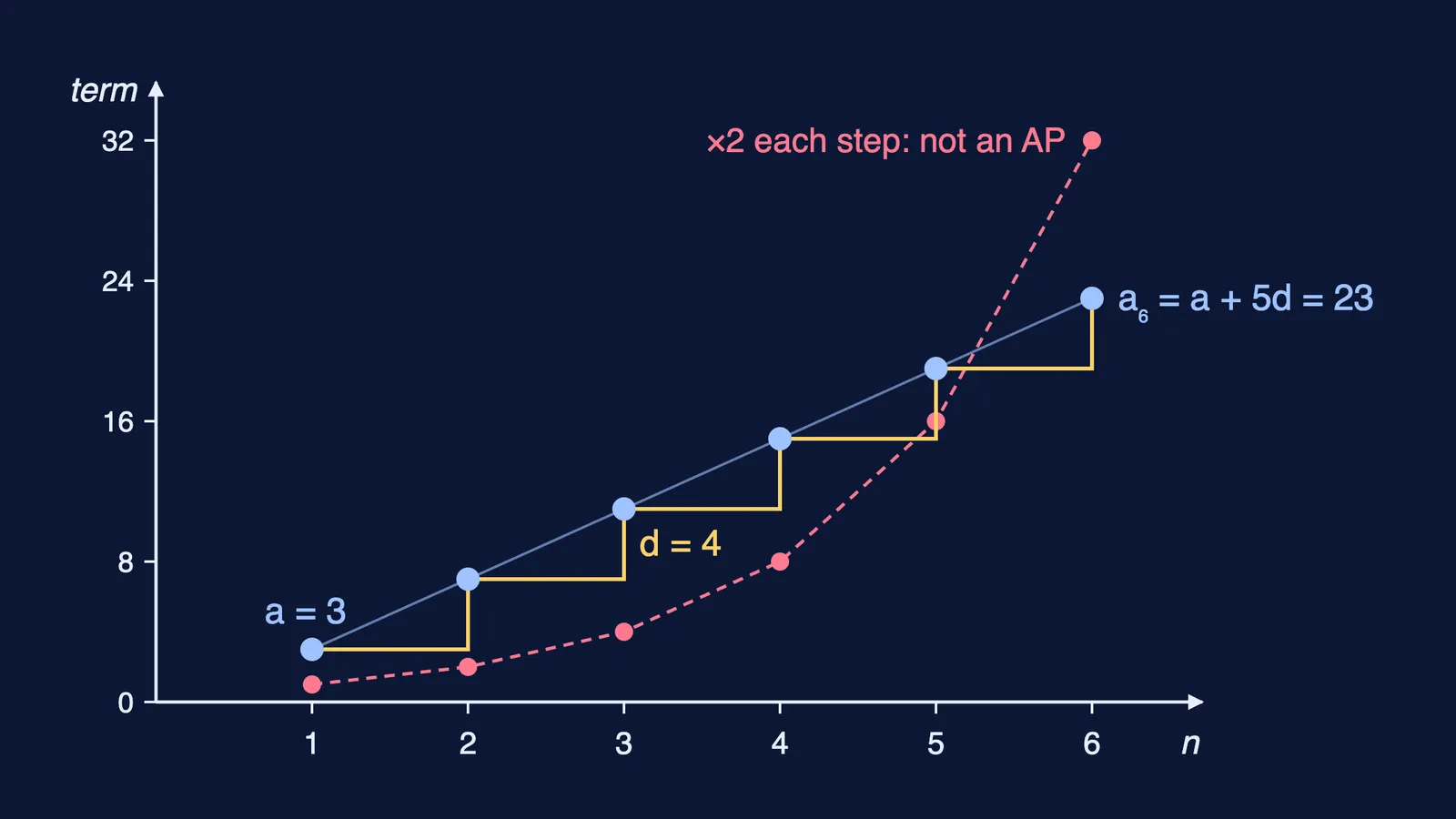
Not an AP: a list whose gaps change, such as 1, 1, 2, 3, 5 or 1, 4, 9, 16. Don't confuse with: a list made by multiplying by a fixed number, such as 2, 4, 8, 16. You meet those as geometric progressions in Class 11 sequences and series.
Finite AP: an AP with a limited number of terms and a last term. Example: the odd numbers 1, 3, 5, …, 19.
Infinite AP: an AP that never ends, with no last term. Example: 2, 4, 6, 8, …
Last term (l): the final term of a finite AP with n terms, so l = aₙ.
What do nth term and general term mean?
nth term (general term), aₙ: the term in position n, given by aₙ = a + (n − 1)d. Example: for 3, 7, 11, …, a₂₀ = 3 + 19 × 4 = 79.
Position n: a term's place in the list, always a positive integer. Example: is 100 a term of 3, 7, 11, …? 100 = 3 + (n − 1) × 4 gives n − 1 = 24.25, not a whole number, so no.
Number of terms: put l in place of aₙ and solve for n. Example: two-digit multiples of 7 run 14, 21, …, 98, so n = (98 − 14)/7 + 1 = 13.
Term from the end: in an AP with n terms, the mth term from the end is the (n − m + 1)th term, or l − (m − 1)d. Example: 5, 9, 13, …, 81 has 20 terms, so the 4th term from the end is 81 − 3 × 4 = 69, which is a₁₇.
What is the sum of the first n terms of an AP?
Sₙ: the sum of the first n terms. Example: for 2, 5, 8, …, S₃ = 15.
Sum formula with d: Sₙ = n/2 [2a + (n − 1)d]. Example: for 2, 5, 8, …, S₁₀ = 5 × (4 + 27) = 155.
Sum formula with the last term: Sₙ = n/2 (a + l), used when you know the last term but not d. Example: 5 + 9 + … + 81 has 20 terms, so S = 10 × 86 = 860.
Reverse-and-add method: write the sum forwards and backwards and add; every pair totals a + l. NCERT derives the sum this way, starting from Gauss adding 1 to 100. Example: 1 + … + 10 gives 2S = 10 × 11, so S = 55.
Sum of the first n positive integers: Sₙ = n(n + 1)/2. Example: 1 + 2 + … + 50 = 50 × 51/2 = 1275.
Four quantities: Sₙ, a, d and n are linked by the sum formula, so knowing three lets you solve for the fourth. Example: a = 4, d = 3, Sₙ = 50 gives n = 5.
Two valid values of n: when a is positive and d negative, the same sum can appear twice because later negative terms cancel earlier ones. Example: for 15, 12, 9, …, Sₙ = 36 gives n = 3 or n = 8.
nth term from sums: aₙ = Sₙ − Sₙ₋₁ for n ≥ 2, and a₁ = S₁. Example: if Sₙ = n² + 2n, then a₅ = 35 − 24 = 11.
Arithmetic mean: if a, b, c are in AP, then b = (a + c)/2, and b is the arithmetic mean of a and c. Example: the arithmetic mean of 6 and 20 is 13.
How to learn these terms
For every AP, write "a = …, d = …" before anything else.
Say "later minus earlier" aloud when finding d; it stops sign errors.
Plot an AP against n: equal steps on a straight line, while a doubling list curves upward.
Pair the sum formulas: n/2 [2a + (n − 1)d] when you know d, n/2 (a + l) when you know l.
For "is it a term?", check that n is a positive whole number.
If a definition feels loose, the Fermi Concept Library gives every mathematics concept its own lesson. Before a test, read our guide to common Class 10 maths mistakes.