On this page
Pair of Linear Equations in Two Variables is Chapter 3 of the rationalised NCERT Class 10 Mathematics textbook (Reprint 2026-27). The CBSE Class X Mathematics syllabus for 2026-27 lists the graphical method, algebraic conditions for the number of solutions, substitution and elimination. Neither covers cross-multiplication or equations reducible to a linear pair, so both are omitted. Definitions are our own wording. For the whole chapter, read our pair of linear equations Class 10 chapter guide.
What is a pair of linear equations in two variables?
Linear equation in two variables: an equation that can be written as ax + by + c = 0, where a, b, c are real numbers and a and b are not both zero. Example: 2x + 3y = 12. Counter-example: xy = 6 is not linear, because x and y are multiplied.
Variables and coefficients: x and y are the unknowns; a and b are the numbers multiplying them. Example: in 2x + 3y − 12 = 0, a = 2 and b = 3.
Constant term: the number c with no variable attached. Example: c = −12 above. Don't confuse with: the 12 on the right of 2x + 3y = 12; move everything to one side before reading c.
General form of a pair: a₁x + b₁y + c₁ = 0 and a₂x + b₂y + c₂ = 0, the form the chapter uses to compare coefficients.
Pair of linear equations: two linear equations in the same two variables, taken together. Example: 2x + 3y = 12 and x − y = 1.
Solution of one equation: an ordered pair (x, y) that makes the equation true. Example: (3, 2) and (0, 4) both satisfy 2x + 3y = 12; so do infinitely many others.
Solution of the pair: an ordered pair that satisfies both equations. Example: (3, 2) fits both 2x + 3y = 12 and x − y = 1. Don't confuse with: a point that fits only one of the two.
How do the lines show the number of solutions?
Each linear equation in two variables graphs as a straight line, so a pair gives two lines (NCERT section 3.2).
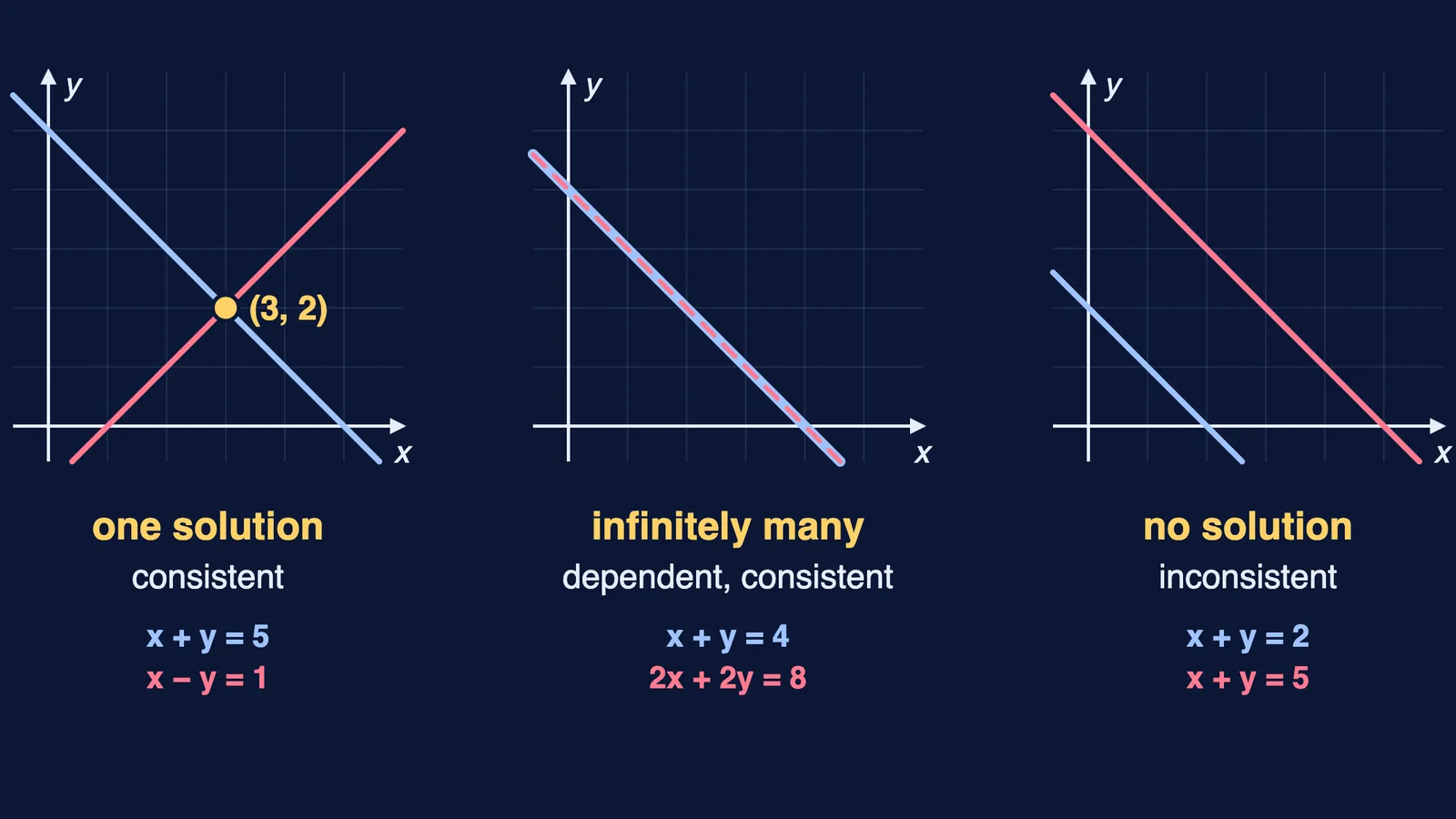
Graphical method: plot both lines and read the solution from where they meet. Example: x + y = 5 and x − y = 1 meet at (3, 2).
Table of values: two or more solutions of an equation listed to plot its line. Example: (0, 5) and (5, 0) for x + y = 5.
Intersecting lines: lines that cross at exactly one point, giving a unique solution.
Parallel lines: lines that never meet, so the pair has no solution. Example: x + y = 2 and x + y = 5.
Coincident lines: two equations that draw the same line, so every point on it is a solution. Example: x + y = 4 and 2x + 2y = 8. Don't confuse with: parallel lines, which never touch.
Non-integral coordinates: a meeting point such as (−1.75, 3.3). NCERT notes these are easy to misread on a graph, so algebraic methods help.
Consistent, inconsistent or dependent: what is the difference?
Consistent pair: a pair with at least one solution (intersecting or coincident lines).
Inconsistent pair: a pair with no solution (parallel lines).
Dependent pair: one equation is a multiple of the other, so they share infinitely many solutions (coincident lines). A dependent pair is always consistent. Don't confuse with: inconsistent; "dependent" means too many solutions, not none.
Ratio test: compare a₁/a₂, b₁/b₂ and c₁/c₂. If a₁/a₂ ≠ b₁/b₂, the lines intersect. If a₁/a₂ = b₁/b₂ = c₁/c₂, they coincide. If a₁/a₂ = b₁/b₂ ≠ c₁/c₂, they are parallel (NCERT Table 3.1). Example: x + 2y − 4 = 0 and 2x + 4y − 5 = 0 give 1/2 = 2/4, but c₁/c₂ = 4/5, so the lines are parallel.
How do substitution and elimination work?
The current chapter teaches two algebraic methods (NCERT section 3.3).
Substitution method: write one variable in terms of the other from one equation, put it into the other equation, solve, then substitute back. Example: from x + 2y = 7, x = 7 − 2y; then 3(7 − 2y) − y = 7 gives y = 2 and x = 3.
Elimination method: scale one or both equations by non-zero numbers so one variable's coefficients match in size, then add or subtract to remove it. Example: 3x + 2y = 11 and 2x + 3y = 9; multiply by 3 and 2 to get 9x + 6y = 33 and 4x + 6y = 18; subtract: 5x = 15, so x = 3 and y = 1. Don't confuse with: substitution, which replaces a variable instead.
True statement with no variable: if solving leaves something like 8 = 8, the pair has infinitely many solutions. Example: x + 2y = 4 and 2x + 4y = 8.
False statement with no variable: if solving leaves something like 8 = 5, the pair has no solution. Example: x + 2y = 4 and 2x + 4y = 5.
Verification: putting your answer back into both original equations.
What do word problems in this chapter need?
Forming the pair: naming the two unknowns with letters and turning each condition into one equation. Example: 2 notebooks and 3 pens cost Rs 80, and 1 notebook and 2 pens cost Rs 45. With notebook n and pen p: 2n + 3p = 80 and n + 2p = 45, so p = 10 and n = 25.
Checking against the situation: the answer must make sense in the story, such as a whole number of items.
How to learn these terms
Learn the three cases together: line picture, number of solutions, name.
Pair the opposites: parallel and coincident, consistent and inconsistent, true and false statements.
Invent your own pair for each ratio case and test it by graph and algebra.
Solve one pair by both methods and compare the steps.
If an idea, such as why equal ratios mean the same line, feels shaky, the Fermi Concept Library gives each mathematics concept its own lesson. Our list of common Class 10 maths mistakes helps you spot slips.