On this page
These are the key terms of Chapter 11, Areas Related to Circles, in the NCERT Class 10 Mathematics textbook (Reprint 2026-27), each in plain words with a short worked example. For full solved problems, see our areas related to circles Class 10 guide.
The CBSE Class 10 Mathematics syllabus for 2026-27 lists area of sectors and segments of a circle, and problems on their areas and perimeters, with segment problems "restricted to central angle of 60°, 90° and 120° only". The current NCERT chapter covers sectors and segments only; areas of combinations of plane figures are not in it.
Examples use π = 22/7, the value NCERT's Exercise 11.1 uses unless a question says otherwise.
Which circle basics does this chapter use?
The rationalised chapter has no review section on a circle's perimeter and area; it only recalls πr² and 2πr from earlier classes.
Radius (r): the distance from the centre O to any point on the circle, so OA = OB = r.
Circumference: the length of the whole circle, 2πr, where the diameter is 2r. Example: r = 7 cm gives 2 × 22/7 × 7 = 44 cm.
π (pi): the fixed ratio of circumference to diameter. 22/7 and 3.14 are only approximations, so use the one the question gives.
Circular region (disc): the circle together with all the points inside it; its area is πr². Example: r = 7 cm gives 154 cm².
Arc: a piece of the circle between two points on it.
Chord: the straight segment joining two points on the circle. Don't confuse with: the arc between the same two points, which is curved and longer.
Angle at the centre (central angle): the angle ∠AOB that an arc or chord subtends at O. Every formula in this chapter needs it in degrees.
What is a sector of a circle?
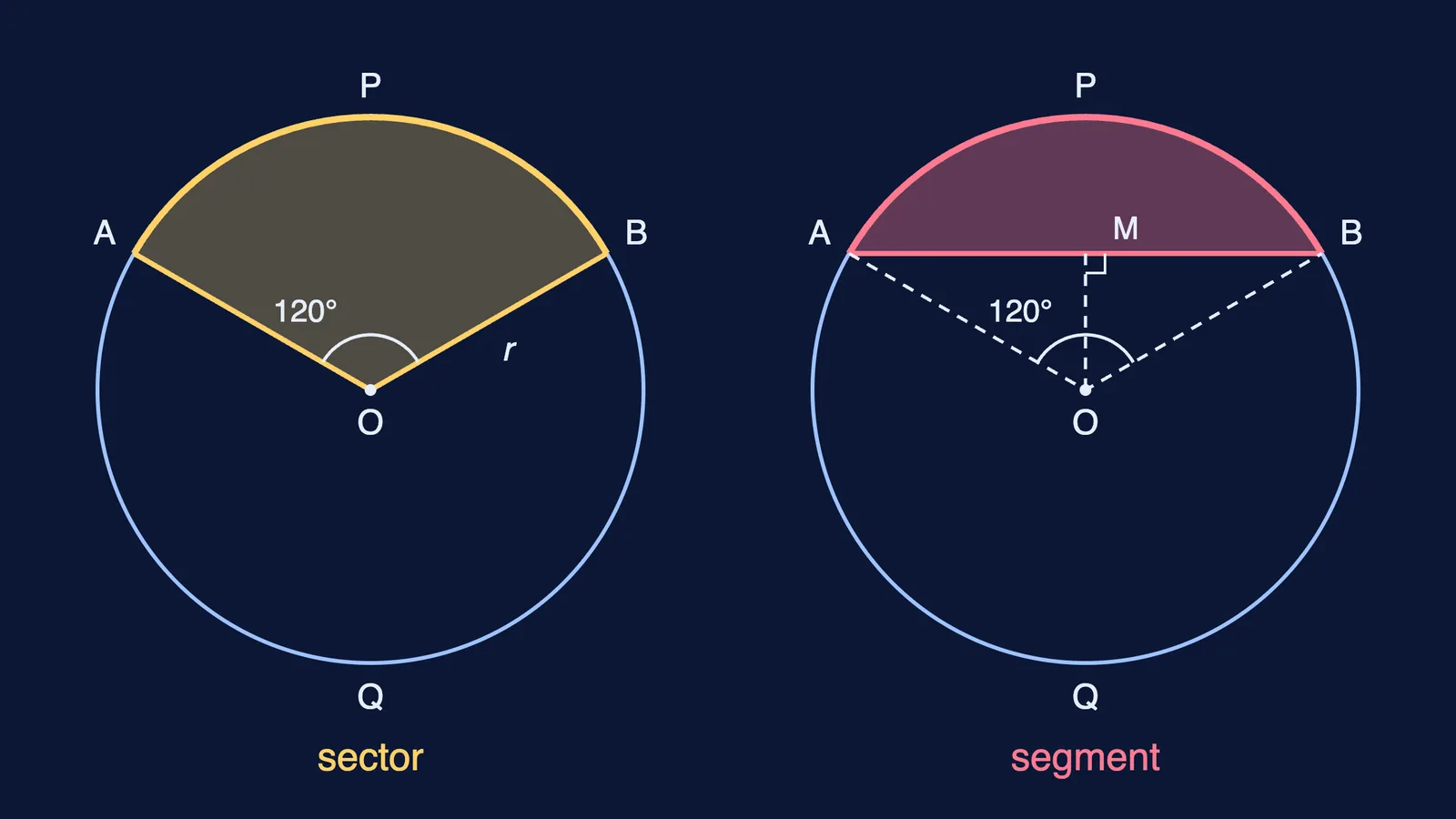
Sector: a slice of the disc cut out by two radii, with the arc joining their ends as its curved edge. Example: OAPB.
Angle of the sector (θ): the central angle ∠AOB between the two radii.
Minor sector: the smaller sector, with angle θ. When a question just says "sector", it means the minor one unless it states otherwise.
Major sector: the rest of the disc, OAQB, with angle 360° − θ. Example: a 60° minor sector leaves a 300° major sector.
Quadrant: a sector of angle 90°, a quarter of the disc, area πr²/4. Example: r = 14 cm gives 616/4 = 154 cm².
Unitary method: treat the full disc as a 360° sector, so 1° gets 1/360 of the area or circumference and θ° gets θ/360.
How do you find arc length, sector area and perimeter?
Length of an arc: (θ/360) × 2πr. Example: r = 21 cm, θ = 60° gives (1/6) × 132 = 22 cm.
Area of a sector: (θ/360) × πr². Example: r = 21 cm, θ = 60° gives (1/6) × 1386 = 231 cm². Don't confuse with: arc length, which uses 2πr and is in cm, not cm².
Area of the major sector: πr² − area of the minor sector, or ((360 − θ)/360) × πr². Example: 1386 − 231 = 1155 cm².
Perimeter of a sector: two radii plus the arc, 2r + (θ/360) × 2πr. Example: 42 + 22 = 64 cm.
Area swept by a clock hand: a sector whose angle comes from the time. The minute hand turns 360° in 60 minutes, so 6° a minute. Example: a 7 cm minute hand in 10 minutes turns 60° and sweeps (1/6) × 154 ≈ 25.67 cm².
What is a segment of a circle?
Segment: the piece of the disc cut off by a chord, with the chord as its straight edge and an arc as its curved edge. Example: APB, bounded by chord AB and arc APB.
Minor segment: the smaller segment, on the side of the minor arc. "Segment" alone means this one unless stated otherwise.
Major segment: the larger segment, AQB, on the other side of the same chord.
Area of a segment: area of the sector OAPB − area of triangle OAB. Don't confuse with: the sector area alone, which still includes the triangle.
Area of the major segment: πr² − area of the minor segment.
Triangle OAB: always isosceles, because OA = OB = r.
Perpendicular from the centre (OM ⊥ AB): drawing OM splits triangle OAB into two congruent right triangles (RHS), so M is the mid-point of AB and OM bisects ∠AOB.
How do you find the triangle at 60°, 90° and 120°?
60° case: triangle OAB is equilateral with side r, area (√3/4)r². Example: r = 14 cm gives sector 308/3 cm², triangle 49√3 cm², segment (308/3 − 49√3) cm².
90° case: triangle OAB is right-angled at O, area r²/2. Example: r = 14 cm gives sector 154 cm², triangle 98 cm², segment 56 cm², major segment 616 − 56 = 560 cm².
120° case: with OM ⊥ AB, ∠AOM = 60°, so OM = r cos 60° = r/2 and AB = 2r sin 60° = r√3; the triangle's area is ½ × AB × OM = (√3/4)r². Example: r = 7 cm gives sector 154/3 cm², triangle 49√3/4 cm². Don't confuse with: the 60° case, which has the same triangle area but a sector half the size.
How to learn these terms
Draw one circle, shade a sector in one colour and a segment in another, and label O, A, B, P, Q, M.
Learn the formulas in pairs: arc length with sector area (same θ/360, different whole), minor with major (subtract from the whole).
Before any segment problem, write "segment = sector − triangle" and the central angle; then pick the 60°, 90° or 120° triangle.
Check units at the end: lengths and perimeters in cm, areas in cm².
For the circle and tangent terms this chapter builds on, revisit our Class 10 circles and tangents guide; next, the same area thinking carries into combined solids in surface areas and volumes. If a term still feels shaky, the Fermi Concept Library has a lesson for each concept in mathematics, with its place in the map.