On this page
This glossary follows Chapter 14 of the NCERT Class 10 Mathematics textbook (Reprint 2026-27) and Unit VII of the CBSE Class X Mathematics curriculum for 2026-27, which lists the classical definition of probability and simple problems on finding the probability of an event. Every definition below is in our own words. For the full chapter walk-through, read our Probability Class 10 chapter guide.
What words describe an experiment and its outcomes?
Experiment: an action whose possible outcomes you can list in advance but whose actual result you cannot predict, such as tossing a coin or throwing a die. Example: drawing one card from a deck.
Outcome: one possible result of the experiment. Example: a 4 on a die.
Fair (unbiased): a coin or die that is symmetrical, so no side is favoured. NCERT assumes every die in the chapter is fair.
At random: chosen with no bias, so every item has the same chance. Example: a marble drawn at random from a box.
Well-shuffled: a deck mixed so that every card is equally likely to be drawn.
Equally likely outcomes: outcomes that each have the same chance. Example: 1 to 6 on a fair die. Counter-example: from a bag of 4 red and 1 blue ball, "red" and "blue" are not equally likely.
Event: a result you are interested in, made of one or more outcomes. Example: "a number greater than 4" on a die is made of 5 and 6.
Favourable outcome: an outcome that makes the event happen. Example: for "an even number", the favourable outcomes are 2, 4 and 6.
Elementary event: an event with only one outcome. Example: "getting a head" in one toss. Don't confuse with: an event like "number greater than 4", which has 2 outcomes.
What is the difference between experimental and theoretical probability?
Trial: one repetition of an experiment. Example: each of 50 coin tosses is a trial.
Experimental (empirical) probability: the number of trials in which the event happened divided by the total number of trials. Example: 26 heads in 50 tosses gives 26/50 = 0.52.
Theoretical (classical) probability, P(E): the number of outcomes favourable to E divided by the number of all possible outcomes, valid only when the outcomes are equally likely. Example: P(prime on a die) = 3/6 = 1/2, since 2, 3 and 5 are prime.
P(E): the notation for "probability of event E". NCERT calls theoretical probability just "probability" in this chapter.
Don't confuse with: experimental probability comes from what actually happened; theoretical probability predicts from assumptions. NCERT's closing note says the two may be expected to come close as the number of trials grows.
What are sure, impossible and complementary events?
Sure (certain) event: an event that always happens; its probability is 1. Example: a number less than 7 on one die.
Impossible event: an event that can never happen; its probability is 0. Example: getting 8 on one die.
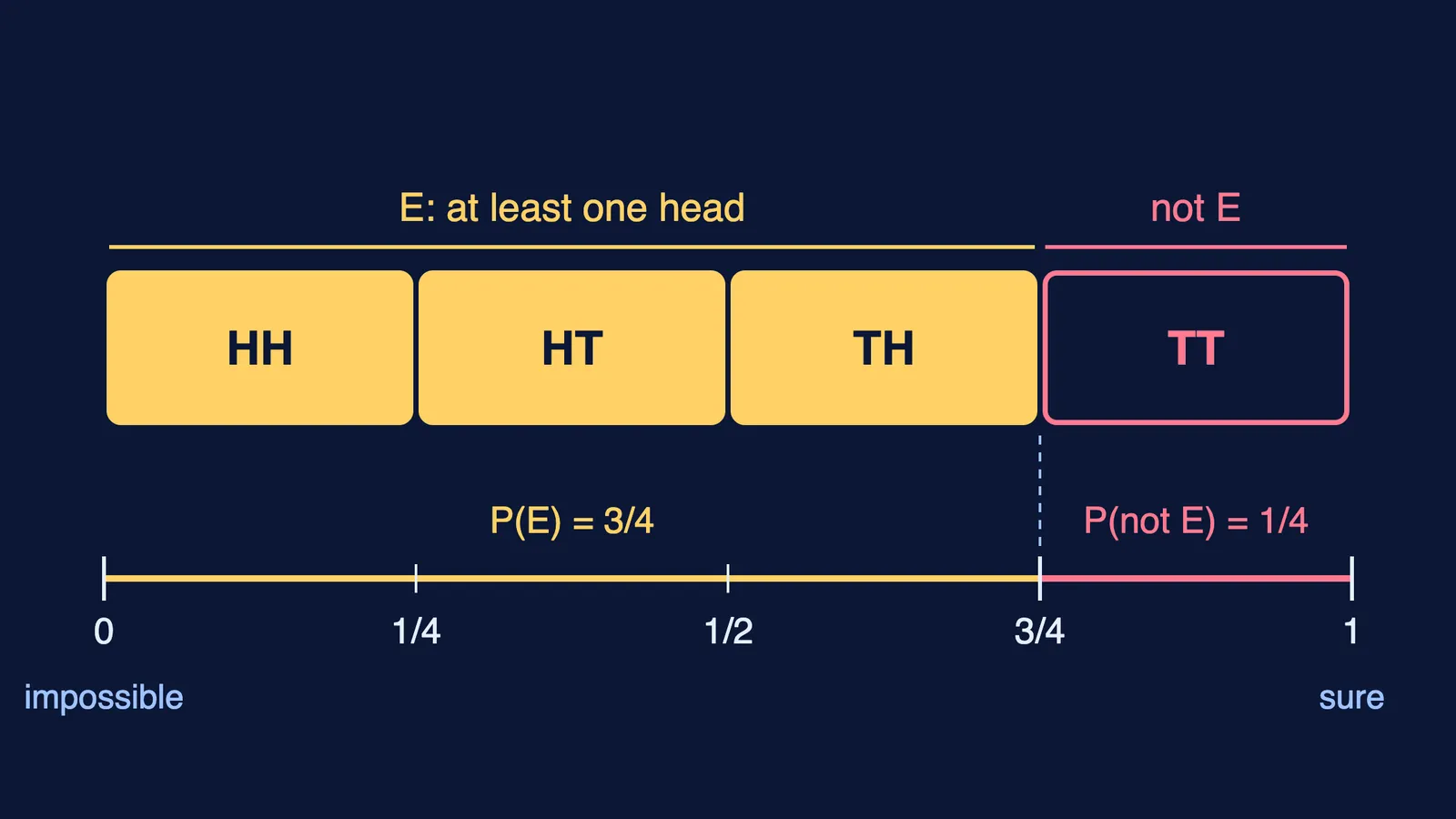
Range of probability: for any event, 0 ≤ P(E) ≤ 1, because favourable outcomes can never outnumber all outcomes. Example: 15% (0.15) can be a probability; −1.5 cannot.
Sum of elementary events: the probabilities of all elementary events of an experiment add up to 1. Example: six faces of a die, 1/6 each.
Complement of E ("not E", written Ē): the event that E does not happen. Example: if E is "an ace", Ē is "not an ace".
Complementary events: E and Ē together, with P(E) + P(Ē) = 1, so P(Ē) = 1 − P(E). Example: P(not an ace) = 1 − 1/13 = 12/13.
At least one: one or more. Example: in two coin tosses, "at least one head" is HH, HT, TH, so its probability is 3/4. Its complement is "no head" (TT), 1/4. Don't confuse with: "exactly one head" (HT, TH), which is 2/4 = 1/2.
Cards, coins and dice: the setups NCERT uses
Deck of cards: 52 cards in 4 suits of 13. Example: P(an ace) = 4/52 = 1/13.
Suit: one of spades, hearts, diamonds and clubs; spades and clubs are black, hearts and diamonds are red. Example: P(a spade) = 13/52 = 1/4.
Face cards: the kings, queens and jacks, 12 in all. Don't confuse with: aces, which are not face cards. Example: P(a red face card) = 6/52 = 3/26.
Two coins tossed together: 4 equally likely outcomes, HH, HT, TH, TT.
Ordered pair: a way to record two dice, (blue, grey). Example: (1, 4) and (4, 1) are different outcomes. Don't confuse with: the sum, which is the same 5 for both.
Two dice thrown together: 6 × 6 = 36 equally likely outcomes. Example: a sum of 8 comes from (2, 6), (3, 5), (4, 4), (5, 3), (6, 2), so P(sum 8) = 5/36. NCERT treats throwing one die twice as the same experiment.
Without replacement: an item drawn is not put back, so the total for the next draw drops by one. Example: from 20 bulbs with 4 defective, after one good bulb is kept aside, P(next is good) = 15/19.
NCERT marks Examples 10 and 11 and question 20 of Exercise 14.1, which find probability from lengths and areas, "Not from the examination point of view" (NCERT Chapter 14).
How to learn these terms
Learn the pairs together: sure and impossible, E and not E, experimental and theoretical, "at least one" and "exactly one".
Write the full list of outcomes before any division. A missing or extra outcome gives a wrong denominator.
Draw the 6 × 6 dice grid once from memory and shade the sums 2 to 12; you will see why each sum is not 1/11.
Use the complement whenever the event says "not" or "at least one".
Check every answer sits between 0 and 1.
If a term still feels slippery, the Fermi Concept Library gives each concept in mathematics its own lesson. For practice with the same terms, try our statistics and probability case study questions for Class 10, then revise the rules in Probability Class 10 formulas with examples.