

On this page
Case studies on this unit wrap a frequency table or a box of outcomes in a short story, and the skill is pulling the right numbers out. Below are three original cases, easiest first, each with four parts and worked answers.
What do statistics and probability case studies test?
The CBSE 2026-27 Class 10 maths syllabus gives Unit VII, Statistics and Probability, 11 of the 80 theory marks. It covers the mean, median and mode of grouped data (bimodal cases avoided) and simple problems on classical probability.
The CBSE 2026-27 Maths Standard sample paper puts three case-study questions of 4 marks each in Section E, each with three sub-parts worth 1, 1 and 2 marks. Calculators are not allowed. Our cases add a fourth part.
Every formula used here is from the NCERT chapters on Statistics and Probability, Reprint 2026-27. For a chapter recap, see our Class 10 Statistics guide; for exam technique, read how to answer case-based questions in board exams.
Case 1: What is in the lucky dip?
At a school's Children's Day fete in Bhopal, the Class 10 stall runs a lucky dip. A box holds 80 identical folded slips. Four slips say "Pen set", 12 say "Chocolate", 24 say "Keychain" and the rest say "Try again". Each player draws one slip at random and keeps it, so slips are not put back. Kabir, who runs the stall, wants to work out the chances on paper before the gates open.
(i) The probability that the first player wins a chocolate is: (a) 1/12 (b) 3/20 (c) 1/5 (d) 3/10
(ii) What is the probability that the first player wins some prize?
(iii) The first 10 players draw 1 pen set, 2 chocolates, 3 keychains and 4 "Try again" slips. What is the probability that the 11th player wins a pen set?
(iv) For day two, Kabir wants P(prize) = 3/5 by swapping some "Try again" slips for "Keychain" slips, keeping 80 slips. How many must he swap, and what is the new P(keychain)?
Answers.
(i) (b). P(chocolate) = 12/80 = 3/20.
(ii) "Try again" slips = 80 − 4 − 12 − 24 = 40, so prize slips = 40 and P(prize) = 40/80 = 1/2.
(iii) 70 slips are left, of which 4 − 1 = 3 are pen sets. P(pen set) = 3/70.
(iv) (40 + k)/80 = 3/5 gives 40 + k = 48, so k = 8. Keychains become 32, so P(keychain) = 32/80 = 2/5.
Case 2: Morning milk at the collection centre
A village dairy cooperative near Anand, Gujarat, records the milk each farmer pours in one winter morning. The secretary groups the 50 deliveries by volume, but a smudge hides one frequency in the paper register.
Milk (litres): 0–4, 4–8, 8–12, 12–16, 16–20. Number of farmers: 6, 11, f, 9, 5.
The secretary needs a typical delivery to size the new chilling tank, and the most common delivery size for planning the steel cans.
(i) Find the missing frequency f.
(ii) The modal class is: (a) 4–8 (b) 8–12 (c) 12–16 (d) 16–20
(iii) Using the step-deviation method with assumed mean a = 10 and h = 4, find the mean delivery.
(iv) Find the mode, and say whether it is above or below the mean.
Answers.
(i) 6 + 11 + f + 9 + 5 = 50, so f = 19.
(ii) (b). 8–12 has the highest frequency, 19.
(iii) Class marks 2, 6, 10, 14, 18 give u = −2, −1, 0, 1, 2. Σfu = −12 − 11 + 0 + 9 + 10 = −4, so mean = 10 + 4 × (−4/50) = 10 − 0.32 = 9.68 L.
(iv) l = 8, f₁ = 19, f₀ = 11, f₂ = 9, h = 4. Mode = 8 + [(19 − 11) ÷ (38 − 11 − 9)] × 4 = 8 + 32/18 = 88/9 ≈ 9.78 L, slightly above the mean.
Case 3: Rides on the campus cycles
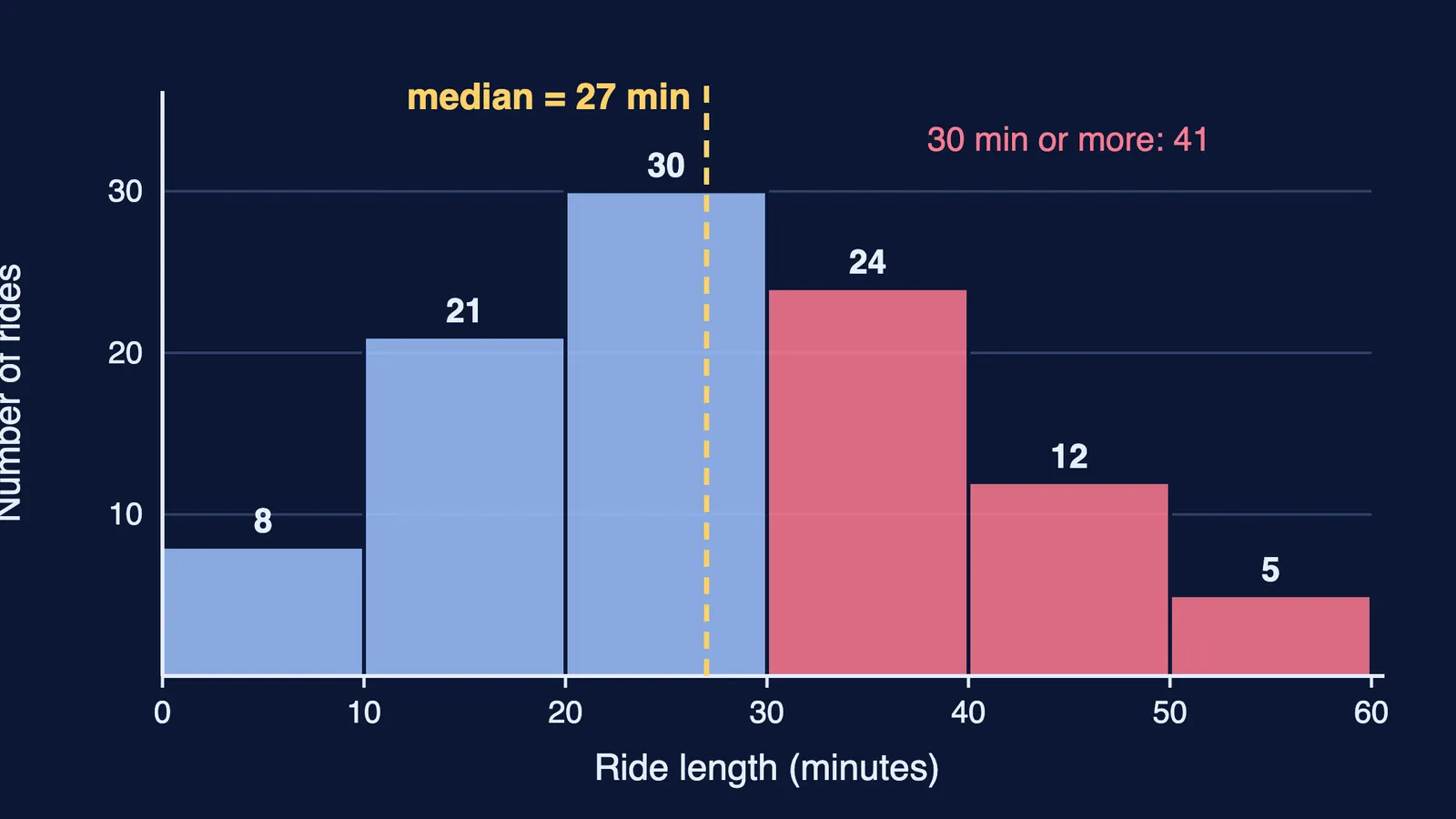
A college in Pune runs a cycle-sharing scheme for its students. One week, the office logs the length of 100 rides, but two frequencies, x and y, are missing from the printout. The office knows the median ride length was 27 minutes. Rides of 30 minutes or more are charged an extra fee, and the manager needs the missing counts before the monthly report.
Ride length (minutes): 0–10, 10–20, 20–30, 30–40, 40–50, 50–60. Number of rides: 8, x, 30, y, 12, 5.
(i) The median class is: (a) 10–20 (b) 20–30 (c) 30–40 (d) cannot be found
(ii) Write an equation in x and y from the total number of rides.
(iii) Use the median to find x and y.
(iv) One ride is picked at random from the log. Find the probability that it was charged the extra fee, and the probability that it lasted less than 20 minutes.
Answers.
(i) (b). The median, 27 minutes, lies in 20–30.
(ii) 8 + x + 30 + y + 12 + 5 = 100, so x + y = 45.
(iii) n/2 = 50, l = 20, cf = 8 + x, f = 30, h = 10. So 27 = 20 + [(50 − 8 − x) ÷ 30] × 10, which gives 21 = 42 − x, so x = 21 and y = 24. Check: cumulative frequencies 8, 29, 59 first pass 50 in 20–30.
(iv) Rides of 30 minutes or more = 24 + 12 + 5 = 41, so P = 41/100. Rides under 20 minutes = 8 + 21 = 29, so P = 29/100.
How to attack case-study questions
Copy the table first. Write classes and frequencies in columns before any formula.
Find the total early. Missing-frequency parts start with Σf = n.
Name every symbol. Write l, cf, f, f₀, f₁, f₂ and h before substituting; mixing cf with f is a common slip.
Count what is left. Without replacement, both counts change.
Check the class. A median or mode must lie inside the class you used.
If a step keeps breaking, the Fermi Problem Library has worked problems with a step-by-step solver that explains the reasoning rather than printing an answer. For the probability half of the unit, see our Class 10 probability guide.


