On this page
Here are the key terms of NCERT Class 10 Mathematics Chapter 12, Surface Areas and Volumes (Reprint 2026-27), grouped by topic. For solved problems, see our guide to surface area and volume of combined solids.
The CBSE Mathematics syllabus for 2026-27 covers surface areas and volumes of combinations of any two of cubes, cuboids, spheres, hemispheres and right circular cylinders or cones. The frustum of a cone and converting one solid into another are not in the current chapter. Examples take π = 22/7 or leave π in the answer.
Which basic solids does the chapter combine?
Cube (edge a): a solid with six equal square faces. TSA = 6a², volume = a³. Example: a = 4 cm gives 96 cm² and 64 cm³.
Cuboid (l, b, h): a box with six rectangular faces. TSA = 2(lb + bh + hl), volume = lbh. Example: 5 × 3 × 2 cm gives 62 cm² and 30 cm³.
Right circular cylinder (r, h): two equal circular bases joined by a curved surface, the axis at right angles to them. CSA = 2πrh, volume = πr²h. Example: r = 7 cm, h = 10 cm gives 440 cm² and 1540 cm³.
Right circular cone (r, h): a circular base joined to a vertex directly above its centre. CSA = πrl, volume = (1/3)πr²h. Example: r = 3 cm, h = 4 cm gives 15π cm² and 12π cm³.
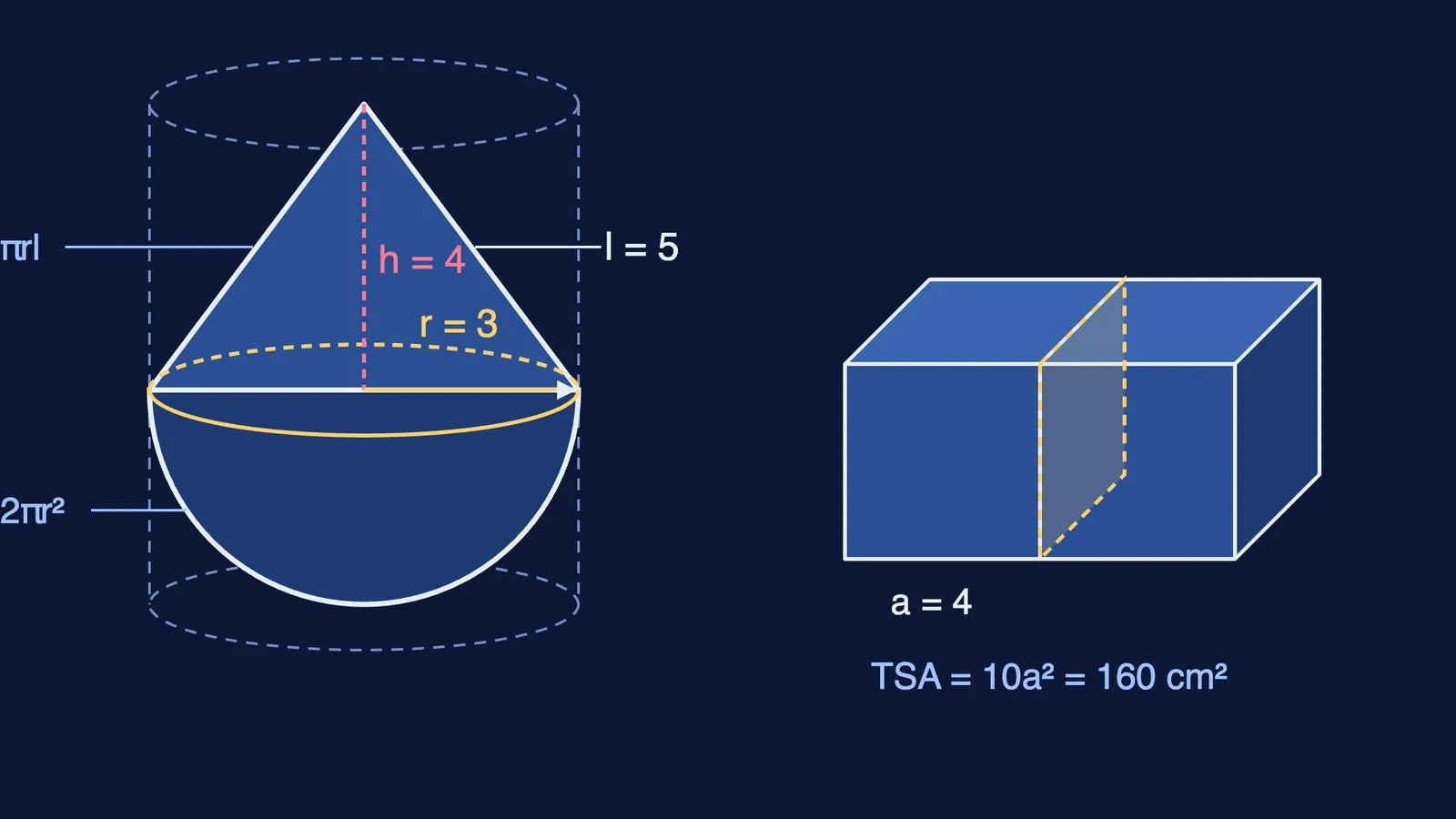
Slant height (l): the distance from the vertex to any point on the rim of the base, l = √(r² + h²). Example: r = 3, h = 4 gives l = 5. Don't confuse with: the height h, measured along the axis and always shorter than l.
Sphere (r): a solid whose surface is every point at distance r from a centre. Surface area = 4πr², volume = (4/3)πr³. Example: r = 3 cm gives 36π cm² and 36π cm³.
Hemisphere: half a sphere, cut by a plane through its centre. CSA = 2πr², TSA = 3πr², volume = (2/3)πr³. Example: r = 7 cm gives CSA 308 cm² and TSA 462 cm².
Radius and diameter: diameter = 2 × radius. Example: a diameter of 3.5 cm means r = 1.75 cm. Don't confuse with: putting the diameter into a formula that asks for r.
What is the difference between CSA and TSA?
Curved surface area (CSA): the area of the curved part only, in square units.
Total surface area (TSA): the CSA plus every flat face. Example: the cylinder above has TSA 440 + 2 × 154 = 748 cm². Don't confuse with: CSA; an open tank or tent leaves out faces, so read what is covered.
Base area: the area of a flat circular face, πr². Example: r = 7 cm gives 154 cm².
Inner surface area: the area of the inside of a hollow vessel, from inner measurements. Example: a hollow hemispherical bowl of inner radius 7 cm has 308 cm² inside.
Cost of covering: area × rate. Example: 20 m² of canvas at ₹500 per m² costs ₹10,000.
How do you find the surface area of a combination of solids?
Combination of solids: basic solids joined into one object. Example: a capsule, a cylinder with a hemispherical end on each side.
Surmounted by: "A surmounted by B" usually means B sits on top of A, flat faces together. Example: in a cube surmounted by a hemisphere, the hemisphere is on top.
Common radius: a cone joined to a hemisphere takes the same radius, so the surface is smooth.
Hidden faces: faces pressed together inside the object; they are not counted. Example: two cubes of edge 4 cm joined end to end give 2 × 96 − 2 × 16 = 160 cm². Don't confuse with: adding both TSAs, 192 cm².
TSA of a combination: the sum of only the surfaces you can see. Example: a toy made of a cone of height 4 cm on a hemisphere of radius 3 cm gives 18π + 15π = 33π cm².
Exposed ring: when a larger base rests on a smaller one, the uncovered ring has area π(R² − r²). Example: a cone base of radius 4 cm on a cylinder of radius 3 cm leaves 7π cm².
Depression or cavity: a hollow scooped out of a solid. For area, remove the flat circle of the opening and add the hollow's curved surface. For volume, subtract the hollow. Example: a hemisphere of radius 3 cm scooped from a 10 cm cube gives (600 + 9π) cm² and (1000 − 18π) cm³.
How do volume and capacity work for combined solids?
Volume of a combination: the sum of the volumes of the parts, in cubic units; nothing disappears when solids are joined. Example: the toy above has 18π + 12π = 30π cm³.
Capacity: the volume a hollow container holds inside.
Apparent and actual capacity: apparent treats the vessel as a plain shape from its inner measurements; actual subtracts any raised part inside. Example: a glass with r = 3 cm, h = 10 cm and a raised hemispherical bottom of radius 3 cm holds 90π − 18π = 72π cm³, not 90π.
Circumscribing cylinder: the cylinder that just encloses a solid, with the same radius and the full height. Example: the toy fits a cylinder with r = 3 cm, h = 7 cm: 63π − 30π = 33π cm³ is empty.
Mass from volume: mass = volume × mass of 1 cm³. Example: 1540 cm³ of iron at 8 g per cm³ is 12,320 g.
Units: 1 m² = 10,000 cm² and 1 m³ = 1,000,000 cm³. Example: 33,000 cm² = 3.3 m².
How to learn these terms
Sketch each object and shade the surfaces you could paint before writing a formula.
Pair CSA with TSA, height with slant height, and apparent with actual capacity, with your own example for each.
Halve diameters and convert units before you substitute.
Next, revise areas related to circles and the common Class 10 maths mistakes. If a term still feels slippery, the Fermi Concept Library gives every concept in mathematics its own lesson and its place in the map.