On this page
This glossary covers the terms in Chapter 1 of the rationalised NCERT Class 10 Mathematics textbook (NCERT Real Numbers chapter, Reprint 2026-27). The CBSE Class X Mathematics syllabus for 2026-27 lists two topics for it: the Fundamental Theorem of Arithmetic and proofs that √2, √3 and √5 are irrational. Each term gets a definition, an example and, where students mix things up, a "Don't confuse with" note. Study plan: our Real numbers Class 10 chapter guide.
Not here: Euclid's division algorithm and decimal expansions, which the current chapter's introduction mentions but no section, exercise or 2026-27 syllabus line covers.
What are real numbers made of?
Natural numbers: the counting numbers 1, 2, 3 and so on. Example: 253 is natural; 0 is not.
Integers: the natural numbers, their negatives and zero.
Rational number: a number that can be written as p/q, where p and q are integers and q ≠ 0. Example: 0.75 = 3/4.
Irrational number: a number that cannot be written as p/q with integers p and q, q ≠ 0. Example: √2, √15, π and 0.10110111011110… (non-repeating). Don't confuse with: 22/7, which is rational and only an approximation of π.
Real numbers: the rational and irrational numbers together; each is a point on the number line.
Primes, composites and factors
Factor (divisor): for positive integers, b is a factor of a if a = b × k for some integer k; we say "b divides a". Don't confuse with: multiple. 13 is a factor of 32760; 32760 is a multiple of 13.
Prime number: a natural number greater than 1 whose only factors are 1 and itself. Example: 2, 3, 7, 11. There are infinitely many primes.
Composite number: a natural number greater than 1 with at least one factor other than 1 and itself. Example: 253 = 11 × 23. Don't confuse with: 1, which is neither prime nor composite.
Prime factorisation: writing a number as a product of primes only. Example: 140 = 2 × 2 × 5 × 7.
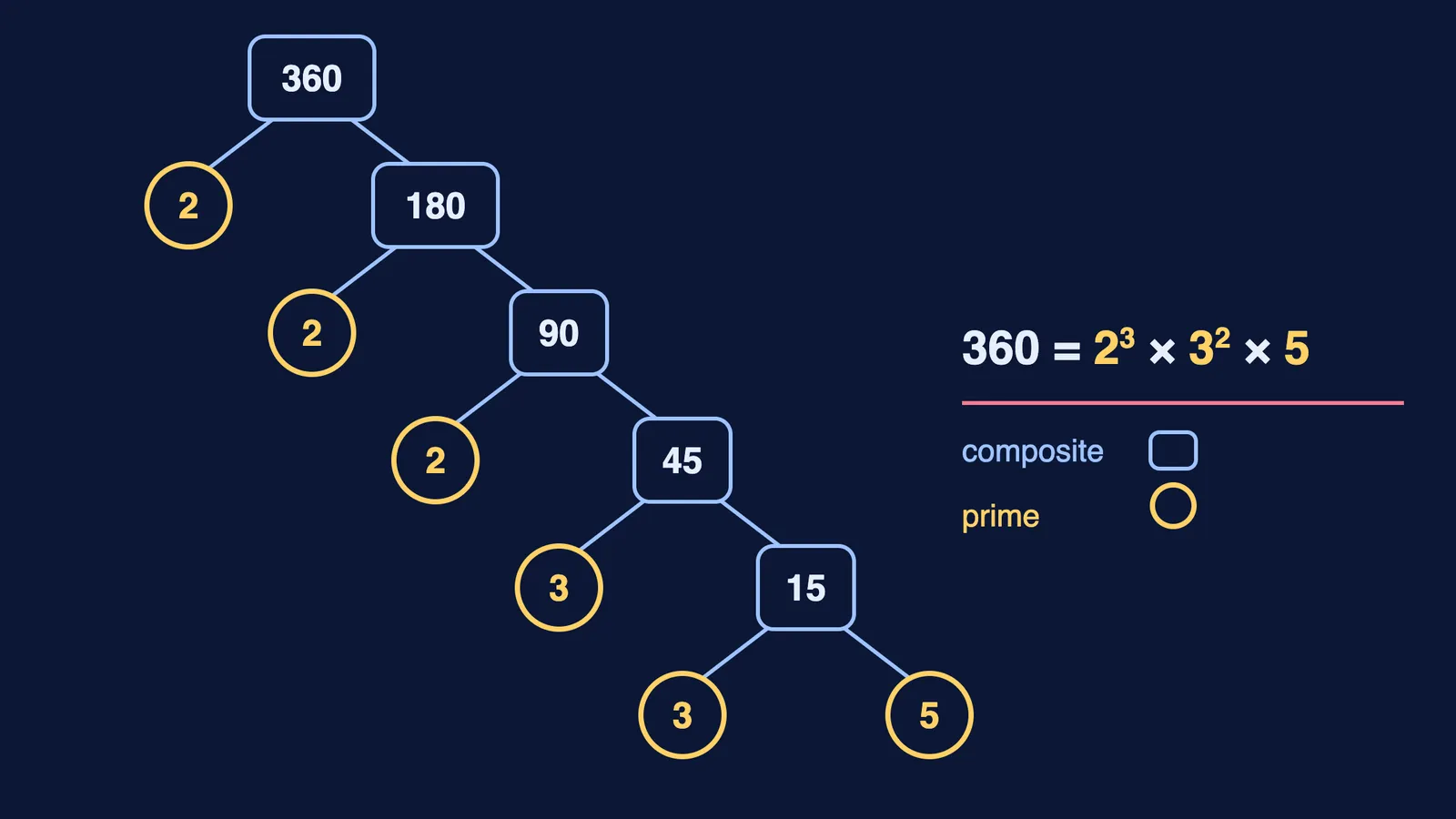
Factor tree: a diagram that keeps splitting a number into two factors until every branch ends in a prime. Example: the tree in the image above, for 360.
Powers of primes: repeated primes grouped with exponents. Example: 32760 = 2³ × 3² × 5 × 7 × 13.
Ascending order: listing prime factors from smallest to largest, which makes the written factorisation unique.
What does the Fundamental Theorem of Arithmetic say?
Fundamental Theorem of Arithmetic (Theorem 1.1): every composite number can be written as a product of primes, and that product is unique apart from the order of the factors. Example: 2 × 3 × 5 × 7 and 3 × 5 × 7 × 2 both give 210 and count as one factorisation.
Uniqueness: no second factorisation exists, so you can rule primes out. Example: 4ⁿ = 2²ⁿ has no prime 5, so 4ⁿ never ends in the digit 0.
How are HCF and LCM found from prime factors?
HCF (highest common factor): the largest number dividing each given number. Multiply the smallest power of each common prime. Example: 96 = 2⁵ × 3 and 404 = 2² × 101, so HCF = 2² = 4.
LCM (lowest common multiple): the smallest positive number each given number divides. Multiply the greatest power of every prime that appears. Example: 6 = 2 × 3 and 20 = 2² × 5, so LCM = 2² × 3 × 5 = 60.
Common prime factor: a prime that divides every number in the set. Example: 2 and 3 are common to 6, 72 and 120; 5 is not.
HCF × LCM rule: for any two positive integers a and b, HCF(a, b) × LCM(a, b) = a × b. Example: LCM(96, 404) = 96 × 404 ÷ 4 = 9696. Don't confuse with: three numbers. For 6, 72 and 120, HCF × LCM = 6 × 360 = 2160, but 6 × 72 × 120 = 51840.
Coprime numbers: two integers whose only common factor is 1, so their HCF is 1. Example: 8 and 9, though neither is prime. Don't confuse with: prime, which describes one number; coprime describes a pair.
How do you prove √2 is irrational?
Theorem 1.2: if a prime p divides a², then p divides a, where a is a positive integer. Example: 3 divides 36 = 6², and 3 divides 6. Don't confuse with: non-primes. 4 divides 36 but not 6, so the rule needs p to be prime.
Proof by contradiction: assume the opposite of what you want, reason correctly until something impossible appears, and conclude the assumption was false.
Contradiction: two statements that cannot both be true. In the √2 proof, coprime a and b both turn out divisible by 2.
Lowest terms: a fraction a/b after cancelling every common factor, so a and b are coprime.
Irrationality of √p: for any prime p, √p is irrational. The chapter proves √2 and √3; √5 is an exercise.
Rational plus irrational: the sum or difference of a rational and an irrational number is irrational. Example: 5 − √3.
Non-zero rational times irrational: the product or quotient of a non-zero rational and an irrational number is irrational. Example: 3√2 and 7√5. Don't confuse with: irrational times irrational, which can be rational, since √2 × √2 = 2.
How to learn these terms
Learn opposites in pairs: prime and composite, rational and irrational, factor and multiple, HCF and LCM.
Draw a factor tree a day for a three-digit number, then write it as powers of primes in ascending order.
Write the √2 proof from memory: assume √2 = a/b in lowest terms, get 2b² = a², so 2 divides a; put a = 2c, get b² = 2c², so 2 divides b: contradiction. Redo it for √3 and √5.
Test the HCF × LCM rule on two numbers, then three, to see where it breaks.
Use the terms in context with our Real numbers Class 10 formulas and proofs sheet and the real numbers assertion-reason questions with answers.
If a term feels shaky, the Fermi Concept Library gives every mathematics concept its own lesson and shows its place in the map.