

On this page
Real Numbers, Chapter 1 of NCERT Class 10 Mathematics, covers the Fundamental Theorem of Arithmetic, HCF and LCM by prime factorisation, and proofs that numbers like √2 are irrational. Every statement below was checked against NCERT Class 10 Mathematics, Chapter 1 Real Numbers (Reprint 2026-27), and every number was recomputed.
How do you answer assertion-reason questions?
Mark each line true or false on its own. Only if both are true, ask: is R the direct reason A is true?
Keys for Q1 to Q6:
(A) Both A and R are true and R is the correct explanation of A.
(B) Both A and R are true but R is NOT the correct explanation of A.
(C) A is true but R is false.
(D) A is false but R is true.
Keys for Q7 to Q10:
(A) Both statements are correct.
(B) Both statements are incorrect.
(C) Statement I is correct, Statement II is incorrect.
(D) Statement I is incorrect, Statement II is correct.
For the full method, see our three-check method for assertion-reason questions.
Real numbers assertion-reason questions with answers
Q1 (easy). Assertion (A): HCF(2³ × 3², 2² × 3³ × 5) = 2² × 3² = 36. Reason (R): The HCF is the product of the smallest power of each prime factor common to the numbers.
Answer: (A). Both are true and R is the rule used: the common primes 2 and 3 at their smallest powers, 2² and 3². The 5 is not common.
Trap: taking the larger powers, which belong to the LCM.
Q2 (easy). Assertion (A): 2√3 × √3 is a rational number. Reason (R): The product of two irrational numbers is always irrational.
Answer: (C). A is true: 2√3 × √3 = 2 × 3 = 6. R is false, and A itself is the counterexample.
Trap: stretching the rational-times-irrational rule to two irrationals.
Q3 (medium). Assertion (A): 14ⁿ × 9ⁿ cannot end with the digit 0 for any natural number n. Reason (R): 2 is a prime factor of 14ⁿ × 9ⁿ.
Answer: (B). Both are true, but R is not why A holds. A number ending in 0 must have both 2 and 5 as prime factors. Since 14ⁿ × 9ⁿ = 2ⁿ × 3²ⁿ × 7ⁿ, unique factorisation means 5 never appears. The missing 5 is the reason.
Trap: seeing "2" and ticking (A).
Q4 (medium). Assertion (A): HCF(4, 6, 8) × LCM(4, 6, 8) = 4 × 6 × 8. Reason (R): For any two positive integers a and b, HCF(a, b) × LCM(a, b) = a × b.
Answer: (D). A is false: HCF = 2 and LCM = 24, giving 48, while 4 × 6 × 8 = 192. R is true for two numbers; NCERT's Remark gives a three-number case where it fails.
Trap: carrying the two-number rule over to three numbers.
Q5 (hard). Assertion (A): If √5 = a/b, where a and b are coprime positive integers, then a must be a multiple of 5. Reason (R): From √5 = a/b we get a² = 5b², so 5 divides a²; since 5 is prime, 5 then divides a.
Answer: (A). Both are true and R is the direct argument, using the NCERT theorem that a prime dividing a² divides a. It is the first step of the proof that √5 is irrational.
Trap: calling A false because √5 is irrational. A is an "if" statement.
Q6 (hard). Assertion (A): (√3 + √2)(√3 − √2) is rational. Reason (R): The product of a non-zero rational number and an irrational number is irrational.
Answer: (B). A is true: the product is 3 − 2 = 1. R is true, as NCERT states, but it is about a rational times an irrational; A multiplies two irrationals.
Trap: reading R, deciding A "must" be irrational, and marking (D).
Statement I and II questions on real numbers
Q7 (medium). Statement I: The prime factorisation of 2520 is 2³ × 3² × 5 × 7. Statement II: Writing the prime factors of a composite number in a different order gives a different prime factorisation.
Answer: (C). Statement I is correct: 8 × 9 × 5 × 7 = 2520. Statement II is incorrect: the theorem says the factorisation is unique apart from order, so 2 × 3 and 3 × 2 are the same factorisation.
Trap: misreading "apart from the order" in the theorem.
Q8 (medium). Statement I: The HCF of two different prime numbers is the smaller of the two. Statement II: The LCM of two different primes p and q is pq.
Answer: (D). Statement I is incorrect: different primes share no factor except 1, so their HCF is 1. Statement II is correct, for example LCM(7, 11) = 77.
Trap: assuming the HCF is the smaller number, true only when one divides the other.
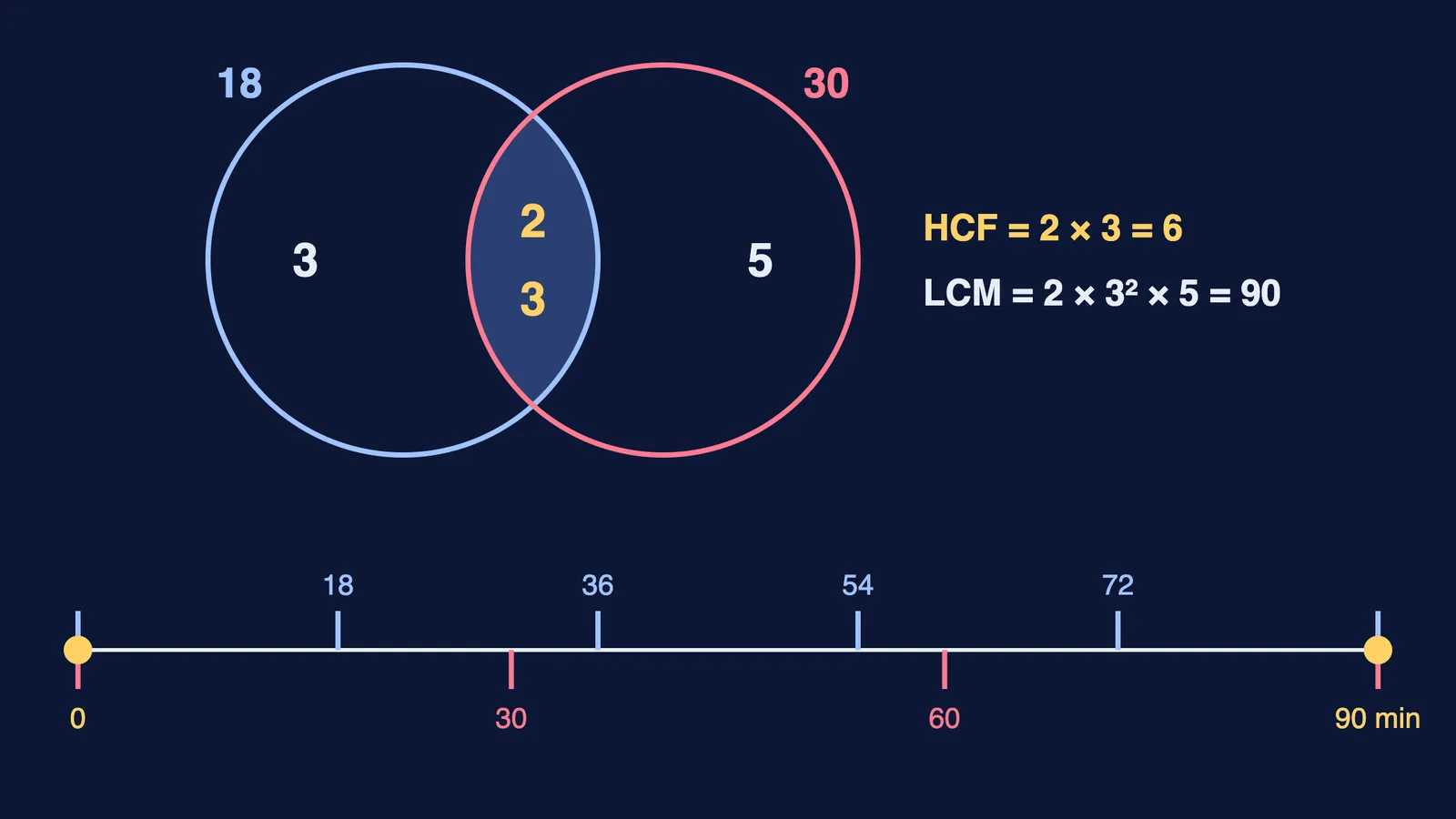
Q9 (hard). Statement I: Two school bells ring every 18 and 30 minutes. If both ring at 9:00 am, they next ring together at 10:30 am. Statement II: HCF(18, 30) = 6.
Answer: (A). Both are correct. 18 = 2 × 3² and 30 = 2 × 3 × 5, so LCM = 90 minutes and HCF = 6. Check: 6 × 90 = 540 = 18 × 30.
Trap: using the HCF for a "next time together" question.
Q10 (hard). Statement I: The sum of two irrational numbers is always irrational. Statement II: 0.10110111011110... is rational because its digits follow a pattern.
Answer: (B). Both are incorrect. √2 + (−√2) = 0 breaks Statement I. NCERT lists 0.10110111011110... as irrational: it neither ends nor repeats a fixed block.
Trap: treating "has a pattern" as "repeats".
How should you use this set?
Cover the answers; mark each line T or F before choosing a key.
For every (B), write the real reason in one line.
Redo missed items after two days.
If a slip comes from a shaky idea, reread it in our Real Numbers Class 10 guide.
If the gap is the idea rather than the format, the Fermi Concept Library gives every concept in mathematics its own lesson and its place in the map. For more sets in this format, see our assertion-reason practice questions.


