On this page
Three original cases, easy to hard. For the methods, read our guide to quadratic equations in Class 10: factorisation, formula and roots first.
What do case-study questions on quadratic equations look like?
The CBSE Class 10 Mathematics Standard sample paper for 2026-27 has three case study-based questions of 4 marks each in Section E, each with three sub-parts of 1, 1 and 2 marks, and calculators are not allowed. We add a fourth part per case; every number works out by hand. All cases stay inside the CBSE 2026-27 Class X Mathematics curriculum (real roots by factorisation and the quadratic formula) and the rationalised NCERT Chapter 4, Quadratic Equations (Reprint 2026-27).
Case 1: Chairs for the society Diwali show
The residents' welfare association of a housing society in Jaipur is setting up chairs on the clubhouse lawn for its Diwali cultural show. Every row has the same number of chairs, and each row has 6 more chairs than there are rows. They hired exactly 280 plastic chairs from a tent house and want to use every one. Let x be the number of rows. Next year the committee expects 300 guests and wonders whether the same pattern will work again without any empty seats.
(i) The number of rows satisfies: (a) x² + 6x + 280 = 0 (b) x² − 6x − 280 = 0 (c) x² + 6x − 280 = 0 (d) x² + 280 = 6x
(ii) How many rows are there, and how many chairs in each row?
(iii) Can exactly 300 chairs be set out in this pattern?
(iv) What is the least number of chairs above 300 that fits the pattern, and how many rows would it use?
Answers.
(i) (c). x(x + 6) = 280.
(ii) x² + 6x − 280 = (x + 20)(x − 14) = 0, so x = 14 or −20. Rows cannot be negative, so 14 rows of 20 chairs. Check: 14 × 20 = 280.
(iii) No. x² + 6x − 300 = 0 has discriminant 36 + 1200 = 1236, which lies between 35² = 1225 and 36² = 1296. So √1236, and hence x, is not a whole number.
(iv) x(x + 6) for x = 15 is 15 × 21 = 315. So 315 chairs, 15 extra, in 15 rows of 21.
Case 2: Two pumps and one farm tank
A grape farmer near Nashik fills a large overhead water tank using two borewell pumps. Pump A is newer and faster; on its own it takes 16 hours less than the older Pump B to fill the empty tank. Last week, with both pumps running together from empty, the tank was full in exactly 6 hours. His daughter, in Class 10, works out how long each pump takes alone. Let Pump A take x hours to fill the tank alone. Each pump works at its own steady rate.
(i) In one hour, Pump A fills what fraction of the tank? (a) x (b) 1/x (c) x/6 (d) 6/x
(ii) Write the equation for the two pumps working together and reduce it to standard form.
(iii) How long does each pump take on its own?
(iv) One morning, starting with the tank empty, Pump A runs alone for 2 hours, then Pump B is switched on as well. How much longer until the tank is full?
Answers.
(i) (b).
(ii) 1/x + 1/(x + 16) = 1/6. Multiply by 6x(x + 16): 6(x + 16) + 6x = x(x + 16), so x² + 4x − 96 = 0.
(iii) (x + 12)(x − 8) = 0, so x = 8 or −12. Time cannot be negative: Pump A takes 8 hours and Pump B 24 hours. Check: 1/8 + 1/24 = 4/24 = 1/6.
(iv) Pump A fills 2/8 = 1/4 in 2 hours, leaving 3/4. Together they fill 1/6 per hour: (3/4) ÷ (1/6) = 4.5 hours, or 4 hours 30 minutes.
Case 3: Fencing a plot against the school wall
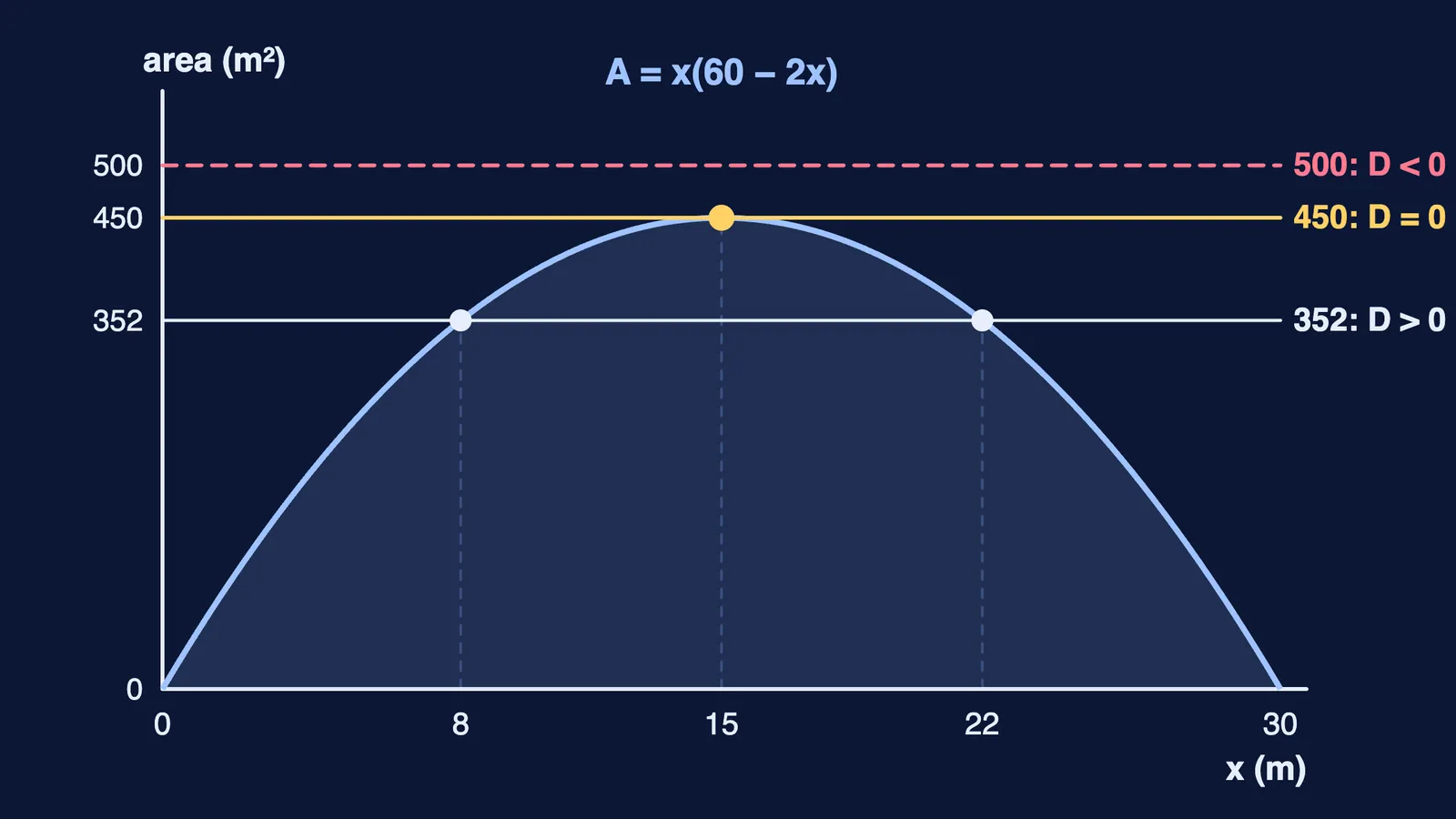
A government school in Madurai wants a rectangular garden of medicinal herbs beside its long compound wall. The wall forms one side, so wire fencing is needed only on the other three sides, and the school has exactly 60 m of fencing to use in full. Let x m be the length of each side perpendicular to the wall. The eco-club first wants 352 m²; a teacher asks whether 500 m² is possible, and what the largest possible area is.
(i) The side parallel to the wall is: (a) (60 − x) m (b) (60 − 2x) m (c) (30 − x) m (d) (60 + 2x) m
(ii) Find the possible dimensions of a 352 m² garden.
(iii) Use the discriminant to show that a 500 m² garden is not possible.
(iv) Find the largest area A for which such a garden exists, and its dimensions.
Answers.
(i) (b). The two x m sides use 2x m.
(ii) x(60 − 2x) = 352 gives x² − 30x + 176 = 0, so (x − 8)(x − 22) = 0. Either 8 m by 44 m, or 22 m by 16 m.
(iii) x(60 − 2x) = 500 gives 2x² − 60x + 500 = 0, with discriminant 3600 − 4000 = −400 < 0. No real x exists.
(iv) 2x² − 60x + A = 0 has real roots only if 3600 − 8A ≥ 0, that is A ≤ 450. At A = 450 the roots are equal: x = 60/4 = 15. So 450 m², 15 m by 30 m.
How should you attack case-study questions on quadratic equations?
Write what x stands for, with its unit, first.
Bring the equation to standard form and note a, b and c with their signs.
Test each root against the story and reject negative rows, hours or lengths with a reason.
For "is it possible?", use the discriminant; for counts like rows, also check for a whole number.
For a "largest" or "smallest" value, set the discriminant to zero: equal roots mark the limit.
Read our guide to case-based questions in board exams and the assertion-reason set on quadratic equations. If one step keeps slipping, the Fermi Problem Library has worked problems with a step-by-step solver that explains the reasoning rather than printing an answer.