On this page
Students often mix up these two words in Class 9 and 10 geometry. The fix is one number: the scale factor. It tells you which relation you are proving and which criterion to use.
What is the difference between similar and congruent triangles?
The NCERT Class 10 Triangles chapter gives both definitions on its first page.
Congruent: two figures are congruent if they have the same shape and the same size.
Similar: two figures are similar if they have the same shape, but not necessarily the same size.
The chapter's examples make it concrete. All circles are similar, but only circles with the same radius are congruent. All squares are similar, and so are all equilateral triangles. A bigger print of a photograph is similar to the original.
In the Wikipedia article on congruence), a figure also counts as congruent to its mirror image. Flipping a triangle over does not change its size or shape.
Are congruent triangles also similar?
Yes. NCERT says that all congruent figures are similar, but similar figures need not be congruent (NCERT Class 10, Chapter 6).
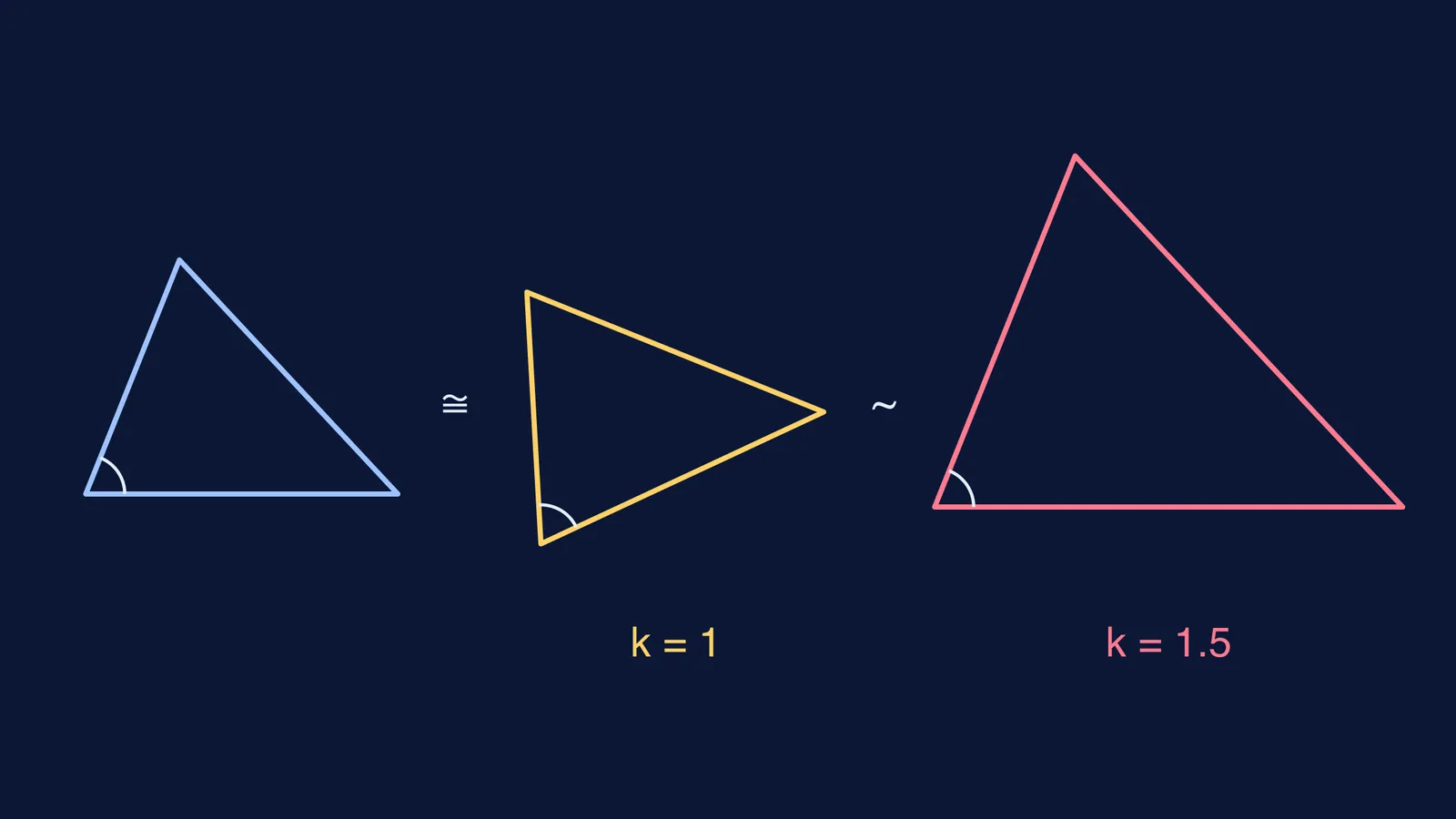
The scale factor shows why. NCERT defines the scale factor as the common ratio of the corresponding sides of two similar polygons. Two triangles are similar when their corresponding angles are equal and their corresponding sides are in the same ratio. If that ratio is exactly 1, every side matches its partner, so the triangles are the same size too.
Two congruent shapes are similar with a scale factor of 1, as the Wikipedia article on similarity) puts it.
The same source notes that areas of similar figures are in the ratio of the square of the scale factor. Triple every side and the area is multiplied by 9. We go through that in more detail in our post on the area ratio of similar triangles.
Which criteria prove similarity, and which prove congruence?
Congruence criteria want equal parts. Similarity criteria want equal angles and sides in proportion.
Triangle congruence (Wikipedia, Congruence)):
SSS: all three pairs of sides equal.
SAS: two pairs of sides equal, and the angles between them equal.
ASA and AAS: two pairs of angles equal, plus one pair of corresponding sides equal.
RHS: right triangles with equal hypotenuses and one other pair of equal sides.
Triangle similarity (NCERT Class 10, Theorems 6.3 to 6.5):
AAA, or simply AA: two angles of one triangle equal two angles of the other. The third angle then matches by the angle sum property.
SSS: all three pairs of sides in the same ratio.
SAS: one pair of equal angles, and the sides that include those angles in the same ratio.
SSS and SAS appear in both lists. The only change is "equal" versus "in the same ratio". Equal angles fix the shape but say nothing about size, so AAA proves similarity and never congruence. Our post on why SSA and AAA do not prove triangles congruent shows the counterexamples. For a recap of the four congruence rules, see congruent triangles in Class 9: SAS, ASA, SSS and RHS.
How do you check which one it is in an exam?
Ask three questions, in this order.
Which vertex matches which? Write the correspondence before anything else. NCERT warns that if triangle ABC is similar to DEF with A, B, C matching D, E, F, then writing ABC ~ EDF is wrong.
Are the angles equal, or the sides in one ratio? Pick AA, SSS or SAS for similarity.
Is the ratio 1? If it is, the triangles are congruent too. Use the congruence symbol and a congruence criterion.
Worked example: similar or congruent?
These numbers come from Activity 5 in the NCERT chapter. Triangle ABC has AB = 3 cm, BC = 6 cm and CA = 8 cm. Triangle DEF has DE = 4.5 cm, EF = 9 cm and FD = 12 cm.
AB/DE = 3/4.5 = 2/3
BC/EF = 6/9 = 2/3
CA/FD = 8/12 = 2/3
The three ratios are equal, so ABC ~ DEF by SSS similarity, and the corresponding angles are equal. The ratio is 2/3, not 1, so the triangles are not congruent. Now take a third triangle PQR with PQ = 3 cm, QR = 6 cm and RP = 8 cm. Every ratio with ABC is 1, so ABC is congruent to PQR by SSS congruence. It is also similar to PQR with a scale factor of 1.
Where to practise
If you keep picking the wrong criterion, practise with every step written out. The Fermi Problem Library has worked problems with a step-by-step solver that explains the reasoning rather than printing an answer. If the gap is in the idea rather than the method, the Fermi Concept Library gives each concept in mathematics its own lesson and shows where it fits in the map.