

On this page
Mathematics often feels like a long list of disconnected rules to memorise. One of the classic theorems you will meet in school geometry states that the ratio between the areas of two similar triangles is equal to the square of the ratio of their corresponding lengths). But what does that actually mean in practice?
If you simply memorise the formula, it is easy to forget whether to square the ratio, cube it, or leave it alone under the pressure of an exam. Seeing the geometry at work changes how you remember it, turning a dry algebraic statement into a picture you can instantly recall.
How is the area ratio of similar triangles visualised?
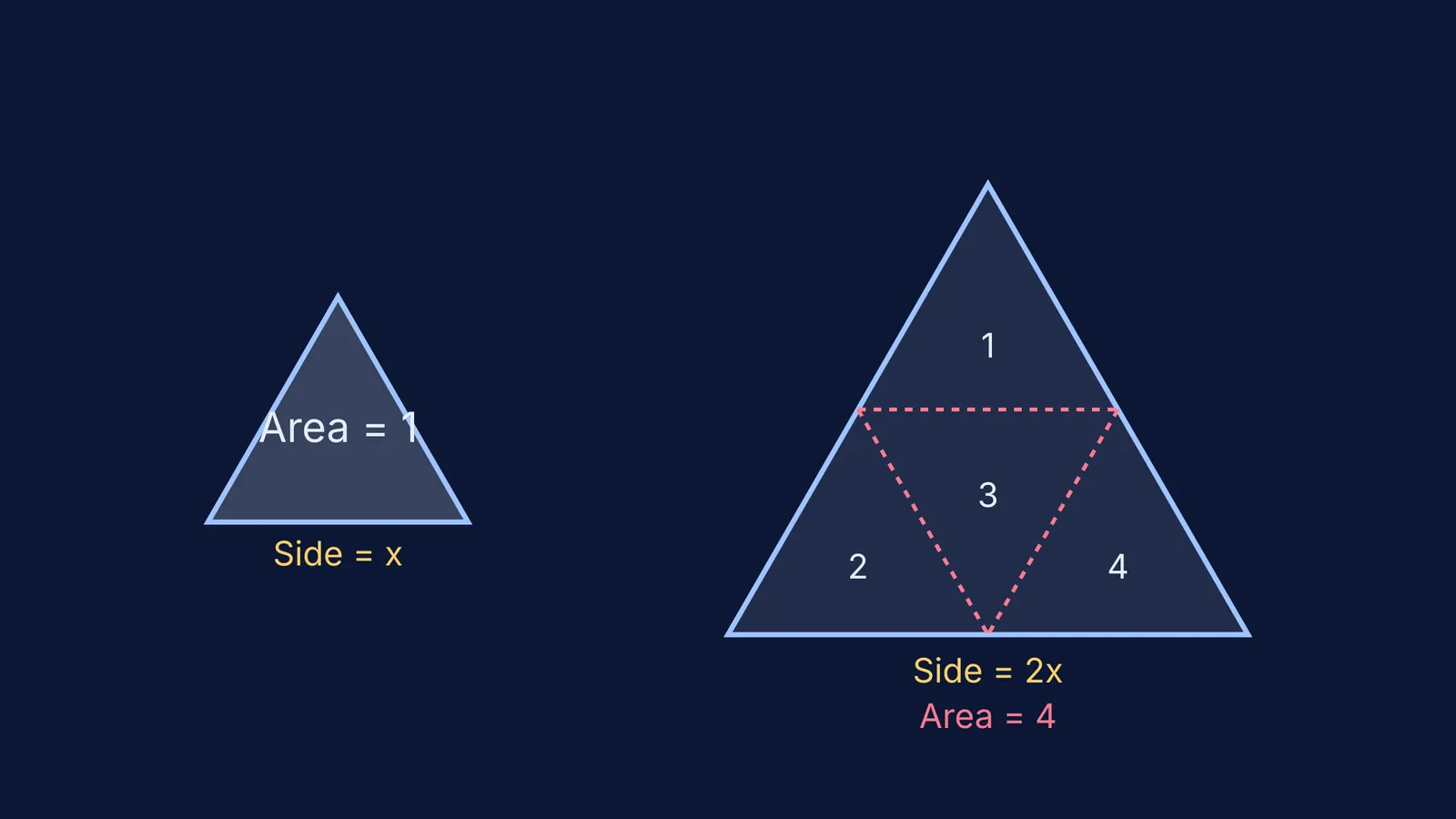
Imagine you have a triangle—any shape you like, whether it is right-angled, isosceles, or completely irregular—with a base of length x. Now imagine drawing a similar triangle with a base of length 2x. Because they are similar, all the sides of the second triangle are exactly twice as long as the first, and all the internal angles match perfectly.
How many of the smaller triangles can you fit inside the larger one?
The answer is exactly four, according to the rules of geometric similarity). You can prove this to yourself with a pencil and paper by drawing the larger triangle and finding the exact midpoints of all three of its sides. If you draw straight lines connecting these three midpoints, you will slice the large triangle into four smaller ones.
A standard rule of geometry, known as the midsegment theorem, tells us that the line connecting two midpoints of a triangle is always parallel to the third side and exactly half its length. This guarantees that all four of these smaller tiles are identical to each other, and geometrically congruent to your original small triangle.
By doubling the sides (a ratio of 1:2), you have quadrupled the area (a ratio of 1:4). The area ratio is precisely the square of the side ratio. If you tripled the sides to 3x, you could draw a grid inside the triangle that perfectly fits nine small tiles.
Why does this matter for your exams?
In a timed exam, knowing *why* a mathematical rule works stops you from second-guessing yourself. If a problem asks you to compare the areas of two similar triangles whose sides are in a 3:5 ratio, visualising this scaling effect makes the jump to an area ratio of 9:25 obvious and intuitive. You do not need to rely on blind memory; you can see the grid of 9 and 25 tiles in your mind.
Having a rock-solid mental picture of basic properties saves critical time when you move on to harder problems. For instance, you might be asked to combine this principle with finding the area of a triangle using determinants, or you might need it to unpick complex quadratic word problems in Class 10 where land areas and dimensions are compared.
How do you solve area ratio problems?
When you face an area ratio problem in your next test, use this simple sequence to avoid careless errors:
Prove similarity: Check that the two triangles are actually similar first, using angle-angle (AA), side-side-side (SSS), or side-angle-side (SAS) similarity rules. The area rule only works if the shapes are similar.
Find the scale factor: Identify the ratio of any two corresponding side lengths. Let us call this factor k.
Square the factor: The ratio of their total areas will always be k².
Check your work geometrically: Does the final answer make visual sense? If the side is three times longer, can you picture a 3 by 3 grid of nine smaller triangles fitting neatly inside the larger boundary?
This approach of teaching the underlying reasoning rather than just printing a final answer is central to how Fermi's AI tutor works. When a student brings a geometry problem, Fermi works out what they already know and builds a clear plan for the session. If you get stuck on an area rule, the tutor decides whether to explain, ask, or show—often drawing the figure right on the board so you can see the mathematical relationship for yourself.
For more interactive models of physical and mathematical ideas that are much easier to see than to read, you can explore the Fermi Simulation Lab.


