On this page
Chapter 5 of the new Class 9 maths book is the circles chapter, despite its fairground title. This guide follows the 2026-27 book, Ganita Manjari Part I (first edition, April 2026), not the older NCERT textbook.
What is Chapter 5 of Ganita Manjari about?
The book's own introduction says Chapter 5 studies the properties of circles, chords, arcs, angles and cyclic figures. The chapter itself starts from a single definition: a circle is the set of all points in a plane at the same distance from one fixed point, the centre. The proofs use congruent triangles and the Baudhāyana–Pythagoras theorem.
The chapter numbers twelve results as theorems, plus one corollary about the diameter, according to the NCERT chapter PDF. If you need a refresher on the words chord, arc and segment, read our guide to the parts of a circle first.
Which circle theorems does the chapter prove?
In the order the chapter builds them:
Exactly one circle passes through three points that are not on a line. Its centre, the circumcentre, is where the perpendicular bisectors meet.
Equal chords make equal angles at the centre, and chords with equal angles at the centre are equal.
The line from the centre to a chord's midpoint is perpendicular to the chord, and the perpendicular from the centre bisects the chord.
Equal chords are the same distance from the centre, and the converse holds. Of two unequal chords, the longer one is closer to the centre.
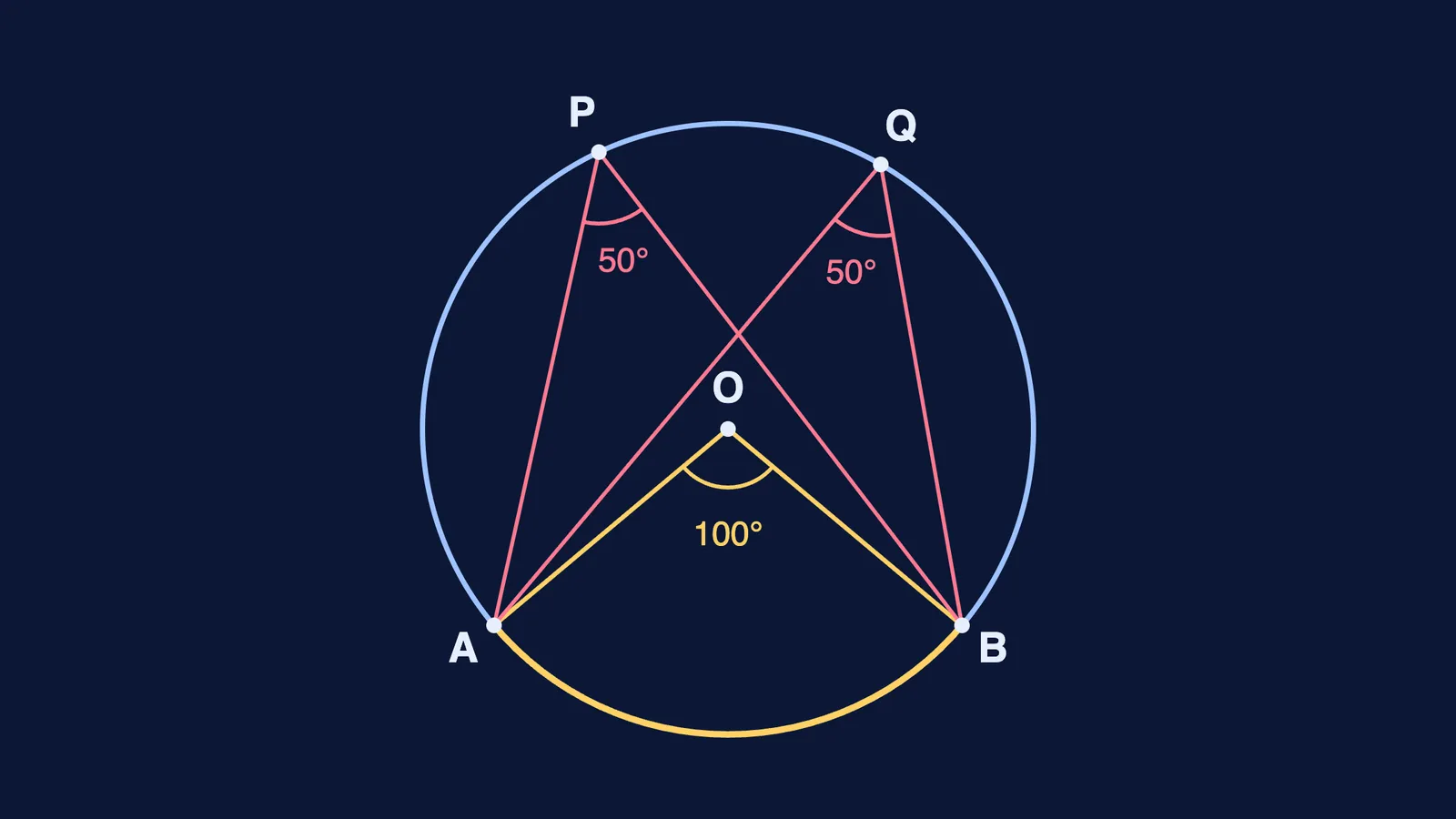
An arc makes an angle at the centre that is twice the angle it makes at any point on the rest of the circle. So the angle in a semicircle is 90°.
If a segment makes equal angles at two points on the same side of it, all four points lie on one circle.
Opposite angles of a cyclic quadrilateral add to 180°, and a quadrilateral whose opposite angles add to 180° is cyclic.
Two points alone do not fix a circle; we worked one case in finding a circle through two points with its centre on a line.
How do you solve chord and angle questions step by step?
These use our own numbers, not the book's exercises.
Example 1: chord length. Radius 17 cm, chord 8 cm from the centre. The perpendicular from the centre bisects the chord, so half the chord is √(17² − 8²) = √(289 − 64) = √225 = 15 cm. The chord is 30 cm. The general rule, chord = 2√(r² − d²), is derived in our post on the length of a chord cut off by a line.
Example 2: which chord is closer? Radius 25 cm, chords of 48 cm and 14 cm. Distances: √(625 − 24²) = 7 cm and √(625 − 7²) = 24 cm. The longer chord is closer.
Example 3: arc angles. Arc AB makes 130° at the centre. At a point on the major arc the angle is 130° ÷ 2 = 65°. At a point on the minor arc, opposite angles of the cyclic quadrilateral give 180° − 65° = 115°.
Example 4: algebra in a cyclic quadrilateral. In cyclic PQRS, ∠P = (4x − 8)° and ∠R = (2x + 14)°. Opposite angles add to 180°, so 6x + 6 = 180, x = 29, ∠P = 108° and ∠R = 72°. Check: 108 + 72 = 180.
Example 5: circumradius. A right triangle has sides 9, 12 and 15 cm. The circumcentre is the midpoint of the hypotenuse, so the circumradius is 15 ÷ 2 = 7.5 cm.
What mistakes cost marks in circle questions?
Using the full chord in Pythagoras instead of half of it.
Measuring a chord's distance from the centre along a slanted line; it is always the perpendicular distance.
Halving the wrong way: the angle at the centre is the larger one.
Taking the point on the same arc you are measuring. The point must be on the remaining part of the circle.
Adding adjacent angles of a cyclic quadrilateral to 180°. Only opposite pairs do.
If your method keeps going wrong at the same step, the Fermi Problem Library has worked problems with a step-by-step solver that explains the reasoning rather than printing an answer, so you can see which step you skipped.
How many marks is Circles in CBSE Class 9 2026-27?
In the CBSE Class IX Mathematics curriculum for 2026-27, Circles sits in the Geometry unit, which carries 25 of the 80 theory marks. Circles shares those marks with Euclid's geometry, lines and angles, triangles and quadrilaterals. The same document lists separate internal assessment of 20 marks.
The curriculum's learning outcomes ask you to explain why each result is true, not only to state it, according to the CBSE syllabus. Practise short "Given, To show, Why" proofs.