On this page
Circle questions in Class 9, Class 10 and JEE use the same six words. Mix up sector and segment, and perfect arithmetic still loses marks.
What are the parts of a circle?
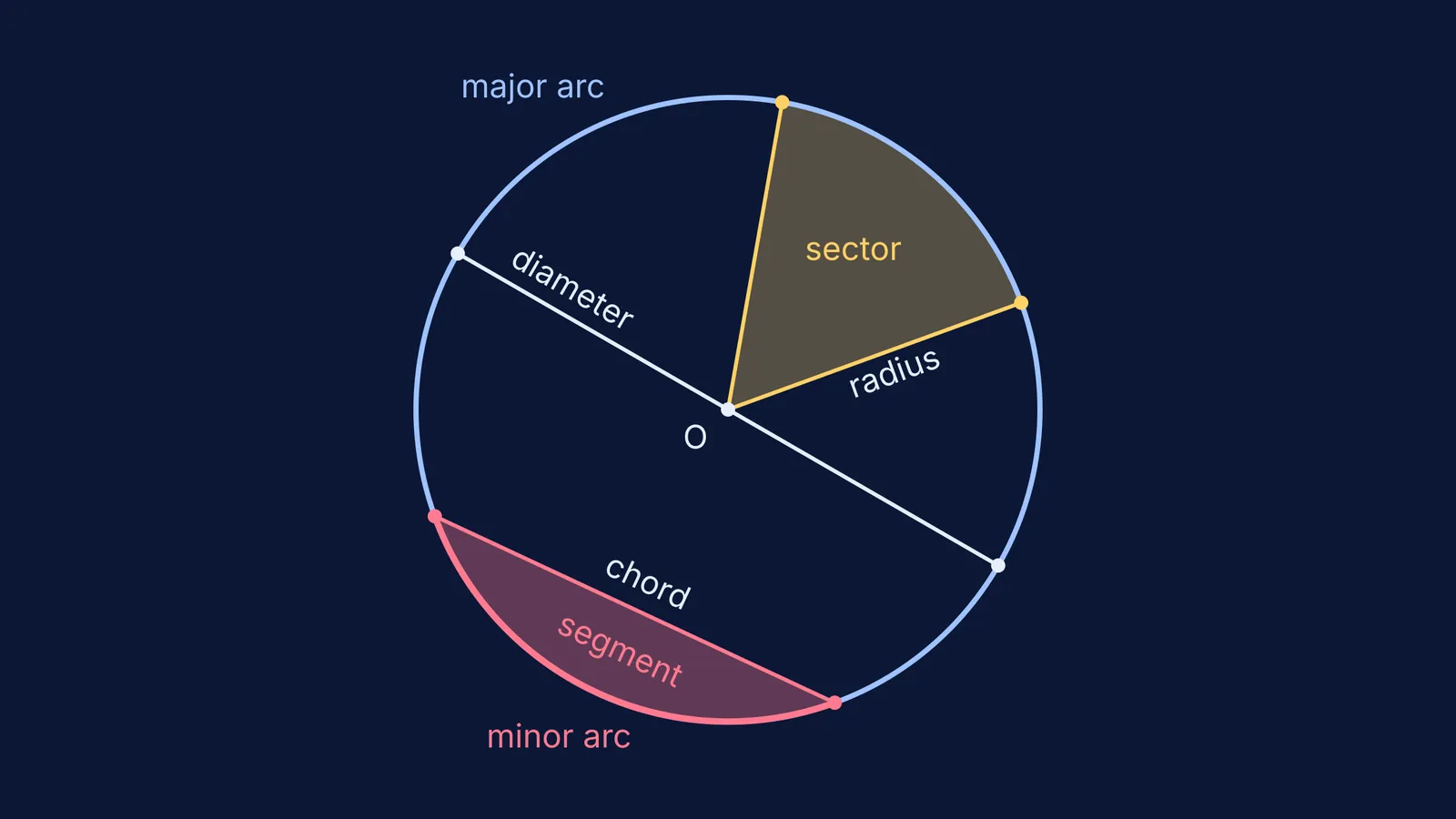
Start with the centre, O. Everything else is a straight line, a curved piece of the circle, or a region inside it.
The straight lines:
Radius: the distance from the centre of a circle to the circle itself, equal to half the diameter (MathWorld, Radius).
Chord: a line segment whose ends lie on the circle (MathWorld, Chord). It does not have to pass through O.
Diameter: the maximum distance from one point on a circle to another, with d = 2r (MathWorld, Diameter). It is the chord through O, and the longest chord.
The curve:
Arc: the portion of the circumference between two points on the circle (MathWorld, Arc).
The regions, as defined in NCERT's Areas Related to Circles (NCERT Class 10 Mathematics, Chapter 11):
Sector: the portion of the circular region enclosed by two radii and the corresponding arc. Think of a slice of pizza.
Segment: the portion of the circular region enclosed between a chord and the corresponding arc. Think of the piece that falls away when you cut a roti with one straight stroke.
What is the difference between a sector and a segment?
Count the straight edges. A sector has two, both radii, meeting at the centre. A segment has one, a chord, with both corners on the circle. If the shaded shape has a corner at O, it is a sector.
The formulas follow the same picture: NCERT writes the area of segment APB as the area of sector OAPB minus the area of triangle OAB (NCERT, Chapter 11).
What do minor and major mean?
Any two points on a circle split it into two arcs. A minor arc is an arc measuring 180° or less (MathWorld, Minor Arc). A major arc is an arc measuring 180° or more (MathWorld, Major Arc). At exactly 180°, both arcs are semicircles and the chord is a diameter.
Sectors and segments split the same way. In NCERT's figures, slice OAPB is the minor sector, the rest of the disc, OAQB, is the major sector, and its angle is 360° − ∠AOB (NCERT, Chapter 11). A chord likewise cuts a minor and a major segment.
So major = whole circle − minor:
Major arc length = 2πr − minor arc length
Major sector area = πr² − minor sector area
Major segment area = πr² − minor segment area
If a word on this list still feels shaky, the Fermi Concept Library gives every concept in mathematics its own lesson and its place in the map.
How do you tell which part a question is asking about?
Ask these four questions of the figure, in order:
Line, curve or region? A curve on the circle is an arc.
A line: where are its ends? Centre to circle is a radius; circle to circle through O is a diameter; circle to circle elsewhere is a chord.
A region: two radii meeting at O make a sector; one chord makes a segment.
Angle at the centre below 180°? Minor. Above? Major. No angle and no word major? Assume minor.
Worked example: one 60° angle, six answers
Take a circle of radius 14 cm and a chord AB that subtends 60° at the centre O. Use π = 22/7 and the NCERT formulas: area of a sector of angle θ = (θ/360) × πr², and length of its arc = (θ/360) × 2πr (NCERT, Chapter 11). The whole circle has area (22/7) × 196 = 616 cm² and circumference 2 × (22/7) × 14 = 88 cm.
Minor arc AB = (60/360) × 88 = 14.67 cm.
Major arc AB = 88 − 14.67 = 73.33 cm.
Minor sector OAB = (60/360) × 616 = 102.67 cm².
Major sector = 616 − 102.67 = 513.33 cm².
Minor segment: triangle OAB is equilateral, since the chord formula 2r sin(θ/2) gives AB = 14 cm (MathWorld, Circular Segment). Its area is (√3/4) × 14² = 84.87 cm², so the minor segment = 102.67 − 84.87 = 17.80 cm².
Major segment = 616 − 17.80 = 598.20 cm².
Quick check: a minor segment sits inside its minor sector, so if your segment answer is bigger, you have swapped them.
For more practice, try these sector area and arc length sums with clocks and wipers, see how to find the area of a minor segment for other angles, or use the chord length formula 2√(r² − d²) when the chord comes from a line's equation.
When a segment answer comes out wrong and you cannot see why, the Fermi Problem Library has worked problems with a step-by-step solver that explains the reasoning rather than printing an answer.
Before your next test, sketch one circle, shade a sector and a segment, and label all six parts from memory.