

On this page
When you slice a circle—for example, one you have drawn by finding a circle through three given points—you can cut it like a pizza from the centre, giving you a sector, or you can slice off a straight edge, giving you a segment. Knowing the difference between these shapes is a core part of high school mathematics, and confusing the two is a very common mistake. In fact, the CBSE Class 10 mathematics syllabus dedicates an entire unit to areas related to circles, restricting exam problems involving the area of a segment to central angles of 60°, 90°, and 120°.
By mastering these three specific angles and understanding the geometry behind the formulas, you can solve any segment problem without relying on rote memorization.
What is the area of a minor segment of a circle formula?
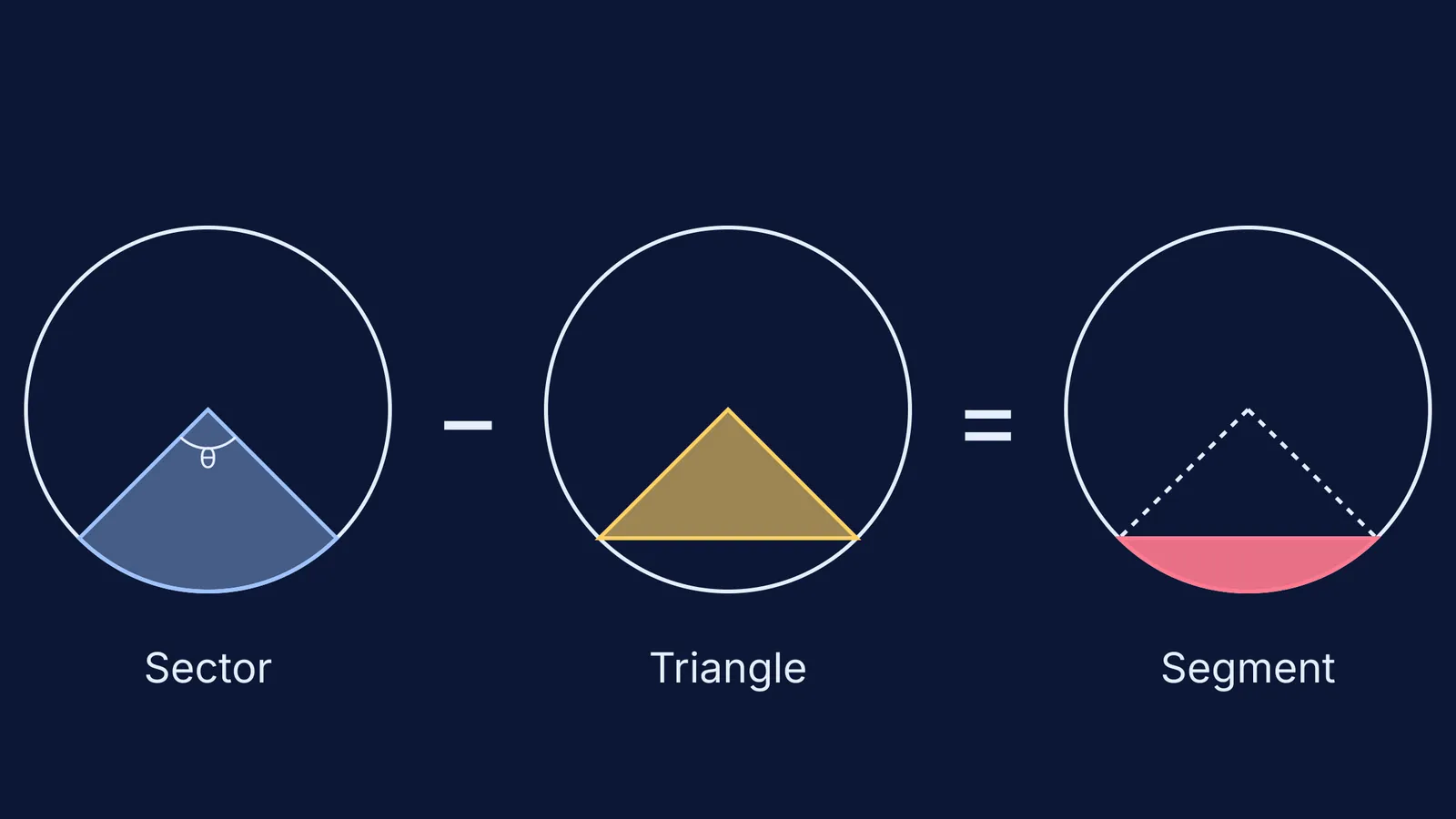
The minor segment is the small region bounded by a chord and the minor arc of the circle. To find its area, you first calculate the area of the entire sector (the pizza slice) and then subtract the area of a triangle formed by the chord and the two radii that meet at the centre of the circle.
The general relationship is always: Area of Minor Segment = Area of Sector − Area of Triangle
The sector is a fraction of the whole circle, given by the central angle θ out of a total 360°. Therefore, its area is (θ/360) × πr².
The triangle's area depends entirely on the central angle θ. A general formula for the area of this triangle is ½ × r² × sin θ, using basic trigonometry.
Combining these two pieces gives the direct formula: Area of Minor Segment = r² × [ (π × θ / 360) − (sin θ / 2) ]
While you can plug numbers directly into this final formula, examiners usually prefer that you show your working for the sector and the triangle separately. This also helps prevent calculation errors and shows a true understanding of the geometry.
How do you solve 60°, 90°, and 120° cases?
Exams usually stick to these three specific central angles because their triangles have well-known properties.
The 60° central angle When θ = 60°, the triangle formed by the two radii and the chord is an equilateral triangle. This is because the two radii are equal in length, forcing the base angles to be equal, and the remaining 120° splits perfectly into two 60° angles.
Sector area: (60/360) × πr² = (1/6) × πr²
Triangle area: The standard formula for an equilateral triangle is (√3 / 4) × r²
Segment area: (1/6) × πr² − (√3 / 4) × r²
The 90° central angle When θ = 90°, the triangle is a right-angled isosceles triangle. The two radii act as the perpendicular base and height, making this the easiest case to calculate.
Sector area: (90/360) × πr² = (1/4) × πr²
Triangle area: ½ × base × height = ½ × r × r = ½r²
Segment area: (1/4) × πr² − ½r²
The 120° central angle When θ = 120°, the triangle is isosceles with a wide, obtuse angle at the centre.
Sector area: (120/360) × πr² = (1/3) × πr²
Triangle area: If you drop a perpendicular from the centre to the chord, you create two right-angled 30°-60°-90° triangles. The base of the large triangle becomes r√3 and the height becomes r/2. Therefore, the triangle's area is ½ × (r√3) × (r/2) = (√3 / 4) × r². Notice this is the exact same area formula as the 60° equilateral triangle.
Segment area: (1/3) × πr² − (√3 / 4) × r²
A worked example for 120° Let's put this into practice. Suppose you have a circle with a radius of 21 cm and a central angle of 120°. How do you find the area of the minor segment?
Find the sector area: Using the fraction (120/360), the sector is one-third of the circle. Area = (1/3) × (22/7) × 21 × 21 = 462 cm².
Find the triangle area: Using the 120° triangle formula (√3 / 4) × r² that we derived earlier. Area = (√3 / 4) × 21 × 21 = (1.732 / 4) × 441 = 190.95 cm².
Subtract to find the segment: Area of Segment = 462 − 190.95 = 271.05 cm².
How do you find the area of a major segment?
The major segment is simply the rest of the circle. Once you have calculated the minor segment's area, you subtract it from the total area of the circle.
Area of Major Segment = πr² − Area of Minor Segment
You could also find it by adding the area of the major sector to the area of the triangle, but subtracting from the whole circle is usually much faster and less prone to mistakes.
If you struggle with spotting these geometric relationships, the Fermi Concept Library maps out every geometry rule so you can see where formulas come from rather than just memorizing them. When working through complex geometry problems, the step-by-step solver in the Fermi Problem Library will help you keep track of which shape you are subtracting from which.


