On this page
A standard Class 11 coordinate geometry question asks for the circle through two given points whose centre lies on a given line. You could set up three equations in h, k and r, but one fact about chords reduces the work to solving two straight lines. Here is the reasoning, a worked example with a check, and what to do when no answer exists.
Why does the centre lie on the perpendicular bisector of the chord?
A circle is the set of all points in a plane at a given distance from a fixed point, the centre (Wikipedia: Circle). So if the circle passes through A and B, the centre is the same distance from A as from B.
Every point on the perpendicular bisector of a segment AB is equidistant from A and B (Wikipedia: Bisection). Put the other way round, the perpendicular bisector of a chord passes through the centre of the circle (Wikipedia: Circle).
So the centre lies on two lines: the perpendicular bisector of AB and the given line. Two non-parallel lines meet at exactly one point, and that point is the centre.
How do you find the circle, step by step?
Find the midpoint M of AB.
Find the slope of AB, then take the negative reciprocal for the bisector's slope.
Write the bisector through M in point-slope form.
Solve the bisector and the given line together. The solution is the centre C.
Radius squared = CA². Write (x − h)² + (y − k)² = r².
Check: substitute A, B and the centre back in.
If step 3 feels shaky, our guide to the equation of a perpendicular bisector works through it two ways.
Worked example: centre on x − y + 4 = 0
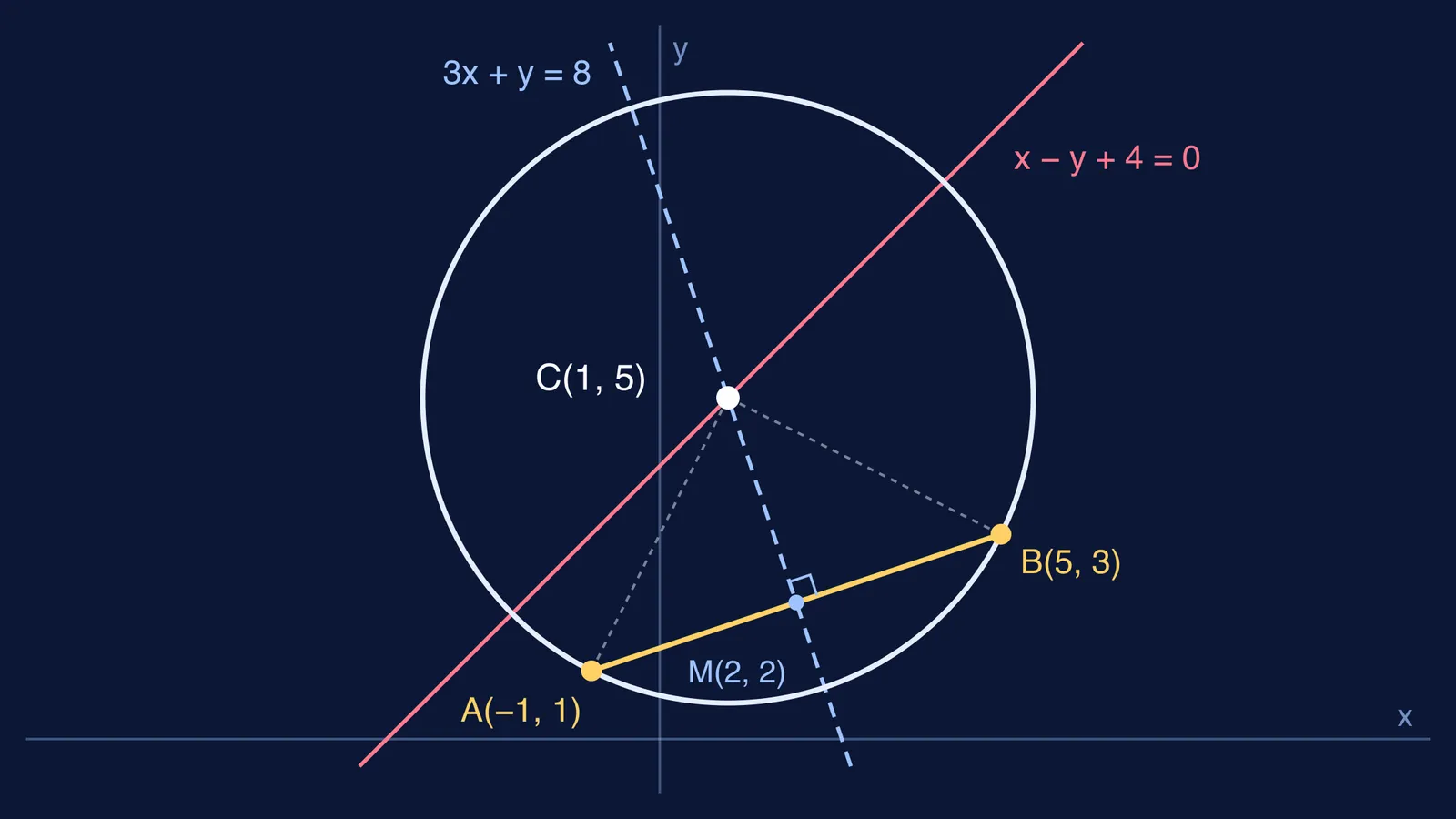
Problem. Find the equation of the circle passing through A(−1, 1) and B(5, 3) whose centre lies on the line x − y + 4 = 0.
Step 1: midpoint. M = ((−1 + 5)/2, (1 + 3)/2) = (2, 2).
Step 2: slopes. Slope of AB = (3 − 1)/(5 − (−1)) = 2/6 = 1/3. The bisector is perpendicular to AB, so its slope is −3.
Step 3: bisector. Through M(2, 2) with slope −3: y − 2 = −3(x − 2), which simplifies to 3x + y = 8.
Step 4: centre. Solve 3x + y = 8 with x − y = −4. Adding the two equations gives 4x = 4, so x = 1. Then y = 8 − 3 = 5. The centre is C(1, 5).
Step 5: radius. CA² = (1 − (−1))² + (5 − 1)² = 4 + 16 = 20, so r = √20 = 2√5.
The circle is (x − 1)² + (y − 5)² = 20. Expanded, that is x² + y² − 2x − 10y + 6 = 0.
Check by substitution.
A(−1, 1): (−2)² + (−4)² = 4 + 16 = 20. On the circle.
B(5, 3): (4)² + (−2)² = 16 + 4 = 20. On the circle.
Centre C(1, 5) in x − y + 4: 1 − 5 + 4 = 0. On the given line.
Expanded form at A: 1 + 1 + 2 − 10 + 6 = 0. The expansion is right too.
These checks take a minute and catch arithmetic slips. To go from the expanded form back to centre and radius, see centre and radius from the general equation of a circle.
Can you solve it with (h, k) instead?
Yes, and it lands on the same line. Since the centre is on x − y + 4 = 0, write it as C(h, h + 4). Setting CA² = CB² gives (h + 1)² + (h + 3)² = (h − 5)² + (h + 1)². Expanding, 2h² + 8h + 10 = 2h² − 8h + 26, so 16h = 16 and h = 1. The centre is again (1, 5).
The squared terms cancel because CA² = CB² is the perpendicular bisector written in algebra, so expect a linear equation.
What if the line never meets the bisector?
Compare the given line's slope with the bisector's:
Different slopes: the lines meet once, so there is exactly one circle.
Same slope, different lines: they are parallel, so no such circle exists. This happens when the given line is perpendicular to AB but misses its midpoint.
Same line: every point on it works as a centre, so there are infinitely many circles.
What to practise next
A natural follow-up is testing whether a third point lies inside or outside this circle. If you keep losing marks on the method rather than the arithmetic, the Fermi Problem Library has worked problems with a step-by-step solver that explains the reasoning rather than printing an answer. For the underlying idea of chords and bisectors, the Fermi Concept Library gives each concept its own lesson.
Try it yourself: change the line to 2x − y = 0 and find the new centre, then run the same four checks.